
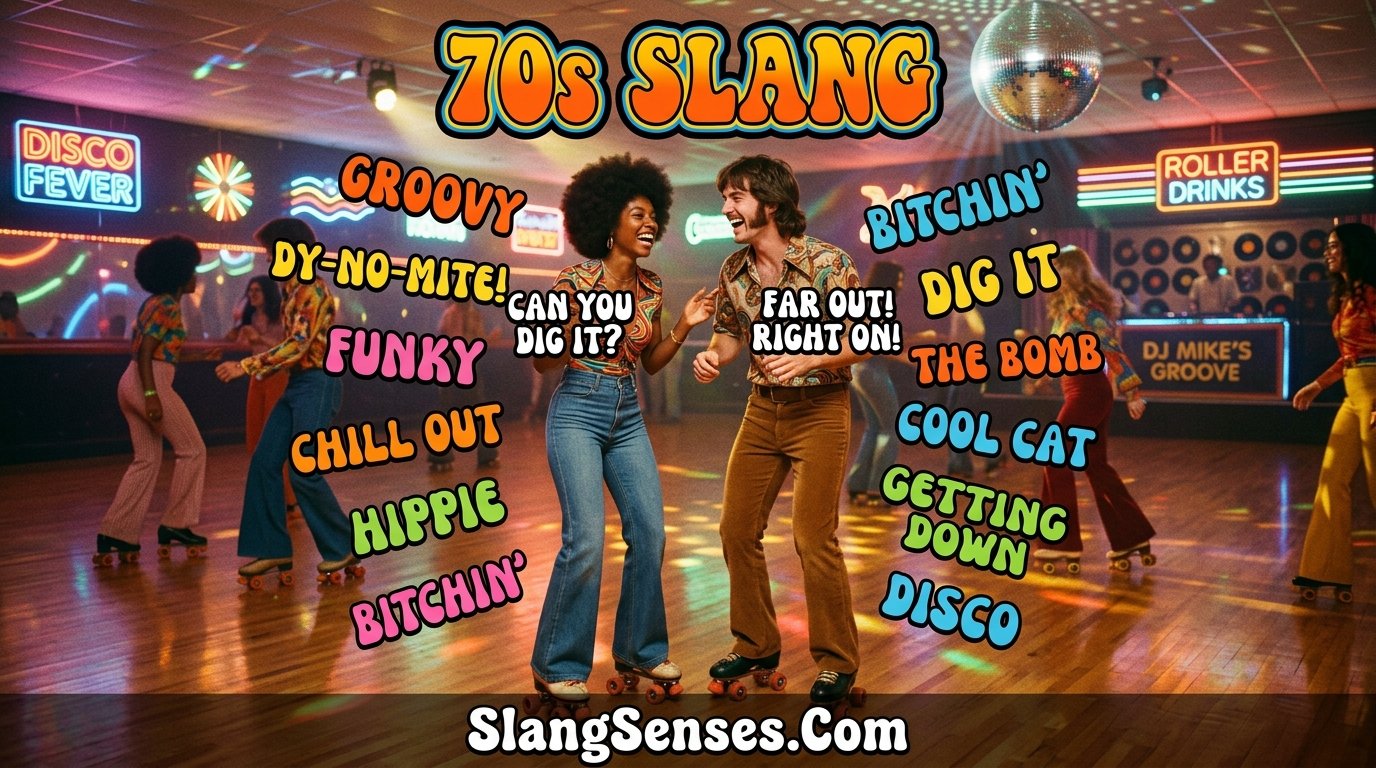
70s Slang words capture the funky, colorful spirit of the 1970s, a decade shaped by disco music, rock and roll, youth culture, counterculture, and changing fashion. People used expressive phrases like “groovy,” “far out,” “right on,” and “outta sight” to show excitement, approval, or admiration.
Words like “dig it” meant to understand or appreciate something, while “boogie” meant to dance or get moving. “Bread” was a popular slang term for money, and calling someone a “cool cat” meant they were stylish, confident, or impressive.
Other memorable 1970s slang words and phrases included “foxy,” “bummer,” “jive turkey,” “solid,” “truckin’,” and “what’s your bag?” Together, these vintage slang words reflected the relaxed, rebellious, humorous, and free-spirited language of an unforgettable decade.
Quick Table
| 70s Slang | Simple Meaning | Typical Feeling |
|---|---|---|
| Groovy | Cool, enjoyable, excellent | Positive |
| Foxy | Attractive, stylish, sexy | Positive |
| Bread | Money | Neutral |
| Dig it | Understand, appreciate, or agree | Positive |
| Far out | Amazing, unusual, impressive | Positive |
| Bummer | Something disappointing | Negative |
| Jive turkey | Fake, foolish, or untrustworthy person | Negative |
| Solid | Reliable, good, excellent | Positive |
| Boogie | Dance or move along | Fun |
| Flip side | The other side; see you later | Casual |
| Truckin’ | Moving along, carrying on | Casual |
| What’s your bag? | What’s your issue or interest? | Curious |
One important point: not every phrase in this table was invented in the 1970s.
Slang doesn’t work like that.
Words move between generations. A phrase can exist earlier, become fashionable during a particular decade, disappear, and then come back decades later. “Boogie,” for example, has musical roots that reach much further back than the disco era, while the 1970s helped give it a strong association with dancing and popular culture.
How My Grandmother Introduced Me to 70s Slang
My grandmother had a strange talent.
She could make an ordinary sentence sound like it belonged in an old movie.
One afternoon, I showed her something I thought was pretty impressive.
She looked at it, smiled, and said, “That’s groovy.”
Groovy?
I knew the word. Everybody knows the word. But hearing it in a completely ordinary conversation was different.
It felt… alive.
Then she started pulling out more expressions.
“That’s far out.”
“Don’t be a jive turkey.”
“Let’s boogie.”
“Catch you on the flip side.”
I laughed at first.
But then I started noticing something.
These expressions weren’t just funny old words. Each one carried a little piece of the time that produced it.
- Groovy sounded relaxed.
- Foxy sounded confident.
- Bread turned money into something casual.
- Bummer could turn disappointment into something almost playful.
And jive turkey? That one had attitude.
That’s the interesting thing about vintage slang. A dictionary can give you the definition, but it can’t always give you the feeling.
The 1970s were full of contrasts. There was disco, funk, soul, rock, television comedy, political tension, changing social attitudes, youth culture, and the continuing influence of counterculture. Slang naturally absorbed all of that.
That’s why 70s slang feels so colorful.
It wasn’t trying to sound formal.
It was trying to sound like itself.
Why 70s Slang Hits Different
There’s a reason people still search for old slang decades later.
It has personality.
Modern communication often values speed. Text messages get shortened. Words become abbreviations. Emojis replace whole sentences.
The slang of the 1970s had a different kind of energy.
Think about saying:
“That’s good.”
Now compare it with:
“That’s groovy.”
The meaning is similar, but the emotional color isn’t.
Or:
“That’s amazing.”
versus:
“That’s far out!”
The second one immediately feels more theatrical.
Music Had a Huge Influence
Music was one of the biggest forces behind the language of the era.
The 1970s brought disco into mainstream culture, while funk, soul, rock, and the emerging influence of hip-hop shaped how people talked and identified with different communities.
And this matters because slang doesn’t spread only through dictionaries.
It spreads through repetition.
A song gets played.
A phrase gets repeated.
A television character says it.
Friends copy it.
Soon everybody knows it.
Television Made Slang Bigger
Television also helped take expressions from specific communities and bring them into mainstream awareness.
Comedy shows, music programs, movies, and sitcoms all played a role in making certain expressions recognizable beyond their original settings.
That doesn’t mean everyone actually spoke exactly like a television character.
That’s a common misconception.
People who remember the era have pointed out that some expressions associated with the 1970s were much more common in pop culture than in ordinary everyday speech.
And honestly, that makes the history more interesting.
The 1970s had real slang and pop-culture slang.
They weren’t always the same thing.
The Words Themselves — And What They Actually Mean
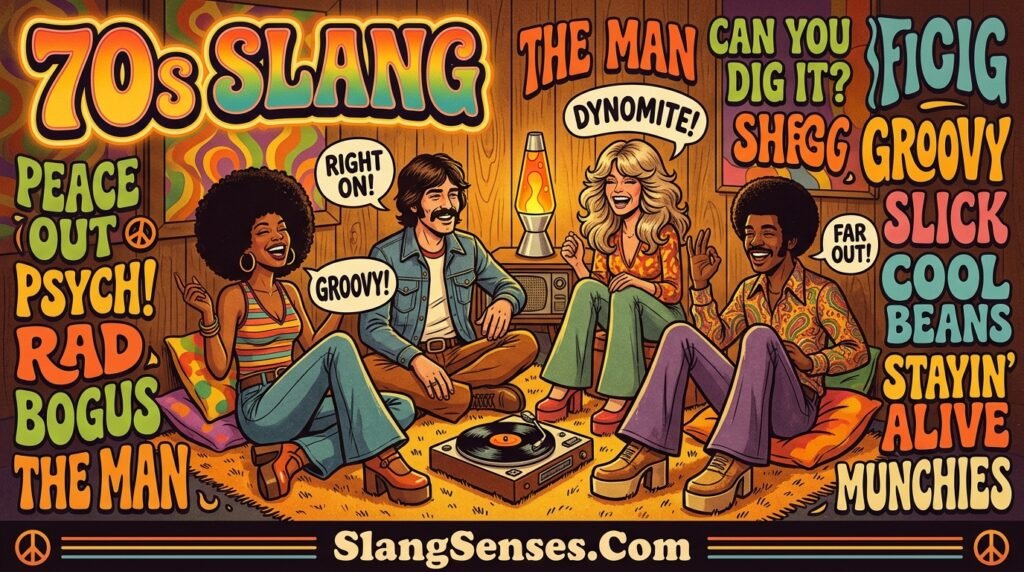
Now for the fun part.
Here are some of the most recognizable 70s slang words and phrases, along with what they meant, how they were used, and where the modern confusion comes in.
“Groovy”
Meaning: Cool, pleasant, excellent, enjoyable, or stylish.
If one word could wear bell-bottom jeans, it would probably be groovy.
When somebody called something groovy, they were usually saying they liked it.
For example:
“That new record is groovy.”
Or:
“What a groovy place.”
The word wasn’t necessarily limited to music. It could describe a person, idea, experience, atmosphere, or object.
Interestingly, groovy wasn’t born in the 1970s. Its history goes back earlier, but it became strongly associated with the hippie and counterculture era and remained recognizable through the 1970s.
Today, people often use it intentionally as retro slang.
And that’s perfectly groovy.
“Foxy”
Meaning: Attractive, stylish, or sexually appealing.
If someone was called foxy, it was generally a compliment about their appearance or charm.
For example:
“She looks foxy tonight.”
Or:
“That guy has a foxy style.”
The word has older roots, but its association with attractive people made it part of the slang vocabulary that carried strongly through the 1960s and 1970s.
One caution, though.
Calling someone “foxy” today can sound playful, old-fashioned, or flirtatious. It doesn’t necessarily sound like normal everyday speech.
Unless you’re deliberately going for that vintage vibe.
“Bread”
Meaning: Money.
No, nobody was asking you to bring a loaf of bread to the party.
Bread was slang for money.
For example:
“I need some bread before we go out.”
That means:
“I need some money.”
The comparison isn’t difficult to understand. Bread is a basic necessity, and the slang turned it into a casual metaphor for cash.
It’s one of those slang expressions that feels strangely understandable even when you haven’t heard it used in real life.
“Dig It”
Meaning: Understand, appreciate, like, or agree with something.
“Dig” had nothing to do with grabbing a shovel in this context.
When someone asked:
“Can you dig it?”
they could be asking whether you understood or appreciated what they were saying.
Depending on context, dig could also mean to like or appreciate something.
For example:
“I really dig this song.”
That’s essentially:
“I really like this song.”
The phrase was strongly connected with earlier counterculture speech and remained recognizable in the 1970s.
“Far Out”
Meaning: Amazing, surprising, unusual, exciting, or impressive.
Far out is one of those expressions that can be tricky because the literal words don’t help much.
Nobody is necessarily talking about physical distance.
Someone might say:
“That concert was far out!”
Meaning:
“That concert was incredible!”
The phrase could also express surprise:
“You met the band? Far out!”
Its history reaches back before the 1970s, particularly into earlier counterculture and hippie language, but it became a recognizable piece of retro slang.
Today, saying “far out” usually sounds deliberately nostalgic.
“Bummer”
Meaning: A disappointment, unpleasant situation, or bad experience.
This one actually survived.
You might still hear someone say:
“That’s a bummer.”
It means something like:
“That’s unfortunate.”
or
“That’s disappointing.”
For example:
“The concert got canceled.”
“What a bummer.”
Simple.
The word has roots that predate the 1970s, but it became familiar as part of the informal vocabulary surrounding the counterculture era.
Unlike some 70s slang, bummer doesn’t sound completely ancient today.
That’s probably why it survived.
“Jive Turkey”
Meaning: A foolish, fake, dishonest, annoying, or untrustworthy person.
This one has serious attitude.
Calling someone a jive turkey wasn’t exactly a compliment.
It could suggest that the person was full of nonsense, acting fake, or trying too hard.
For example:
“Don’t listen to that jive turkey.”
The phrase became particularly recognizable through African American slang and popular culture, especially television and entertainment.
But here’s an important content gap that many simple slang lists miss: not every phrase labeled “70s slang” belonged equally to every American community.
Some expressions emerged from or were strongly associated with Black American speech and later spread through music and mass media. Treating every term as if “all Americans in the 1970s talked this way” oversimplifies the history.
That’s worth remembering when using vintage slang today.
“Solid”
Meaning: Good, reliable, dependable, legitimate, or excellent.
“Solid” was a flexible compliment.
You could call a person solid because you trusted them.
You could describe a plan as solid because it was good.
For example:
“He’s a solid guy.”
Or:
“That’s a solid plan.”
The word doesn’t sound particularly strange today, which is exactly why it’s interesting.
Some slang doesn’t disappear.
It simply becomes normal language.
“Boogie”
Meaning: Dance, move, or sometimes leave quickly.
If someone said:
“Let’s boogie!”
they probably weren’t inviting you to sit quietly.
They were telling you to dance or get moving.
The word has deep musical roots in boogie-woogie, a blues tradition that predates the 1970s. During the disco era, however, “boogie” became strongly associated with dancing and popular music.
You could also hear:
“We gotta boogie.”
Meaning:
“We need to get moving.”
So the word could describe both dancing and movement.
That’s pretty useful for a word that sounds so silly.
“Catch You on the Flip Side”
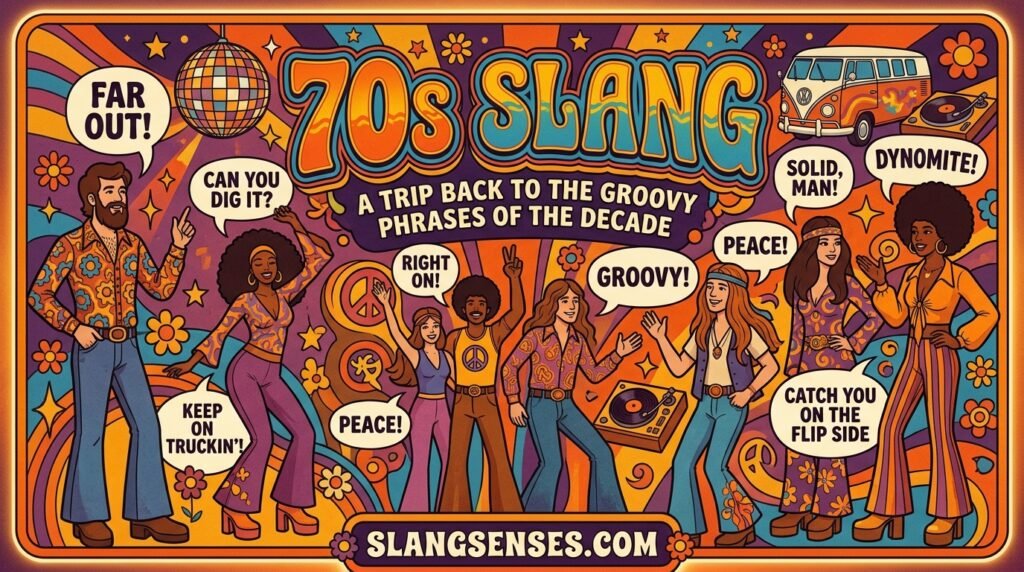
Meaning: See you later.
This phrase is essentially a casual goodbye.
“I’m heading home. Catch you on the flip side.”
It has strong connections to music and the idea of the other side of a record, while the phrase became part of wider informal speech.
The meaning isn’t complicated.
Catch you later.
But the wording has much more character.
That’s why it remains recognizable in retro conversations. YourDictionary includes “catch you on the flip side” among expressions associated with 1970s-style slang.
“Truckin’”
Meaning: Moving along, carrying on, or continuing with life.
Truckin’ can sound like it’s strictly about driving a truck.
Not necessarily.
The expression could suggest keeping going, moving forward, or carrying on.
Its popularity was connected with American road culture, music, and counterculture imagery.
The broader 1970s also had a strong connection between slang and CB radio culture, especially among truckers. Expressions such as “10-4, good buddy” and “What’s your 20?” became famous beyond actual radio users.
So when you hear “truckin’,” think movement.
Keep going.
Keep rolling.
“What’s Your Bag?”
Meaning: What’s your issue, interest, preference, or thing?
This one is especially interesting because bag wasn’t about luggage.
Someone might ask:
“What’s your bag?”
Depending on context, they could be asking:
“What’s bothering you?”
or:
“What’s your thing?”
or:
“What’s your particular interest?”
Older slang could be wonderfully flexible like that.
A similar phrase might appear when someone was behaving strangely:
“What’s your bag today?”
In other words:
“What’s going on with you?”
Historical slang references connect “What’s your bag?” with 1960s and 1970s informal speech.
Common Mistakes When Using Vintage Slang
Here’s where people get it wrong.
They learn five or ten old expressions and then throw all of them into one sentence.
Please don’t.
You don’t want to sound like a time traveler who just fell out of a disco ball.
Mistake 1: Thinking Every Word Was Invented in the 1970s
A lot of popular 70s slang existed before the decade.
Groovy, far out, boogie, and bummer all have histories that reach beyond the 1970s.
The decade’s importance was often about popularization, not invention.
Mistake 2: Assuming Everyone Used the Same Slang
They didn’t.
Slang varies by:
- Region
- Age
- Race and community
- Music scene
- Social group
- Occupation
- Generation
- Pop-culture exposure
The slang of a teenage disco fan in New York wasn’t necessarily identical to the language of a trucker in Texas.
That matters.
Mistake 3: Treating Movie Dialogue as Everyday Speech
Movies and television exaggerate language.
A character may use several famous expressions because writers want the audience to immediately recognize the period.
That doesn’t mean people were walking around saying “groovy” every five minutes.
Some people who remember the decade have specifically noted that certain famous expressions were more common on television than in their everyday conversations.
Mistake 4: Using Slang Without Understanding Tone
“Foxy” can sound flirtatious.
“Jive turkey” can sound insulting.
“Groovy” usually sounds positive.
“Bummer” is negative but mild.
“What’s your bag?” can sound curious or confrontational depending on delivery.
The definition isn’t everything.
Tone matters.
Why These Words Still Matter
At first glance, old slang may seem like nothing more than nostalgia.
It isn’t.
Slang tells us how people saw themselves.
Language captures mood.
The 1970s had major cultural shifts involving music, youth identity, politics, entertainment, fashion, and social movements. The decade’s slang reflects that mixture of optimism, rebellion, humor, experimentation, and casual confidence.
And there’s another reason.
Old slang helps us understand movies and music from the period.
Imagine reading:
“Can you dig it?”
If you know the phrase, you understand more than the literal words.
You understand the attitude.
That’s what good slang does.
It carries culture inside a tiny phrase.
It also explains why modern creators keep bringing it back. Retro fashion, vintage-themed parties, memes, movies, TikTok videos, and nostalgic social posts all create new reasons to use old expressions.
The words may be old.
The feeling doesn’t have to be.
A Few More Worth Knowing
The list above covers the required classics, but there are plenty of other 1970s slang words and phrases worth recognizing.
“Outta Sight”
Meaning: Excellent, impressive, amazing.
“That band was outta sight!”
This is another compliment closely related in feeling to “far out.”
“Right On”
Meaning: Agreement, approval, or encouragement.
“You got the job?”
“Right on!”
It’s basically an enthusiastic “yes” or “that’s great.”
“Cool Beans”
Meaning: Great, good, excellent.
The phrase sounds almost intentionally ridiculous today.
But that was part of its charm.
Babbel notes that “cool beans” became associated with 1970s slang, although its exact origin is uncertain.
“Space Cadet”
Meaning: Someone who seems distracted, detached, or out of touch with reality.
The phrase actually has earlier science-fiction roots, but it took on a different cultural association during the 1960s and 1970s.
Today, calling someone a space cadet usually means they’re daydreaming or not paying attention.
“The Man”
Meaning: The authority, establishment, or powerful system.
The phrase became strongly associated with protest and counterculture language.
You might hear:
The “Man” wasn’t necessarily one specific person. It could represent authority or an establishment viewed as restrictive or oppressive.
“10-4, Good Buddy”
Meaning: Okay, understood.
This came from CB radio culture and became a recognizable piece of 1970s pop culture.
“Psych!”
Meaning: Just kidding; I fooled you.
This was used after saying something deliberately misleading.
For example:
“You have to clean the whole house tonight. Psych!”
Not exactly nice.
But very recognizable.
YourDictionary also lists “psych” among 1970s-era informal expressions.
“Stoked”
Meaning: Extremely excited or enthusiastic.
“I’m stoked about the concert.”
This one survived remarkably well.
“Square”
Meaning: An old-fashioned, conventional, or uncool person.
If someone was a square, they weren’t exactly considered part of the cool crowd.
The Real Experiment
Here’s the fun part.
Try taking a completely ordinary modern sentence and give it a 1970s makeover.
Modern:
“That concert was amazing. Let’s dance, and I’ll see you later.”
Retro:
“That concert was far out. Let’s boogie. Catch you on the flip side.”
See the difference?
The basic information hasn’t changed.
The personality has.
Here’s another.
Modern:
“I don’t have enough money to go.”
Retro:
“I’m short on bread.”
Or:
Modern:
“That’s unfortunate.”
Retro:
“What a bummer.”
Or:
Modern:
“Do you understand what I’m saying?”
Retro:
“Can you dig it?”
That’s why slang is powerful.
It isn’t simply a shortcut.
It’s a social signal.
It tells people something about your personality, generation, community, interests, or the era you’re trying to evoke.
But Don’t Overdo It
If you say:
“Groovy, foxy jive turkey! Let’s boogie with our bread because your bag is far out!”
you haven’t recreated the 1970s.
You’ve created a linguistic car crash.
One or two expressions work much better.
That’s true for historical writing, character dialogue, social media captions, retro parties, and even jokes.
Authenticity is usually quieter than parody.
And that’s one of the biggest differences between knowing slang and actually understanding it.
Frequently Asked Questions
How do you say “cool” in the 70s?
What are some hippie slang words?
What are some disco phrases?
What were some popular catchphrases and expressions in the 1970s?
Conclusion
70s slang words capture the fun, colorful, and free-spirited culture of the 1970s. It was a decade known for disco music, rock, changing fashion, youth culture, and major social changes, and all of these influences found their way into everyday language.
Words like “groovy,” “far out,” “dig it,” “boogie,” and “right on” were used to show excitement, agreement, appreciation, or simply a relaxed attitude. Other expressions like “bread,” “bummer,” “foxy,” and “jive turkey” gave everyday conversations a playful and memorable personality.
Much of this 70s slang was influenced by music, television, movies, counterculture, and different youth communities. Some expressions became popular across the country, while others were more closely connected to particular groups, regions, or cultural movements.
Even today, 1970s slang continues to appear in movies, television, music, memes, retro parties, and nostalgic conversations. Some words have faded from everyday speech, while others, such as “solid,” “boogie,” and “bummer,” are still understood and occasionally used.
Learning these vintage expressions is more than just memorizing old words. It gives us a small glimpse into how people communicated, what influenced them, and what made the 1970s such a memorable decade.
The language of the era may sound old-fashioned today, but its personality hasn’t disappeared. From “groovy” to “catch you on the flip side,” 70s slang remains a fun reminder of a colorful time when language was just as bold, creative, and expressive as the culture around it.

Rathna Kannan is a language enthusiast and writer at Slang Senses, sharing simple explanations of modern slang, internet expressions, and trending phrases. Rathna enjoys exploring how language evolves through social media and everyday conversations.
1 thought on “70s Slang: Amazing Retro Words & Meanings 2026”