
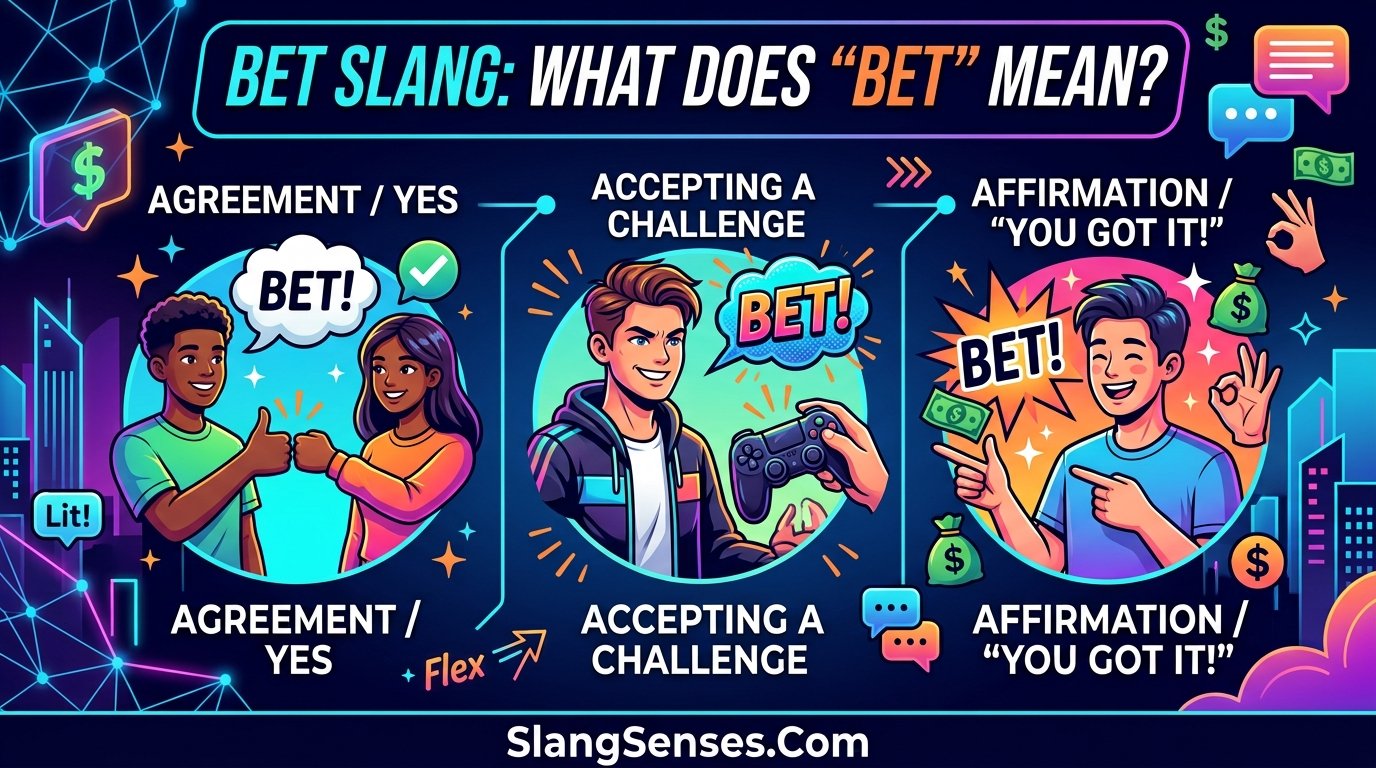
Bet slang is everywhere — in your kid’s texts, in TikTok comments, in every group chat your teen has ever opened. So let’s skip the buildup and give you the answer right now: bet means “okay,” “for sure,” or “sounds good.” That’s it. No gambling. No secret code. Just a fast, confident way of saying yes.
But — and this is the part most guides miss — that same little word can also mean “challenge accepted,” pure hype, or even sarcastic disbelief. One syllable. Four meanings. Which one you’re getting depends entirely on tone and context.
In this guide, you’ll learn exactly what bet means in texting and on TikTok, where it actually came from (spoiler: it’s way older than you think), whether it’s ever rude, how it stacks up against “you bet” and “say less,” and — most importantly — precisely how to respond when someone says it to you.
Bet Meaning at a Glance
| Meaning | What It Really Says | Example |
|---|---|---|
| Agreement | “Okay” / “Sounds good” | “Meet at 7?” — “Bet.” |
| Challenge accepted | “Watch me” / “Try me” | “You can’t beat me.” — “Bet.” |
| Enthusiasm | “Let’s go!” | “I got us tickets!” — “Bet!” |
| Sarcasm | “Yeah, sure, whatever” | “You have to work the weekend.” — “Bet.” |
Four meanings. One syllable. That’s efficient.
What Does Bet Mean in Texting?
In texting, bet is the ultimate low-effort, high-confidence reply. Instead of typing “okay” or “sounds good,” people just drop “bet” and move on with their day.
It’s the texting equivalent of a nod. That’s… kind of it, honestly.
Text examples:
A: movie night at mine, 8pm
B: betA: I’ll send you the notes tonight
B: betA: pick me up at 5?
B: bet
You’ll see it everywhere — Snapchat streaks, Instagram DMs, group chats, gaming lobbies. Anywhere a quick “yes” is needed, bet fills the gap. And no, it never involves actual money. If someone asks “can you cover my shift?” and you reply “bet,” you’re just saying sure, I’ve got you.
One small warning: bet is casual. Very casual. Don’t drop it in a work email to your boss. “Bet, the report is attached” is a choice, and probably not the right one.
What Does Bet Mean on TikTok?
On TikTok, bet works in two main ways.
1. As a comment. Someone posts a video pulling off an insane trick shot or a crazy recipe, and the comments fill up with “bet” — meaning that’s impressive, I acknowledge the confidence. It’s approval, compressed into three letters.
2. As a dare. This is the one parents should know about. The classic setup is “bet you won’t…” — as in “bet you won’t jump in the pool with your clothes on.” Here, bet flips the dare back: challenge accepted, I absolutely will.
Side note: this dare usage is the only real “risk” attached to the word. Most of the time it’s completely harmless. But when teens are goading each other with “bet you won’t,” things can occasionally get bold or impulsive — think TikTok challenges. Not the word’s fault. Just worth an open conversation, not a panic.
You’ll also spot it in captions and replies as pure hype: “moving out next month, bet.”
How Is “Bet” Used in a Conversation?
Okay, real talk — tone does all the heavy lifting here. The dictionary gives bet one neat little definition, but in actual conversation, it bends four different ways.
Think of it like the word “cool.” Same word. Completely different message depending on how it’s said.
1. The agreement. Someone proposes a plan, you approve. “Wanna grab food later?” — “Bet.” Done deal.
2. The challenge. Someone doubts you, you accept. “There’s no way you can finish that whole pizza.” — “Bet.” Now you have to finish the pizza. Them’s the rules.
3. The hype. Good news lands, you celebrate. “I passed my driving test!” — “BET!” Energy. Excitement. Maybe an exclamation mark.
4. The sarcasm. Someone tells you something ridiculous, and you respond with a flat, dry “OK, bet.” What you actually mean: “sure, and I’m the queen of England.” This one’s usually obvious from tone — or from how absurd the statement was.
Same word. Four moods. Context is everything.
Examples of “Bet” in a Sentence
Want to see it in the wild? Here are real-world style examples:
- “Study session at the library at 4?” — “Bet.”
- “You can’t land that trick.” — “Bet.” (= watch me)
- “I’ll be home by 10.” — “Bet, see you then.”
- “Just got us front-row tickets!” — “Bet!!”
- “My manager wants me to come in on my day off.” — “OK, bet.” (= absolutely not, sarcastically)
- “I can get us tickets for the game.” — “Bet?”
- “First one to finish wins.” — “Bet, let’s go.”
- “Bet you won’t text your crush right now.” — “Bet.” (= oh yes I will)
Notice how each one only makes sense because of the situation around it? That’s the whole game.
What Does “Bet” Mean in Gen Z Slang?
In Gen Z slang, bet is the go-to word for confident agreement. It’s what “cool” was to the 90s and “groovy” was to a generation we don’t talk about anymore.
Gen Z (roughly born 1997–2012) grew up online, and their slang is built for speed. Why type “okay, that sounds good to me, I’m in” when “bet” says all of it in one word? Group chats, gaming lobbies, comment sections — bet thrives wherever replies need to be fast.
If you’re a parent, here’s the good news: bet is one of the most harmless pieces of teen slang out there. It’s positive. It’s agreement. Your kid saying “bet” to “homework before games?” is literally the sound of good parenting paying off.
It usually travels with friends like no cap (no lie), fr (for real), and say less (understood, I’m in). Learn those four and you’ll understand roughly 80% of a teenage group chat.
Where Did the Slang “Bet” Come From?
This one surprises people. Bet slang isn’t actually new — not even close.
The word traces back to African American Vernacular English (AAVE), where it’s been used as casual affirmation since the 1980s. And its roots go deeper still: expressions like “you bet” and “you can bet on it” — meaning “of course” or “certainly” — show up in American English as far back as the 1850s. The slang basically took the long-standing gambling metaphor (a bet = something you’re confident enough to stake money on) and squeezed it into a single, punchy word. If you’d bet on it, you were sure of it.
Fast forward to the late 2010s and early 2020s, and social media — Twitter/X, TikTok, memes — launched bet into the mainstream. It spread from hip-hop culture and Black Twitter into every corner of the internet.
Proof it’s fully arrived: Merriam-Webster now has an official entry for bet slang, defining it as “an informal affirmative, sometimes used facetiously.” When the 190-year-old dictionary gives your slang a page, you’ve made it.
You May Like To Read: New York Slang: NYC Words, Phrases & Meanings
Is “Bet” a Disrespectful or Offensive Word?
Short answer: no. Bet is not rude, offensive, or disrespectful in itself.
It’s a friendly, positive word — agreement with a little confidence sprinkled on top. Nobody’s insulted by it. Nobody’s excluded by it.
But context (again, always context) can shade it:
- The sarcastic “OK, bet” can come off as dismissive — like eye-rolling in word form. Aimed at a friend’s absurd joke? Funny. Aimed at a teacher’s instructions? Not your best move.
- “Bet you won’t…” dares can nudge people toward showing off or risky behavior. It’s peer pressure wearing a party hat.
- Tone matters. A flat “bet” can read as whatever, moving on — even when that’s not intended.
So: harmless word, occasional sharp edges. If a teen in your life uses it constantly, that’s normal. Just keep the conversation open.
Bet vs. You Bet: What’s the Difference?
Ah — here’s a distinction almost nobody explains properly. These two get mixed up constantly, so let’s untangle them.
“You bet” is the older generation’s version. It’s been around since the 1800s, and today it mostly means “you’re welcome” or “definitely.” Someone says “thanks for your help!” and you reply “you bet!” — friendly, warm, a little old-school. Your uncle says it. Your dentist says it.
“Bet” is the Gen Z version. It’s a standalone confirmation — “okay,” “deal,” “I’m in.” It answers plans, not thanks. “Movie at 8?” — “Bet.”
A lot of people think bet is just “you bet” with the “you” chopped off. Honestly? That’s probably part of where it came from. But somewhere along the way, it picked up extra jobs — the challenges, the sarcasm — that “you bet” never had.
| Bet | You Bet | |
|---|---|---|
| Vibe | Modern, casual, confident | Warm, slightly old-fashioned |
| Replies to | Plans and proposals | Thanks and statements |
| Age group | Gen Z, teens | Everyone, skewing older |
| Example | “Game night?” — “Bet.” | “Thanks!” — “You bet!” |
Simple version: bet confirms. You bet appreciates.
Bet vs. Facts, No Cap, and Say Less
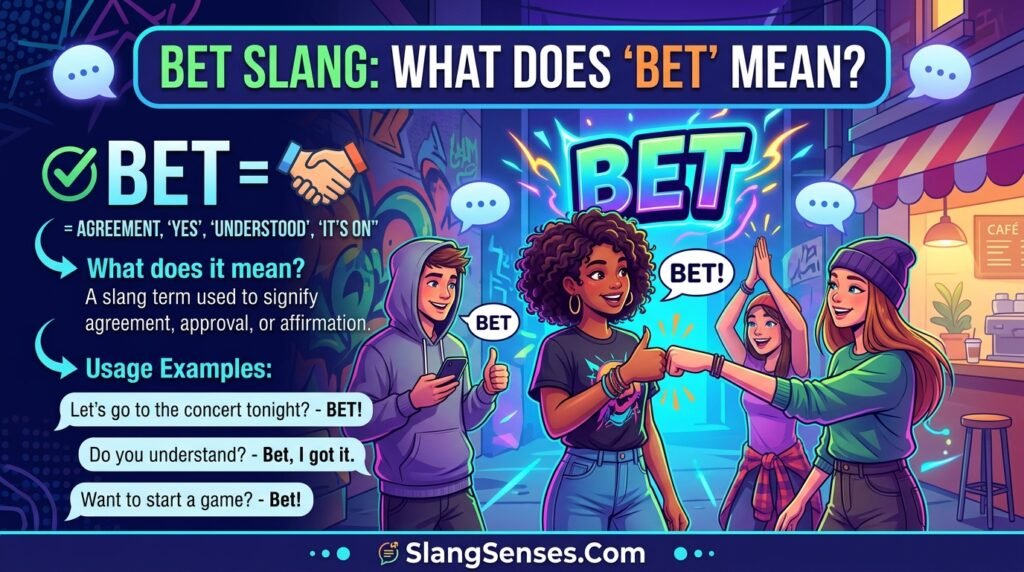
Bet has a squad of slang cousins that all live in the same group chats. People mix them up all the time, so here’s the cheat sheet:
| Slang | Meaning | When It’s Used | Example |
|---|---|---|---|
| Bet | Okay / for sure / deal | Confirming a plan or accepting a dare | “Meet at 7?” — “Bet.” |
| Facts | “That’s true” / I agree | Agreeing with a statement or opinion | “This album is underrated.” — “Facts.” |
| No cap | No lie / for real | Emphasizing you’re being honest | “This pizza is amazing, no cap.” |
| Say less | Understood, no more explanation needed | Accepting a plan instantly | “I got free food.” — “Say less.” |
See the difference? Facts agrees with something already said. No cap vouches for honesty. Say less accepts before the sentence even finishes. Bet locks in the deal.
They overlap sometimes — you could reply “bet” or “say less” to the same plan — but they’re not interchangeable. Kind of like siblings: same house, different personalities.
Is “Bet” Still Popular Today?
Yes — and honestly, it’s not going anywhere.
Here’s the thing about most slang: it burns bright and dies fast. Remember “on fleek”? Yeah. But bet has real staying power, for a few reasons:
- It’s short and useful. One syllable that replaces a whole sentence. Slang that saves effort survives.
- It got dictionary-stamped. Merriam-Webster’s official slang entry (updated for 2026) cemented it as part of modern English, not just a trend.
- It crosses generations now. Teens started it, but millennials, older siblings, and even some brave parents use it. Slang survival rule: once parents adopt a word, teens start retiring it — but bet’s sheer utility keeps it in rotation.
- It’s platform-independent. Texting, TikTok, gaming, X/Twitter, Instagram — bet works everywhere, which most slang doesn’t.
So if you’re learning it in 2026, you’re not late. You’re right on time.
How to Respond When Someone Says “Bet”
Someone hit you with a “bet” and now you’re frozen? Don’t overthink it — the correct response is usually the easiest one possible.
Option 1: Say it back. “Bet.” That’s a complete exchange. Conversation closed, deal sealed.
Option 2: Confirm the details. “Cool, see you at 8.” Simple, human, works.
Option 3: Match the energy. If they said it with excitement, hype them back — “LET’S GO” or “bet!!”
Option 4: Just be normal. “Sounds good,” “alright,” “awesome.” Standard English never goes out of style, and nobody will judge you for it.
Option 5: If it was a dare (“bet you won’t”) — respond with “bet” only if you actually intend to do the thing. Otherwise, laugh it off. There’s no contract. You’re allowed to decline dares, I promise.
The only wrong response? Standing there confused. Now you won’t.
Frequently Asked Questions
Why does Gen Z say bet?
What does bet slang mean in texting?
Is bet a Black term?
How do I respond to bet?
Conclusion
Bet slang meaning is simple, but its tone can change depending on the conversation. In most texts, chats, and social media posts, “bet” means “okay,” “sure,” or “I agree.” It can also show confidence, acceptance, or a playful challenge between friends.
Now that you know what “bet” means, you can understand it more easily when someone sends it in a text. Just pay attention to the context, because the same word can sound casual, confident, or slightly challenging depending on how it is used.
So, the next time someone says “Bet!”, you’ll know exactly what they mean—and you can respond naturally without overthinking it.

Rathna Kannan is a language enthusiast and writer at Slang Senses, sharing simple explanations of modern slang, internet expressions, and trending phrases. Rathna enjoys exploring how language evolves through social media and everyday conversations.
1 thought on “Bet Slang Meaning: The Amazing Truth You Should Know 2026”