
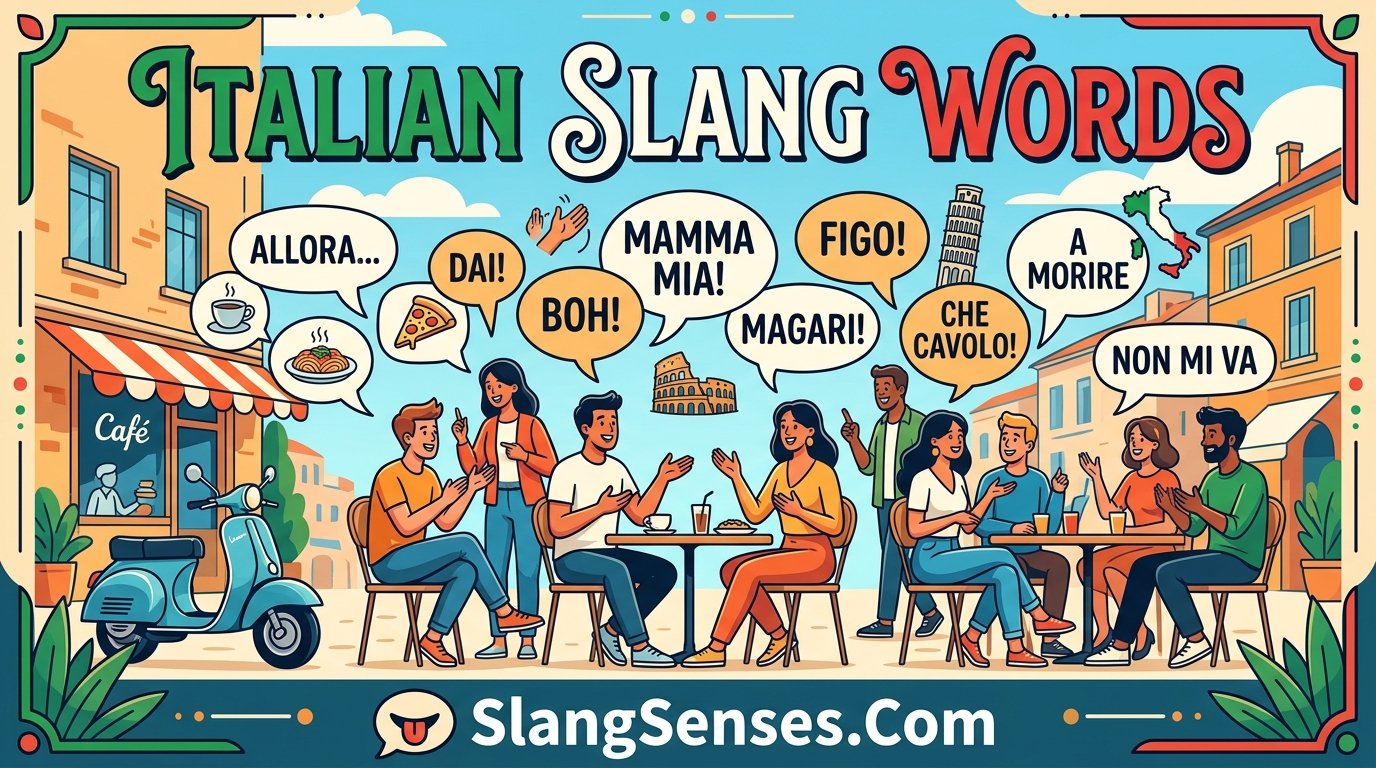
If you want to sound more natural when speaking Italian, learning a few Italian slang words can make a big difference. Textbooks teach you formal Italian, but everyday conversations are often more relaxed, playful, and expressive. From friendly greetings and funny expressions to words used among close friends, Italian slang gives you a better feel for how people actually communicate.
In this guide, you’ll discover 50+ cool Italian slang words and phrases with simple meanings and examples. Some are commonly used by younger speakers, while others have been around for generations. You’ll also learn when a slang word is appropriate and when it may sound rude or awkward. Whether you’re planning a trip to Italy, watching Italian movies, chatting with Italian friends, or simply curious about the language, these expressions can help you understand the culture behind the words.
Quick Table Of Italian Slang Words
| # | Italian Slang / Phrase | Meaning |
|---|---|---|
| 1 | Boh | I don’t know / who knows |
| 2 | Dai | Come on / go ahead |
| 3 | Figata | Awesome / cool thing |
| 4 | Figo | Cool / attractive |
| 5 | Figa | Attractive woman / vulgar depending on context |
| 6 | Tipo | Like / guy / sort of |
| 7 | Scialla | Chill / relax |
| 8 | Bella! | Hey! / cool! / bye! |
| 9 | Bella zio | Hey bro / what’s up |
| 10 | Come butta? | How’s it going? |
| 11 | Che sbatti | What a hassle |
| 12 | Che casino! | What a mess! |
| 13 | Casino | Mess / chaos |
| 14 | Meno male | Thank goodness |
| 15 | Magari | If only / maybe / hopefully |
| 16 | Raga | Guys |
| 17 | Fra | Bro / mate |
| 18 | Bro | Bro |
| 19 | Zio | Bro / dude |
| 20 | Regà | Guys / folks, especially Roman |
| 21 | Cavolo! | Darn! / wow! |
| 22 | Cavolo! | Literally cabbage; mild exclamation |
| 23 | Cazzo! | Damn! / fuck! |
| 24 | Che cazzo? | What the hell? / what the fuck? |
| 25 | Mannaggia! | Damn it! |
| 26 | Porca miseria! | Damn! / for goodness’ sake |
| 27 | Accidenti! | Darn! |
| 28 | Minchia! | Damn! / wow!; strongly regional |
| 29 | Che figata! | How cool! |
| 30 | Spacca! | It rocks! / it’s awesome |
| 31 | Una bomba | Amazing / fantastic |
| 32 | Da paura | Amazing / incredibly good |
| 33 | Da morire | Extremely / hilarious / intensely |
| 34 | Troppo forte | Really cool / hilarious |
| 35 | Forte! | Cool / impressive |
| 36 | Che forte! | How cool! |
| 37 | Ganzo | Cool / clever; especially Tuscan |
| 38 | Bello | Nice / cool / beautiful |
| 39 | Bella | Beautiful / cool / greeting |
| 40 | Mitico! | Legendary / awesome |
| 41 | Grande! | Great! / well done! |
| 42 | Top | Excellent / the best |
| 43 | Super | Great / excellent |
| 44 | Pazzesco | Crazy / unbelievable |
| 45 | Assurdo | Crazy / unbelievable |
| 46 | In gamba | Capable / sharp / competent |
| 47 | Sfigato | Loser / unlucky person |
| 48 | Sfiga | Bad luck |
| 49 | Che sfiga! | What bad luck! |
| 50 | Rosicare | To be bitter / jealous |
| 51 | Rosicone | Bitter or jealous person |
| 52 | Sbatti | Hassle / effort |
| 53 | Scazzo | Boredom / annoyance |
| 54 | Scazzato | Annoyed / fed up |
| 55 | Incazzato | Very angry |
| 56 | Stanco morto | Dead tired |
| 57 | Fuori di testa | Crazy / out of one’s mind |
| 58 | Fuori di zucca | Crazy / nuts |
| 59 | Sclerare | To lose it / freak out |
| 60 | Sclerato | Freaked out / unhinged |
| 61 | Spaccare | To rock / be excellent |
| 62 | Fare schifo | To suck / be disgusting |
| 63 | Schifoso | Gross / disgusting |
| 64 | Che palle! | What a pain / how annoying |
| 65 | Rompipalle | Annoying person |
| 66 | Rompiscatole | Annoying person; milder |
| 67 | Piantala! | Stop it! |
| 68 | Smettila! | Stop it! |
| 69 | Fatti i fatti tuoi | Mind your own business |
| 70 | Fregarsene | To not care |
| 71 | Me ne frego | I don’t care |
| 72 | Ci sta | That works / sounds good |
| 73 | Ci sto | I’m in |
| 74 | Andiamo! | Let’s go! |
| 75 | Dai, su! | Come on! |
| 76 | Vai! | Go ahead! |
| 77 | Forza! | Come on! / let’s go! |
| 78 | Figurati! | Don’t mention it / no problem |
| 79 | Prego | You’re welcome / go ahead |
| 80 | Tranquillo | Relax / don’t worry |
| 81 | Tranquilla | Relax / don’t worry, feminine |
| 82 | A posto | All good / okay |
| 83 | Tutto a posto | Everything’s fine |
| 84 | Ci vediamo | See you |
| 85 | A dopo | See you later |
| 86 | A presto | See you soon |
| 87 | Che figo! | How cool! |
| 88 | Che palle! | What a pain! |
| 89 | Mollare | To quit / ditch / leave |
| 90 | Tirare il pacco | To stand someone up |
| 91 | Beccare | To catch / run into / spot |
| 92 | Sgamare | To catch someone out |
| 93 | Ci becchiamo | See you / we’ll meet up |
| 94 | Pomiciare | To make out |
| 95 | Fare il filo | To flirt with someone |
| 96 | Sballo | Thrill / wild experience |
| 97 | Sballarsi | To have a great time / get high, context-dependent |
| 98 | Cazzeggiare | To mess around / fool around |
| 99 | Ugatz / Ungatz | Italian-American expression for nothing/bullshit |
| 100 | Mamma mia! | Wow! / goodness! / frustration |
Italian slang varies significantly by region, age, and social setting. For example, Babbel notes that expressions such as boh, figata, tipo, magari, figo, and scialla appear in contemporary informal Italian, while some expressions have stronger regional associations.
Why Real Italians Don’t Speak Like Your Textbook
Textbooks have a job.
They teach you grammar.
They teach you vocabulary.
They help you understand how to build a sentence without accidentally turning “I would like some water” into something that sounds like a robot asking for hydration.
But everyday conversation is different.
A textbook might teach:
Non lo so.
I don’t know.
A friend might simply say:
Boh.
That’s it.
One tiny word.
Boh can mean “I don’t know,” “who knows,” or even “I have no idea.” The speaker’s tone does a lot of the work.
You may also hear:
Dai!
Literally, dai comes from dare, “to give,” but in everyday speech it can mean “come on,” “go ahead,” “seriously,” or “give me a break,” depending on tone and context.
That’s where Italian becomes fun.
And slightly dangerous.
The same expression can sound encouraging in one situation and irritated in another.
This is why Italian slang for travelers shouldn’t be treated as a vocabulary checklist alone. You need to learn the feeling attached to the phrase.
Polite standard Italian still matters, especially when you’re talking to hotel staff, restaurant workers, older people, or strangers. Travel guides consistently recommend starting interactions with greetings and polite expressions such as buongiorno, buonasera, grazie, and per favore.
Slang comes after that.
Think of it as the seasoning, not the whole meal.
Why Italian Slang Trips Up Learners (And Even Tourists Who Think They Know Better)
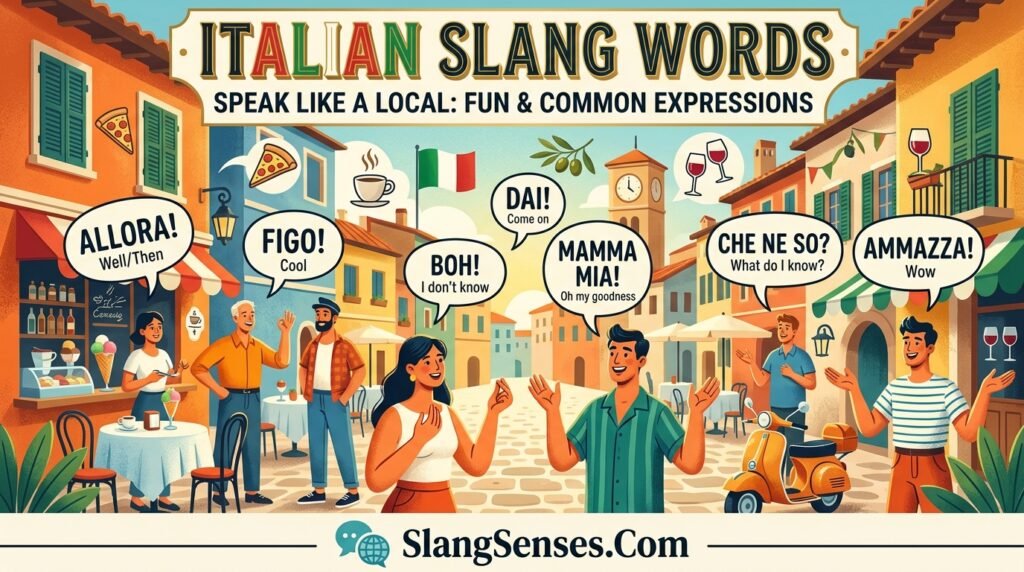
Italian slang is difficult because it isn’t one neat category.
Some expressions are:
- Nationwide
- Regional
- Youth slang
- Internet slang
- Italian-American slang
- Mildly vulgar
- Very vulgar
- Playful
- Romantic
- Sarcastic
- Old-fashioned
- Still extremely common
And sometimes a normal dictionary word becomes slang because of how it’s used.
Take tipo.
It can mean “type” or “guy,” but in casual conversation it can also work like the English filler “like.”
Era tipo stanco.
Depending on context:
“He was, like, tired.”
That’s not the kind of thing most beginners expect.
Then there are regional differences.
In Rome, you’ll hear expressions that may sound different from casual speech in Milan. Tuscan vocabulary can have its own flavor. Southern Italy has expressions that may not travel neatly across the whole country.
And then there’s the internet.
Young Italians regularly borrow English words, abbreviations, memes, gaming language, and social-media expressions. Contemporary slang is moving. Constantly.
So if a phrase sounds unfamiliar, it doesn’t automatically mean your Italian is bad.
Sometimes the phrase is simply local.
The Words You’ll Hear Before You Understand Them
Here are some of the most useful Italian slang words to recognize in the wild.
Boh
Boh is one of the easiest and most useful.
It means:
“I don’t know.”
or:
“Who knows?”
Example:
Boh, vediamo.
“Dunno, we’ll see.”
You may hear this constantly because it fits so many situations.
Someone asks where the group is going.
Boh.
Someone asks whether a restaurant is open.
Boh.
Someone asks why your train is late.
A dramatic shrug.
Boh.
Beautiful.
Dai
Dai is incredibly flexible.
It can mean:
- Come on!
- Go ahead!
- Seriously?
- Hurry up!
- Give me a break!
For example:
Dai, andiamo!
“Come on, let’s go!”
But:
Dai, non ci credo!
“Come on, I don’t believe it!”
Same word.
Different emotional temperature.
Figata
If someone says:
Che figata!
They’re usually saying:
“That’s awesome!”
or:
“How cool!”
It’s one of the classic informal ways to express enthusiasm.
You might hear it after seeing a beautiful view, discovering a great restaurant, or hearing exciting news.
Just remember: it’s informal.
Don’t use it in a formal business presentation unless you’re trying to create a very memorable meeting.
Figo / Figa
Figo can mean cool, attractive, stylish, or impressive.
Questo posto è figo.
“This place is cool.”
Figa can refer to an attractive woman, but it can also have vulgar sexual meanings. Tone and context matter enormously.
So this is one to understand before using.
That’s an important traveler rule.
Not every slang word belongs in your mouth just because you found it on a list.
Scialla
Scialla means something like:
Relax.
Chill.
Take it easy.
It is associated particularly with informal and youth speech.
You might hear:
Scialla, non è un problema.
“Relax, it’s not a problem.”
It has a very casual feel.
Raga
Raga is a shortened form of ragazzi and means something like:
“Guys.”
It’s extremely useful when addressing a group casually.
Raga, andiamo?
“Guys, shall we go?”
Fra
Fra is another casual term used like “bro” or “mate.”
Younger speakers may use it frequently, particularly in informal conversations and online.
It comes from fratello, meaning “brother.”
Che casino!
Casino can mean a mess, chaos, confusion, or a noisy situation.
Che casino!
“What a mess!”
It can also describe a chaotic environment.
Be careful, though: English speakers sometimes assume casino simply means a gambling establishment because of the English word. In Italian, the everyday expression che casino! is something entirely different.
Meno male
This means:
“Thank goodness.”
Example:
Meno male che sei arrivato!
“Thank goodness you arrived!”
It often appears after a stressful situation ends well.
The Emotional Range of a Single Italian Word
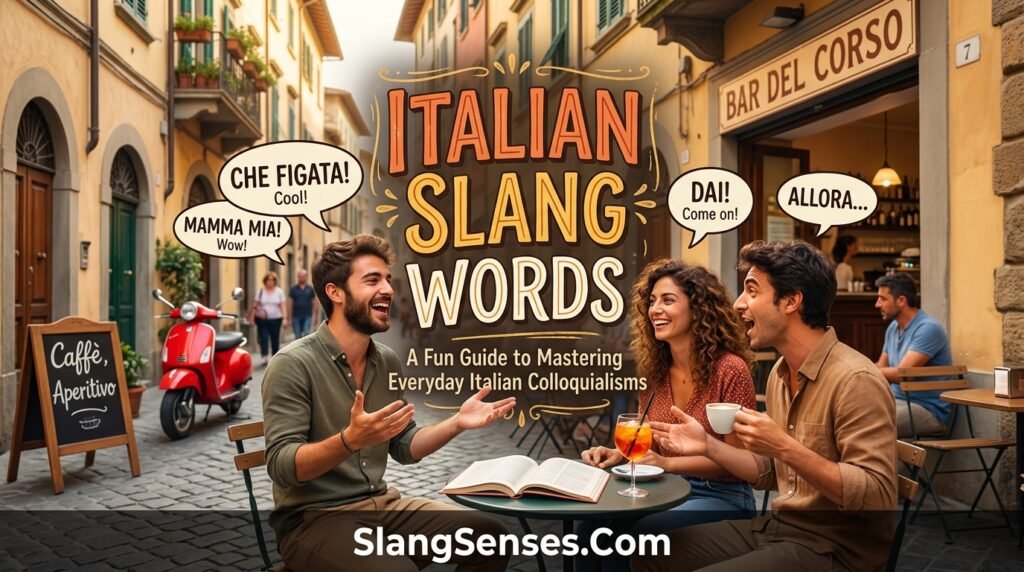
Italian is extremely good at this.
A word doesn’t always carry its entire meaning by itself.
Tone finishes the sentence.
Consider:
Grande!
Literally, “big.”
But in conversation it can mean:
“Great!”
“Well done!”
“Awesome!”
Or even:
“You’re the best!”
depending on the situation.
Then there’s:
Mamma mia!
It can express surprise.
Frustration.
Shock.
Admiration.
Exasperation.
Even amusement.
Someone sees an incredible sunset:
Mamma mia, che bello!
Someone discovers how much a repair costs:
Mamma mia!
Same expression.
Entirely different emotion.
This is one reason translation apps can struggle with slang. They translate words. Humans interpret situations.
Positive Slang
Some expressions are enthusiastic:
- Figo — cool
- Figata — awesome
- Spacca — rocks
- Una bomba — fantastic
- Mitico — legendary
- Grande — great
- Top — excellent
- Da paura — incredibly good
Negative Slang
Others express frustration or annoyance:
- Bummer — though more English than Italian
- Che palle! — what a pain
- Che sbatti — what a hassle
- Sfiga — bad luck
- Scazzo — annoyance/boredom
- Incazzato — very angry
- Fare schifo — to suck/be disgusting
Emotional Slang
Then you’ve got words that can move between categories:
- Pazzesco — crazy/unbelievable
- Assurdo — absurd/crazy
- Da morire — extremely
- Fuori di testa — out of one’s mind
- Rosicare — to be bitter or jealous
This emotional range is a huge part of what makes Italian informal language so expressive.
The Slang That Reveals Italian Humor
- Italian humor often loves exaggeration.
- Something isn’t merely good.
- It’s una bomba.
- Something isn’t merely surprising.
- It’s pazzesco.
- Someone isn’t simply tired.
- They’re stanco morto — “dead tired.”
- The language stretches.
- It exaggerates.
- And that exaggeration often makes everyday conversation more entertaining.
Stanco morto
Sono stanco morto.
“I’m dead tired.”
Nobody thinks you’re literally dead.
The phrase simply emphasizes extreme tiredness.
Fuori di testa
Literally:
“Out of one’s head.”
In casual speech, it can mean someone is crazy, wild, or acting irrationally.
Depending on tone, it can be insulting or playful.
Che palle!
This roughly means:
“What a pain!”
It’s informal and mildly vulgar.
For example:
Che palle, piove di nuovo.
“What a pain, it’s raining again.”
You might hear it from friends.
Maybe don’t use it with your hotel manager.
Cazzeggiare
This means to mess around, fool around, waste time, or do nothing particularly productive.
Sto cazzeggiando.
“I’m just messing around.”
This is definitely informal and contains vulgar language, so it’s another example of a phrase that’s useful to recognize but doesn’t belong in every situation.
Youth Slang: Where Italian and English Collide
Modern Italian slang doesn’t exist in a vacuum.
- English is everywhere.
- Music.
- Gaming.
- TikTok.
- Instagram.
- YouTube.
- Movies.
- Memes.
- Technology.
So younger Italians may naturally mix Italian and English.
You might hear:
- Bro
- Top
- Cool
- Mood
- Cringe
- Chill
- Flexare
- Spoiler
- Random
- Like
Some of these are not uniquely Italian slang. They’re borrowed English expressions used within Italian sentences.
That distinction matters.
Italian youth slang isn’t simply “old Italian words.”
It’s a moving mixture of Italian vocabulary, dialect, regional expressions, English borrowings, internet culture, and shortened forms.
Bella!
Bella! is a great example.
Depending on context, it can mean:
- Hey!
- What’s up?
- Nice!
- Cool!
- Bye!
You may hear:
Bella, fra!
“Hey, bro!”
It’s especially associated with informal youth speech.
Bella zio
Literally, zio means “uncle.”
But in slang, bella zio can work more like:
“Hey bro!”
“What’s up, dude?”
It’s casual.
Very casual.
Don’t walk into a formal business meeting and greet the director with “Bella zio.”
Unless you enjoy creating unforgettable first impressions.
Come butta?
This is a casual way to ask:
“How’s it going?”
It is especially associated with Roman speech.
You may hear:
Oh, come butta?
“Hey, how’s it going?”
This is a great example of why regional Italian slang matters.
A phrase can feel completely natural in one city and less common somewhere else.
Common Mistakes When Using Italian Slang
Learning slang is useful.
Using it badly can be hilarious for all the wrong reasons.
Mistake 1: Using Slang With Everyone
Don’t.
A friendly phrase between young Italians may sound disrespectful when directed at an older stranger.
Start polite.
Use:
Buongiorno.
Buonasera.
Scusi.
Per favore.
Grazie.
These basic phrases remain essential for travelers.
Then listen.
If the other person becomes informal, you can follow their tone.
Mistake 2: Thinking Slang Is Standard Italian
It’s not.
Figata is not the formal way to say something is excellent.
Che cazzo? is definitely not the polite version of “what?”
Scialla isn’t what you’d put in a formal email.
Know the difference between understanding a word and using it appropriately.
Mistake 3: Ignoring Regional Differences
Italian is spoken differently across regions.
A Roman expression may not be the phrase you’d expect in Milan.
A word popular among young people may sound strange to an older speaker.
A southern expression may have a completely different cultural background from a northern one.
That’s normal.
Mistake 4: Using Strong Words Too Early
Words involving sex, profanity, insults, or bodily references can be much stronger than their English translations suggest.
Cazzo, minchia, incazzato, rompipalle, and similar expressions aren’t beginner-friendly vocabulary for every social situation.
Learn what they mean first.
Then decide whether you actually need to say them.
Mistake 5: Treating “Ugatz” as Standard Italian
This is a particularly important content gap.
You may see ugatz, ugats, or ungatz online and assume it’s a standard Italian slang word used throughout Italy.
It isn’t that simple.
Ugatz/ungatz is primarily associated with Italian-American usage and is connected to southern Italian/Neapolitan forms of vulgar language. Online references give meanings such as “nothing,” “bullshit,” or vulgar equivalents depending on context.
So if you’re traveling in Italy, don’t assume everyone you meet will use or understand “ugatz” the way an Italian-American speaker might.
That’s a perfect example of why Italian slang isn’t one giant universal dictionary.
You May Like To Read: New York Slang: Amazing NYC Words, Phrases & Meanings 2026
How to Actually Get Better at This
You don’t need to memorize 100 expressions.
Seriously.
If you try to memorize every word on this page tonight, tomorrow your brain will probably say:
Boh.
Instead, learn slang in context.
Start With Five
Begin with:
Boh — I don’t know.
Dai — come on.
Figata — awesome.
Figo — cool.
Scialla — chill.
That’s enough to start noticing casual Italian.
Listen Before You Copy
Watch Italian interviews.
Listen to podcasts.
Follow Italian creators.
Watch Italian shows with subtitles.
Pay attention to what people say naturally.
You’ll begin noticing that slang isn’t randomly inserted.
It has patterns.
Learn the Emotion
Don’t only memorize:
Figata = awesome
Also learn:
Che figata!
“How awesome!”
And notice how it sounds.
That’s much closer to real usage.
Learn Safe and Unsafe Slang Separately
Make two mental lists.
Safe to recognize and usually easy to use:
- Boh
- Dai
- Grande
- Bello
- Figo
- Ci sta
- Tranquillo
- Meno male
- Andiamo
Understand before using:
- Cazzo
- Figa
- Minchia
- Incazzato
- Cazzeggiare
- Rompipalle
- Fatti i fatti tuoi
This distinction can save you from some awkward moments.
Use Standard Italian as Your Foundation
Slang works best when you already understand normal Italian.
Learn:
Grazie
before trying:
Grande!
Learn:
Scusi
before trying to sound like someone’s lifelong Roman friend.
Learn:
Come stai?
before worrying about every regional version of “how’s it going?”
Travel guides consistently emphasize practical standard phrases because they work across everyday situations such as hotels, restaurants, directions, shopping, and emergencies.
Slang is the bonus layer.
And it’s a fun one.
Frequently Asked Questions
What does “ciao tutti” mean?
What does “bo bo bo” mean in Italian?
What are the Italian slang words used in The Sopranos?
What are some cool Italian words?
Conclusion
Learning Italian slang words is a fun way to understand how Italians really talk in everyday life. From casual greetings and friendly expressions to funny phrases and street-style words, slang can make Italian conversations feel more natural and lively.
The key is knowing when and where to use these expressions. Some are perfect for chatting with friends, while others may sound too informal or even rude in professional situations. So, learn the meaning, understand the context, and use each phrase wisely.
Whether you’re traveling to Italy, watching Italian content, or simply exploring the language, these slang words can help you connect with the culture on a deeper level. Keep practicing, stay curious, and enjoy speaking Italian with confidence!

Rathna Kannan is a language enthusiast and writer at Slang Senses, sharing simple explanations of modern slang, internet expressions, and trending phrases. Rathna enjoys exploring how language evolves through social media and everyday conversations.
1 thought on “Italian Slang Words: 50+ Cool Words You’ll Love 2026”