
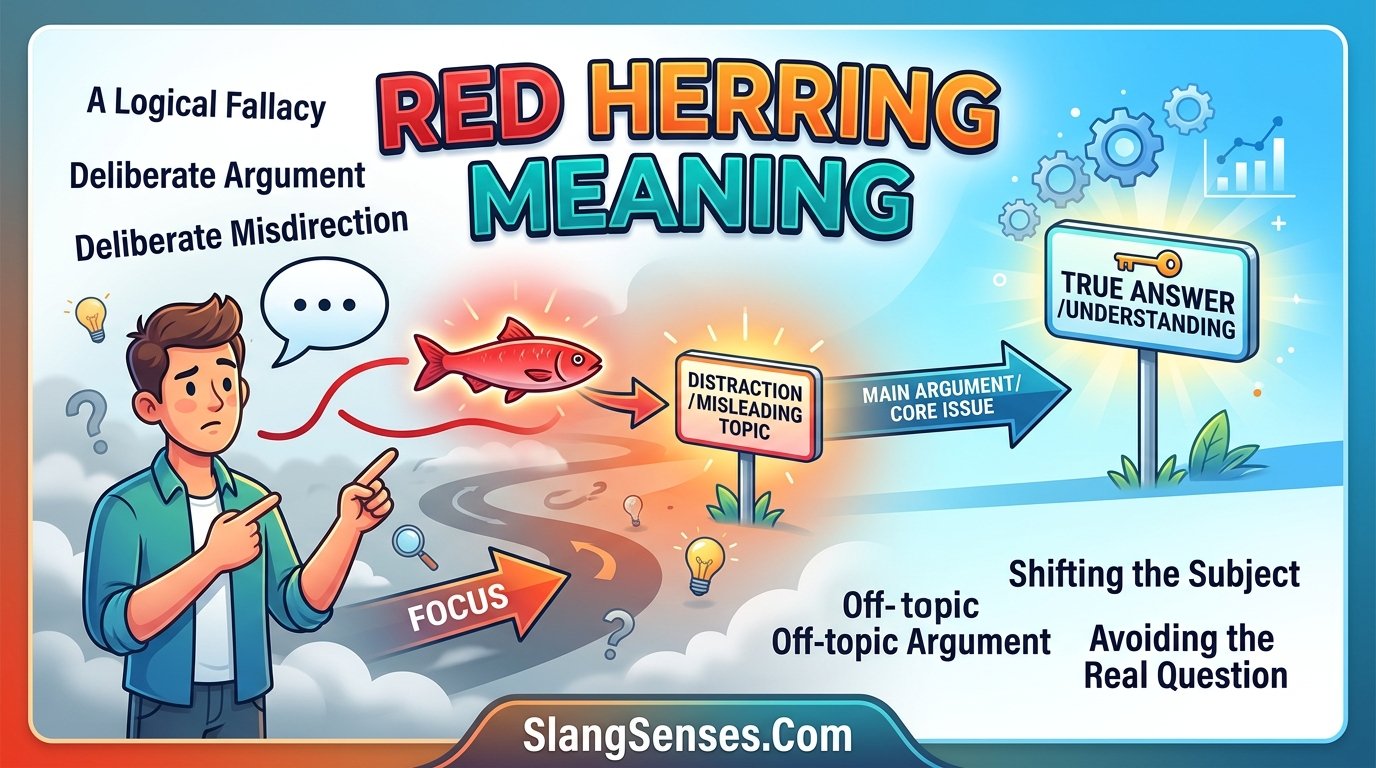
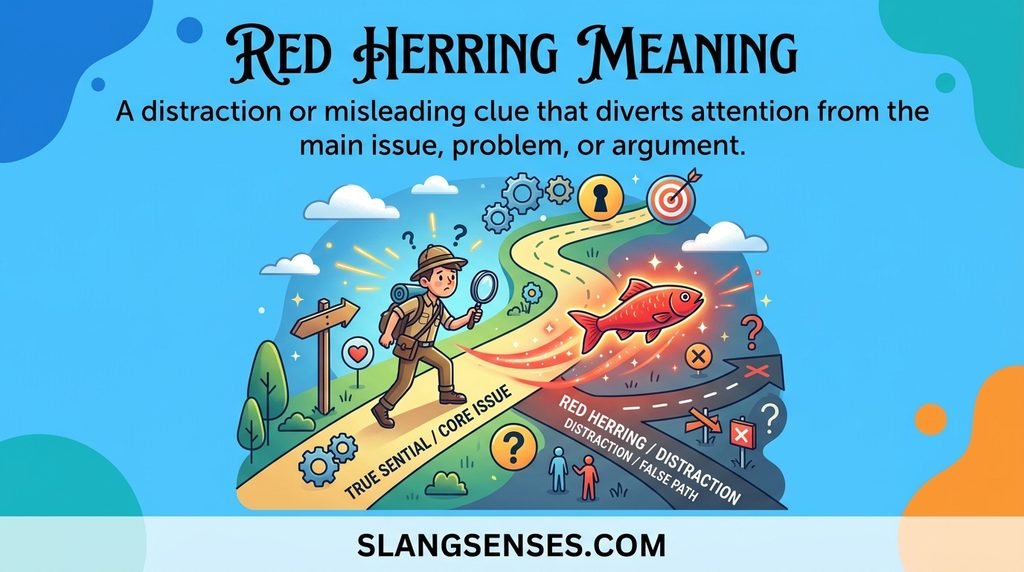
Red Herring Meaning can be confusing, especially when you see the phrase on TikTok, in texting, or during an online conversation. In simple terms, a red herring is something that distracts you from the real issue or leads you toward the wrong idea. You might see it used in jokes, arguments, stories, mystery content, or casual chats.
The phrase can have a slightly different feel depending on the context. Sometimes it describes a deliberate distraction, while other times it simply refers to information that takes attention away from the main point. Understanding the red herring meaning can help you quickly recognize what someone is trying to say and avoid getting caught up in a misleading detail.
What Does “Herring” Mean in Slang?
In slang, herring means a distraction, a misleading excuse, or a comment that pulls attention away from what actually matters. It’s a shortened, casual version of “red herring,” and people use it when they think someone’s dodging the real point — on purpose or not.
That’s it. That’s the core of it. Everything else in this article is just context.
Herring as a Literal Word vs. Herring as Slang
Here’s the thing — herring is, first and foremost, a fish. A small, silvery one that’s been smoked, pickled, and eaten across Europe for centuries. Nothing slangy about that.
But somewhere along the way, English borrowed the fish for a completely different job: describing distraction. The literal meaning and the slang meaning barely overlap anymore. Nobody texting “that’s a herring” is thinking about seafood. They’re thinking about someone changing the subject.
It’s a bit like how “shade” stopped being about sunlight the second Gen Z got hold of it.
The Smoked Fish and Hunting Dog Theory
The most repeated origin story goes like this: smoked herrings turn a deep reddish-brown and give off a strong, pungent smell. Supposedly, this smell was strong enough that people used to drag the fish across a trail to throw hunting dogs off a scent — training them to stay focused despite the distraction.
Whether that actually happened the way legend says is debated by etymologists (some say it’s closer to a metaphor than a documented practice). Either way, the image stuck: something strong-smelling and misleading, dragged across the “real” trail.
How “Red Herring” Entered Everyday Language
From that image, “red herring” jumped into writing — first political commentary, then mystery novels. Detective fiction basically ran on red herrings for a century: fake clues, suspicious characters who turn out innocent, plot twists designed to mislead the reader. If you’ve ever read an Agatha Christie novel and been completely wrong about the killer, you’ve been herring’d.
By the time it hit everyday conversation, “red herring” had settled into a clear meaning: a false clue or a misleading point that distracts from the real issue.
From “Red Herring” to Just “Herring”
This is the newer part. Somewhere around 2022–2024, people started dropping the “red” — probably because it’s faster to type and sounds less like something out of an English lit class. “That’s a herring” hits differently than “that’s a red herring.” It’s punchier. More meme-friendly. More texting-friendly.
By 2025 and into 2026, the shortened version had basically taken over in casual digital spaces, while “red herring” stayed the go-to in writing, debate, and anything more formal.
“Herring” vs. “Red Herring”: What’s the Difference?
They mean the same thing at the core — distraction, misdirection, an irrelevant point dressed up to look relevant. The difference is tone, not definition.
Formal Use
You’ll see “red herring” in essays, news articles, courtroom arguments, book reviews, and anywhere someone wants to sound precise. It signals that the speaker knows the term’s literary and rhetorical roots.
Casual/Slang Use
“Herring” alone shows up in texts, comments, and casual speech. It’s shorter, punchier, and a little more playful or dismissive. Where “red herring” sounds analytical, “herring” sounds like you’re calling someone out mid-conversation.
Comparison Table
| Red Herring | Herring (Slang) | |
|---|---|---|
| Setting | Essays, debates, journalism, courtrooms | Texts, DMs, comments, group chats |
| Tone | Formal, analytical | Casual, playful, sometimes sarcastic |
| Origin era | Centuries old (literary/rhetorical) | Popularized roughly 2022–2026 |
| Example | “That argument is a red herring.” | “Bro that’s such a herring lol” |
| Feels like | A logical observation | A callout or a joke |
How “Herring” Is Used in Texting
Texting is really where the slang version lives. It’s quick, it fits in a bubble, and it doesn’t need explaining if the other person’s chronically online.
10 Real Texting Examples
- “Wait that’s not even the question I asked. Herring.”
- “He said he ‘forgot’ but we all know that’s a herring.”
- “Why are you bringing up 2019? Total herring.”
- “That whole story sounds like a herring ngl.”
- “You’re deflecting so hard rn. Classic herring.”
- “Not you throwing a herring into this convo 😭”
- “That excuse has herring written all over it.”
- “Stop with the herrings and just answer me.”
- “Nice try, but that’s a herring and you know it.”
- “The whole apology was one big herring.”
What It Signals in a Conversation
When someone types “herring,” they’re usually flagging one of three things: a distraction, a weak excuse, or genuine suspicion that the other person is avoiding the real topic. It’s rarely neutral — there’s almost always a little bit of “I see what you’re doing” energy behind it. But it’s softer than calling someone a liar outright. That’s part of why it caught on; it lets people call something out without starting a full-blown argument.
You May Like To Read: DTF Slang Meaning 2026: What Does DTF Mean?
“Herring” Meaning on TikTok
How Creators Use It in Captions and Comments
TikTok is where a lot of slang gets its second life, and herring is no different. Creators use it mostly in two contexts: storytelling videos (where a “twist” turns out to be fake or misleading) and reaction content (calling out something someone said in a viral clip).
You’ll see it in captions layered over text-on-screen, and in comment sections where people are dissecting a video frame by frame.
TikTok-Style Examples
- Caption on a “storytime” video: “Plot twist… that whole thing was a herring 🐟😭”
- Comment under a drama recap: “the way she brought up his ex out of nowhere — pure herring behavior”
- Duet caption: “he really tried to herring his way out of that interview answer”
- Comment on a debate clip: “not the herring at 0:42, we SAW that”
Why It’s Trending in 2026
A few things are stacking up here. First, short-form video thrives on quick, punchy language — “herring” is one syllable shorter than “distraction” and way more visual (people can literally show a fish emoji). Second, TikTok culture rewards spotting manipulation or dodging in real time, whether it’s in a reality show clip or a political soundbite. “Herring” gives commenters a fast, slightly funny way to call that out without writing a paragraph.
“Herring” Meaning on Reddit and in Comment Sections
Debate and Argument Usage
Reddit’s a different environment — longer threads, more argument-heavy, more people trying to “win” a discussion. Here, herring shows up closer to its original rhetorical meaning: pointing out that someone introduced an irrelevant point to dodge the actual argument.
It’s basically the internet’s way of saying “that’s whataboutism” but shorter and a little less academic-sounding.
Reddit-Style Examples
- “Bringing up unrelated stats here is a herring, the original claim still hasn’t been addressed.”
- “Classic herring move — deflect to a different topic the second you’re losing.”
- “Not falling for the herring, let’s stay on topic.”
- “This whole reply is one long herring dressed up as a rebuttal.”
In long comment threads, you’ll sometimes see it used almost like a debate foul — someone calls “herring,” and the conversation resets back to the original point.
Urban Dictionary’s Take on “Herring”
How User-Submitted Definitions Differ From Standard Slang Use
Urban Dictionary entries for “herring” are, unsurprisingly, all over the place — that’s kind of the platform’s whole thing. Some entries lean into the distraction/misdirection meaning most people actually use. Others go in wildly different, more niche directions that don’t really match how the word shows up in day-to-day texting or TikTok comments.
That’s worth knowing if you go looking it up yourself: not every definition you find reflects common usage. The “distraction or misleading excuse” meaning is the one that’s actually spread into mainstream slang. The odder, more specific entries tend to stay confined to small pockets of the internet rather than becoming widely used.
Notable Variations People Search For
A few related searches worth knowing about, even if they’re low-key niche:
- “Blue herring” — not standard slang. It occasionally pops up as a playful twist on “red herring” in creative writing or memes, but it doesn’t have an agreed-upon meaning the way “herring” or “red herring” does.
- “Herring energy” — describes someone or something that consistently distracts or misleads, almost like a personality trait (“he has such herring energy”).
- “Herring-coded” — meme-speak for something that feels like it’s designed to mislead, even if it’s not stated outright.
Tone Variations: How to Use “Herring” Appropriately
Context matters a lot here. What sounds funny in a group chat can sound rude in a work email, and what sounds professional in a meeting can sound stiff between friends.
| Tone | Example Phrase | Best Used |
|---|---|---|
| Casual/Friend Group | “That’s such a herring, be fr” | Texts, DMs, group chats |
| Sarcastic/Playful | “Wow, nice herring, didn’t see that coming (I did)” | TikTok comments, memes |
| Professional | “That point may not be directly relevant to the core issue” | Work emails, meetings |
Casual/Friend Group Tone
Among friends, herring is basically a lighthearted callout. It says “I noticed what you did there” without escalating things.
Sarcastic/Playful Tone
On social media, herring often gets paired with humor — exaggerated reactions, emojis, or mock disbelief. It’s less about calling someone out seriously and more about being funny.
Professional/Workplace Alternatives
In professional settings, skip the slang entirely. Phrases like “that seems like a diversion from the main point” or “let’s refocus on the original issue” get the same message across without sounding out of place in a meeting.
Common Mistakes to Avoid With “Herring” Slang
Using It as a Synonym for “Lie”
A herring isn’t necessarily a lie — it’s a distraction. Someone can bring up an irrelevant point without lying about anything. Mixing these up can make you sound like you’re accusing someone of dishonesty when you’re really just saying “this isn’t relevant.”
Overusing It in Every Disagreement
Not every disagreement is a herring. If someone’s genuinely making a related point you just don’t like, calling it a herring can come across as dismissive rather than accurate. Save it for actual distractions.
Using It in Formal or Professional Writing
“Herring” alone reads as slang, full stop. In anything formal — essays, reports, professional emails — stick with “red herring” or a plain-English alternative instead.
Related Slang Worth Knowing
Red Flag
A warning sign that something’s off — usually about a person’s behavior rather than a specific argument or excuse.
Smokescreen
Something used to hide the real issue or intention, often more deliberate-sounding than a herring.
False Trail / Decoy
Both describe something designed to mislead — closer to the original “red herring” meaning, minus the modern slang shorthand.
Frequently Asked Questions
What is the meaning of herring?
What is another name for a herring?
Why do we say “red herring”?
What does herring symbolize?
Conclusion: The Evolving Meaning of “Herring” in 2026
At the end of the day, herring slang is just a fast, slightly playful way to call out distraction — whether that’s a bad excuse in a text, a deflection in a Reddit argument, or a misleading twist in a TikTok video. It’s not complicated once you see the pattern: someone’s avoiding the real point, and “herring” is the word that catches them doing it.
Language keeps shrinking things down for speed — “red herring” becoming “herring” is just the latest example. Understanding it means you won’t be the one left confused in the group chat wondering why everyone’s talking about fish.

Rathna Kannan is a language enthusiast and writer at Slang Senses, sharing simple explanations of modern slang, internet expressions, and trending phrases. Rathna enjoys exploring how language evolves through social media and everyday conversations.