
Seaver Meaning In Text can be confusing because “Seaver” doesn’t have one fixed definition in everyday texting. If you’ve seen it in a message, comment, TikTok caption, or social media post, you might wonder whether it’s slang, an abbreviation, or something else entirely.
Seaver is a name or surname rather than a common texting shortcut. However, its meaning can change depending on the conversation and where you saw it. Some people may also confuse it with words like “severe” or “sever,” while a few online sources give it less common slang meanings.
So, what does Seaver actually mean in text? Let’s break down its possible meanings, origins, online uses, and the simple clues that help you understand it correctly.
Seaver Meaning Origin and Cultural Footprints
The Seaver name meaning is mainly connected with surname and personal-name history. Current competitor pages describe Seaver as an English surname and discuss historical forms and possible origins, including connections to the medieval personal name Sefare and Old English elements associated with sea and journey. Some sources also mention a possible German-American surname connection.
These historical explanations should be treated carefully. A surname can have more than one proposed origin, especially when spelling changed over centuries.
Seaver also has a strong American cultural footprint because of Tom Seaver, the Hall of Fame baseball pitcher. Major League Baseball records that the New York Mets retired his No. 41 in 1988.
There’s another pop-culture connection.
The surname was used by the fictional Seaver family in the 1985 sitcom Growing Pains. Jason, Maggie, Mike, Carol, Ben, and later Chrissy Seaver made the name familiar to many American television viewers.
So when someone sees “Seaver,” they might think of a real family name, a baseball legend, a TV character, or an online username.
Context does the heavy lifting.
Others Seaver Meaning
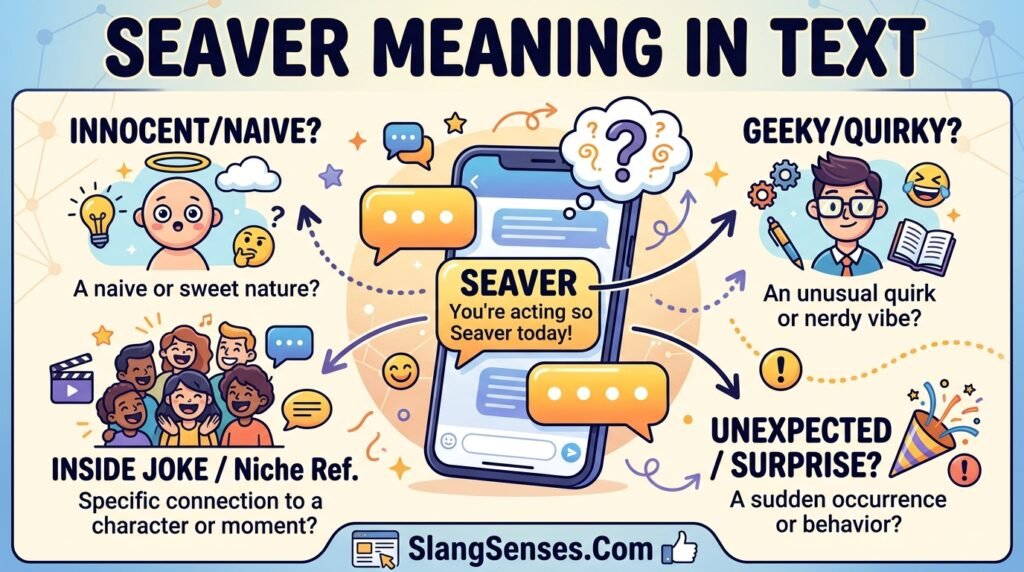
There isn’t one universal alternative meaning for Seaver in modern texting. Instead, the word can identify different things depending on where you find it.
| Use | What Seaver may refer to |
|---|---|
| Surname | A person’s family name |
| First name | A personal name |
| Username | An online account or handle |
| Display name | A chosen social-media identity |
| Organization | A school, company, or group |
| Building | A named building or facility |
| Character | A fictional person |
| Public figure | Someone such as Tom Seaver |
Current SERP competitors repeatedly make this same distinction: Seaver can have different references without actually becoming different slang words.
For example:
“I emailed Seaver yesterday.”
That almost certainly means a person.
But:
“Follow Seaver on Instagram.”
Now it could be a username or creator account.
The spelling stays the same. The reference changes.
Why Does Seaver Have So Many Different Definitions?
This is where Seaver Meaning In Text becomes tricky.
People often assume that every unusual word appearing online must be slang. That’s simply not true.
The internet mixes together:
- Names
- Surnames
- Usernames
- Nicknames
- Brands
- Places
- Acronyms
- Slang
- Fictional characters
- Community-specific expressions
A name can therefore look like slang even when it isn’t.
Capitalization is another clue. Seaver begins with a capital letter, which often suggests a proper noun in standard English.
Grammar helps, too.
If someone writes:
“Seaver called me last night.”
Seaver is probably a person.
If they write:
“I followed Seaver yesterday.”
It could be a social media account.
And if someone says:
“Meet me at Seaver Hall.”
Now you’re probably looking at a place or building name.
The mistake is assuming that one dictionary-style definition must fit all three.
Does Seaver Mean the Same Thing Outside the US?
Not necessarily.
A surname can travel across countries without developing a new slang meaning. Someone in the United States may recognize Seaver because of Tom Seaver or Growing Pains, while someone elsewhere may simply see it as an unfamiliar surname.
The online use can vary even more.
A person in the UK might use Seaver as a surname. Someone in Canada could have it as a family name. A social-media user anywhere could use it as a username.
So there isn’t good evidence that Seaver has one special international texting meaning.
If you see the word outside the United States, look at the sentence rather than assuming the American cultural references apply.
That little habit prevents a lot of confusion.
Who Uses It Most?
There isn’t reliable evidence showing that one specific age group uses Seaver as slang more than everyone else.
Instead, you’ll most commonly encounter it among people who:
- Have Seaver as a surname
- Know someone named Seaver
- Follow a person with Seaver as a username
- Discuss sports history
- Watch or reference Growing Pains
- Research family history
- Use Seaver as an online identity
- Attend or visit a place named Seaver
That makes it different from popular Gen Z expressions that were specifically created as internet slang.
In other words, people don’t generally need to “learn” Seaver as a slang term. They usually learn who or what Seaver refers to.
Real Conversation Examples Using Seaver
Let’s make the Seaver meaning in text easier to understand with ordinary examples.
Example 1: Personal Conversation
Alex: “Did you talk to Seaver?”
Jordan: “Yeah. They said they’ll call tonight.”
Here, Seaver is clearly being used as someone’s name.
Example 2: Workplace
Manager: “Seaver reviewed the report.”
Employee: “I’ll make those changes.”
Again, it’s a person’s surname.
Example 3: Instagram
Alex: “Who is Seaver?”
Jordan: “That’s the photographer I mentioned.”
Here, Seaver could be a display name or username.
Example 4: Gaming
Player 1: “Seaver joined the lobby.”
Player 2: “Okay, let’s start.”
Here, Seaver is probably a gamer tag.
Example 5: Location
Alex: “Where’s the event?”
Jordan: “It’s in Seaver Hall.”
Now Seaver is part of a building or location name.
Notice something?
None of these examples requires a secret slang definition.
Usage of Seaver in Different Contexts
The meaning becomes much easier when you identify the context first.
| Context | Likely meaning |
|---|---|
| Text message | Person or surname |
| Person, username, or named entity | |
| Username or display name | |
| TikTok | Creator/account name |
| Discord | Username or gamer identity |
| Gaming | Player name or nickname |
| Workplace | Colleague, client, or surname |
| Family records | Surname |
| Television | Seaver family from Growing Pains |
| Baseball | Often a reference to Tom Seaver |
This contextual approach is stronger than trying to invent a universal slang definition.
Current competitors also emphasize this point, especially when explaining Seaver in texting, gaming, Instagram, TikTok, and Discord.
How Gen Z Uses Seaver Today
There is an important distinction here.
Gen Z can use Seaver online, but that doesn’t automatically make Seaver Gen Z slang.
A young person might use it as:
- A username
- A display name
- A nickname
- A reference to a creator
- A gaming identity
- A person’s surname
For example:
“Seaver just posted again.”
That could sound like online slang when taken out of context. But it probably isn’t. It is more likely someone’s account or name.
Current search results don’t establish a broadly accepted Gen Z definition that gives Seaver a special slang meaning.
So don’t confuse Gen Z usage with Gen Z slang.
They’re not the same thing.
Does Seaver Mean “To Achieve Easily”?
This is one of the more unusual claims you’ll find when searching online.
Some informal pages and user-generated slang sources may attach creative definitions to uncommon words. One such claim describes Seaver as meaning something similar to “to achieve easily.” However, this is not supported as a standard English definition or a broadly established texting meaning in the current SERP.
That distinction matters.
If your friend says:
“You seavered that test.”
You might understand the intended meaning from the conversation if that particular friend group uses the word that way.
But that doesn’t mean everyone reading the message will understand it.
For SEO and accuracy, it is better to describe “achieve easily” as an informal, niche, or user-generated claim, not as the official Seaver definition.
Seaver Meaning Across Social Media

On social media, Seaver Meaning In Text can change depending on what the account is doing.
TikTok
On TikTok, Seaver may be a creator name, display name, username, or reference to someone in a video or comment.
Instagram users can have a display name that differs from their actual username. Seaver could therefore be either a real surname or a chosen account identity.
In WhatsApp messages, Seaver is usually a person’s name or something both people already understand.
Discord
Discord makes usernames and nicknames especially common. A person named Seaver could simply be another server member.
Gaming
In gaming, Seaver could function as a gamer tag.
The key point remains the same: the platform doesn’t automatically create a new slang meaning.
Common Confusions
Several words and concepts can make Seaver harder to understand.
| Confusion | What to remember |
|---|---|
| Seaver vs. severe | “Severe” is a normal adjective meaning very serious or intense |
| Seaver vs. sever | “Sever” means to cut or separate |
| Seaver vs. username | Seaver may itself be a username |
| Seaver vs. slang | It isn’t broadly recognized as standard slang |
| Seaver vs. acronym | There is no established texting full form |
| Seaver vs. nickname | It may be a nickname, but you need context |
| Seaver vs. surname | Surname use is one of its strongest established uses |
The similar spelling can create a false connection.
Seaver and severe may look alike, but they don’t mean the same thing.
Related Slang Terms
If you’re searching for Seaver because it appeared in a casual message, you may also encounter genuine texting and internet slang such as:
- LOL
- BRB
- IDK
- TBH
- IMO
- HBU
- FR
- GNG
These have recognizable online uses.
Seaver is different. Current competitors consistently describe it as a proper name rather than a standard texting abbreviation.
How to Reply When Someone Says Seaver
Your response depends entirely on the context.
If you know who they mean, simply respond normally.
Them: “Seaver is coming tonight.”
You: “Okay, I’ll see you both there.”
If you don’t know who Seaver is, ask:
“Which Seaver do you mean?”
Or:
“Who is Seaver?”
That’s better than guessing.
If the word appears as a username, you can also ask:
“Is that their username?”
Simple. Clear. No awkward misunderstanding.
The Day They Put His Number on the Building
One of the most interesting cultural connections to Seaver comes from Tom Seaver.
The New York Mets retired Seaver’s No. 41 in 1988.
Then, in 2019, the Mets and New York City renamed the street in front of Citi Field Seaver Way. The stadium’s address became 41 Seaver Way, connecting his famous uniform number with his surname.
That’s a pretty memorable footprint for a surname.
The story also helps explain why Americans may recognize “Seaver” even if they don’t personally know anyone with that last name.
And there’s another layer: Growing Pains used Seaver as the surname of its central fictional family, giving the name a second major pop-culture association.
So when people say Seaver has a cultural footprint, they aren’t necessarily talking about slang.
They’re talking about names people remember.
When Did Seaver Go Mainstream?
There isn’t one exact date when Seaver became mainstream as a word.
As a surname, it existed long before the internet. Its modern American visibility was strengthened by recognizable cultural references.
Tom Seaver became a major baseball figure during his MLB career, and the Mets officially retired his No. 41 in 1988.
Then Growing Pains, which premiered in 1985, introduced millions of television viewers to the fictional Seaver family.
More recently, social media has made names such as Seaver searchable in completely different ways.
A surname can now become:
surname → profile name → username → searchable identity
That’s part of why modern searches for Seaver can look like slang searches even when the word itself hasn’t become slang.
Frequently Asked Questions
What does “Seaver” mean?
What does the name Seaver mean
What does “sea” mean in slang?
How do you say “Seaver”?
Conclusion
Seaver Meaning In Text depends heavily on context. Unlike common texting abbreviations such as “LOL” or “BTW,” Seaver isn’t a widely recognized slang term with one universal meaning. Most often, it appears as a name, surname, username, or reference to a specific person or character.
If you see “Seaver” in a message, don’t assume it has a hidden slang meaning right away. Look at the words around it and consider who or what the conversation is discussing. It may simply be someone’s name—or, in less common cases, an informal online usage.
That’s what makes Seaver interesting. A single word can look confusing at first, but the surrounding context usually provides the answer.

Rathna Kannan is a language enthusiast and writer at Slang Senses, sharing simple explanations of modern slang, internet expressions, and trending phrases. Rathna enjoys exploring how language evolves through social media and everyday conversations.
1 thought on “Seaver Meaning In Text: The Amazing Meaning Explained In 2026”