
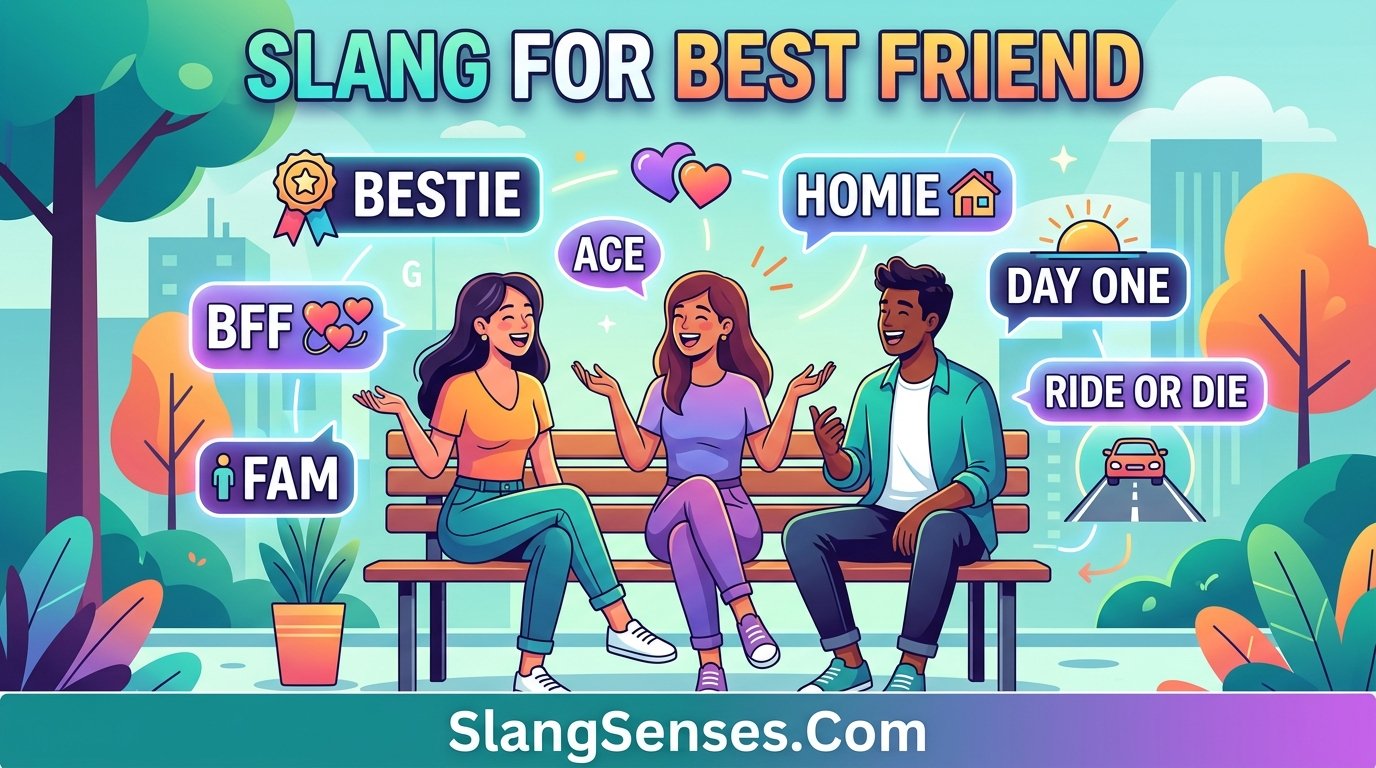
Slang for Best Friend can make your everyday conversations feel more fun, friendly, and personal. Instead of always saying “best friend,” people often use short and catchy words like bestie, BFF, bro, buddy, homie, or day one. These slang terms can show closeness, trust, and the special bond you share with someone.
You may see these words in text messages, Instagram captions, TikTok comments, Snapchat posts, or casual chats with friends. But not every slang word has the same meaning. Some sound funny and playful, while others feel cool, warm, or more like street slang.
Quick Table
| Slang Term | Vibe | Best Used For |
|---|---|---|
| Bestie | Warm, casual, a little overused | Anyone from your ride-or-die to your new work friend |
| BFF | Nostalgic, safe, universally understood | Texts, cards, captions, all ages |
| Ride or Die | Loyalty, no matter the cost | The friend who shows up at 2am, no questions asked |
| Day One | Time-tested, earned closeness | Someone who’s known you since before you “made it” |
| Homie | Casual, familiar, a little regional | Close friends you’d call without a second thought |
| Twin | Uncanny similarity | The friend people mix you up with |
| My Person | Intimate, non-romantic soulmate energy | Your actual number one, no contest |
| Comfort Person | Emotional safety, low-key | Someone you can sit in silence with |
| Main Character | Hype, spotlight energy | The friend who lights up every room |
| Partner in Crime | Playful mischief | Your go-to for spontaneous, slightly chaotic plans |
Why Everyone Has a Different Word for Their Best Friend
I once called my best friend “twin” in a group chat, and a coworker who’d never met her asked if we were actually related. We’re not. We don’t even look alike. But we’ve had the same haircut by accident three separate times, so at this point the universe’s just messing with us.
That’s the thing about this slang — it’s not random. Every word carries a slightly different flavor of closeness. “Bestie” feels light and current. “Day one” feels earned, almost sacred. “Ride or die” has weight to it, history even, borrowed from a phrase that used to mean someone who’d literally put themselves in danger for you. Nobody agreed on this stuff in a meeting. It just… evolved, mostly on TikTok, mostly by accident, the same way slang always has.
And it keeps evolving. Late 2025 and early 2026 brought a fresh wave of it — “best friend dictionary” videos (where duos test each other on made-up words only they understand) racked up millions of views, and linguists started tracking terms like “medium friend” for someone closer than an acquaintance but not quite bestie-tier. Even “friendflation” popped up, describing how expensive it’s gotten just to hang out with your friends these days. Language for friendship isn’t static. It’s basically a live feed.
2026 TikTok Trend Spotlight
If you’ve scrolled TikTok recently, you’ve probably seen the “friend dictionary” trend — two besties quizzing each other on inside-joke words like “Chilean sea bass” (apparently that means “cold” to one pair of sisters). Linguists say this trend isn’t just cute content, it’s proof that any two people who spend enough time together start building their own private shorthand. Basically, slang for best friend isn’t only about the words everyone knows — it’s also about the ones only your circle does.
Why This Even Matters
You might be thinking, it’s just a word, who cares. Fair point. But word choice does a lot of quiet work in a friendship.
Call your actual ride-or-die something too casual, like just “friend,” and it can feel like you’re undercutting the relationship. Call a work acquaintance “bestie” too soon, and it can come off performative, or just confusing. I’ve watched someone get genuinely offended when a coworker called them “bestie” after knowing them for two weeks — not because it’s a bad word, just because it landed wrong for the relationship it was describing.
Tone matters too. “My guy” in a group chat is playful. “My guy” at a funeral is a different energy entirely. Context and timing shape a word just as much as the word itself.
The Classics That Never Really Die
Best friend / BFF. The original. This one’s been around since notebook margins had hearts drawn around it, and it still works everywhere — texts, cards, semi-formal settings, introducing someone at a party. Nobody’s confused when you say “this is my best friend.” It’s not flashy, but it’s honest.
Bestie. This one exploded thanks to TikTok and Twitter culture, and now it’s everywhere — sometimes for actual best friends, sometimes for someone you met at brunch once. That’s the tradeoff. It’s warm and easy to say, but it’s also gotten a little diluted. If you want the word to actually mean something, don’t hand it out to everyone in your comments section.
Ride or die. This phrase has real history — it originally meant someone who’d literally ride into danger with you and not bail. These days it’s looser, used for anyone who shows up no matter what, even if “danger” just means helping you move a couch up three flights of stairs on a Sunday.
Mate. Enormously common in British, Australian, and New Zealand English, less so in American English, but universally understood. “Best mate” carries the same emotional weight as “best friend” — just with a different accent attached to it.
Homie. Rooted in hip-hop and West Coast culture, this one’s casual and warm, used for the friends you’d call up without hesitation. It can feel out of place in more formal settings, so read the room before using it with, say, your grandmother.
Regional and Generational Stuff I Learned the Hard Way
Day one. This means someone who’s been there since the actual beginning — before things were good, before anyone noticed you, before any of it. It’s not a word for everybody. I use it for maybe two people, tops, because tossing it around cheapens what it’s supposed to mean.
My person. This term got a huge boost from a certain hospital drama where a character says it to describe her closest friend, and it stuck because it fits. It’s intimate without being romantic — it just says “you’re the one I call first.”
Comfort person. A newer, Gen Z-favored term for the friend you go to when you need to feel calm and safe, not entertained or hyped up. It leans emotional, and it’s used more in vulnerable, quieter conversations than in captions.
Wifey / hubby (platonic). Confusing the first time you hear it, since it sounds romantic but usually isn’t. Some close friends — often women — use it ironically or affectionately to describe a best friend who feels like a life partner, minus the romance. It works fine inside the friendship. Outside of it, without context, it can raise eyebrows.
International variations. English speakers have borrowed plenty of best-friend slang from other languages. “Hermano/hermana” (Spanish for brother/sister) shows up in bilingual communities. “Habibi/habibti” (Arabic for “my beloved”) carries deep affection and has crossed into wider use. “Yaar” (Hindi/Urdu for friend) is casual and common among South Asian English speakers. “Bruv” and “blud,” both British urban slang, mean roughly “brother” and “someone close enough to be family.”
Mistakes I’ve Made With These Words (So You Don’t Have To)
- Using casual slang with someone who doesn’t share that vibe. Not everyone reads “bruh” or “my guy” as friendly — some people read it as disrespectful, especially in professional settings.
- Overusing “bestie” until it stopped meaning anything. If everyone’s your bestie, nobody feels singled out. I had to dial it back on purpose.
- Assuming slang translates across generations. My own mom heard “ride or die” and genuinely thought I was talking about motorcycle gangs. Explain your slang before you use it around people from a different generation.
- Borrowing regional slang outside its region. I tried “homegirl” with a friend from a totally different part of the country, and it landed weird — like I was performing a personality instead of just talking.
- Forgetting that tone doesn’t travel over text. Ironic or ironic-adjacent slang like “wifey” can look genuinely confusing without an emoji or some context clue to signal you’re joking.
How to Pick the Right One (Step by Step)
Step 1: Think about who you’re actually talking to. Close friend, work buddy, or someone you just met? Match the intensity of the word to the real closeness of the relationship.
Step 2: Consider the platform. An Instagram caption can handle “bestie for the restie.” A LinkedIn post about your business partner probably can’t handle “my ride or die.”
Step 3: Read the room, generationally. If you’re talking with someone significantly older or younger, some slang just won’t land right. When in doubt, “best friend” is always a safe default.
Step 4: Save the heavy-hitters for people who’ve actually earned them. Words like “day one” or “my person” hit harder when they’re not handed out to everyone.
Step 5: Watch how people respond. If someone looks confused after you use a term, just ask. A quick “did that sound weird?” has saved me from more awkward moments than I’d like to admit.
A Few Honorable Mentions
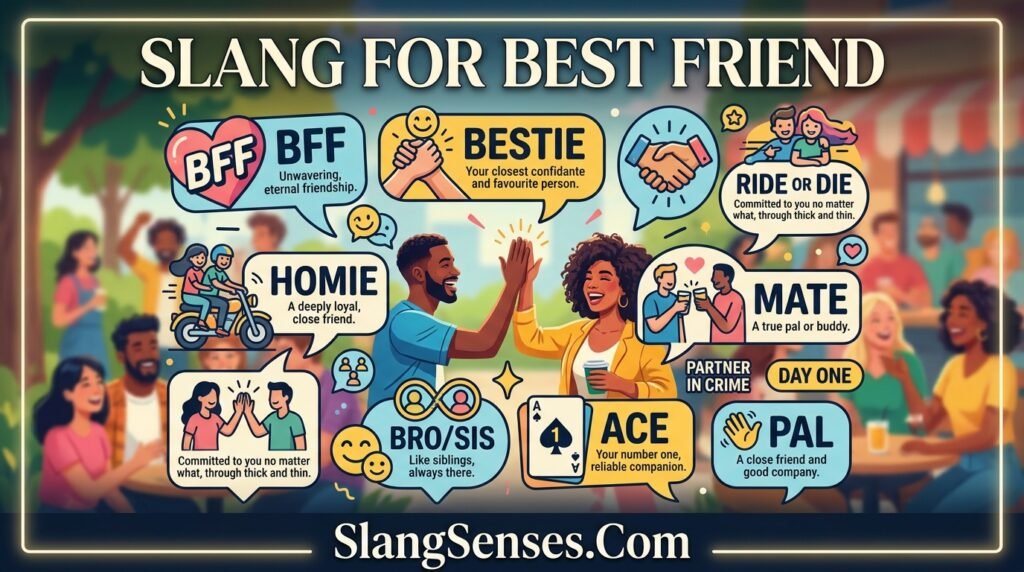
- Twin — for a friend who thinks (or dresses) exactly like you
- Soulmate (platonic) — a best friend who just “gets” you on a level that’s hard to explain
- Main character — the friend who somehow becomes the center of attention wherever you go
- Partner in crime — classic phrase for the person who’s down for anything with you
- Squad — your whole tight-knit group, not just one person
- Ace / my ace — less common now, but still shows up, especially with older generations
Frequently Asked Questions
How does Gen Z say best friend?
What can I say instead of bestie?
What is Gen Z’s favorite slang?
What is gangster slang for “friend”?
Conclusion About Slang for Best Friend
Slang for best friend keeps shifting, and that’s kind of the point — it grows alongside how we actually experience friendship. From old-school “BFF” to newer terms like “comfort person” and “main character,” each word captures a slightly different shade of closeness, whether that’s shared history, loyalty, or just an inside joke nobody else would understand.
The word you pick says something about the relationship itself. Use it with intention, match it to the person and the moment, and don’t be afraid to save the heavier terms for the friendships that have actually earned them. At the end of the day, the slang is just a container — what matters is the friendship you’re pouring into it.

Rathna Kannan is a language enthusiast and writer at Slang Senses, sharing simple explanations of modern slang, internet expressions, and trending phrases. Rathna enjoys exploring how language evolves through social media and everyday conversations.
1 thought on “Slang for Best Friend Popular TikTok and Social Media Terms”