
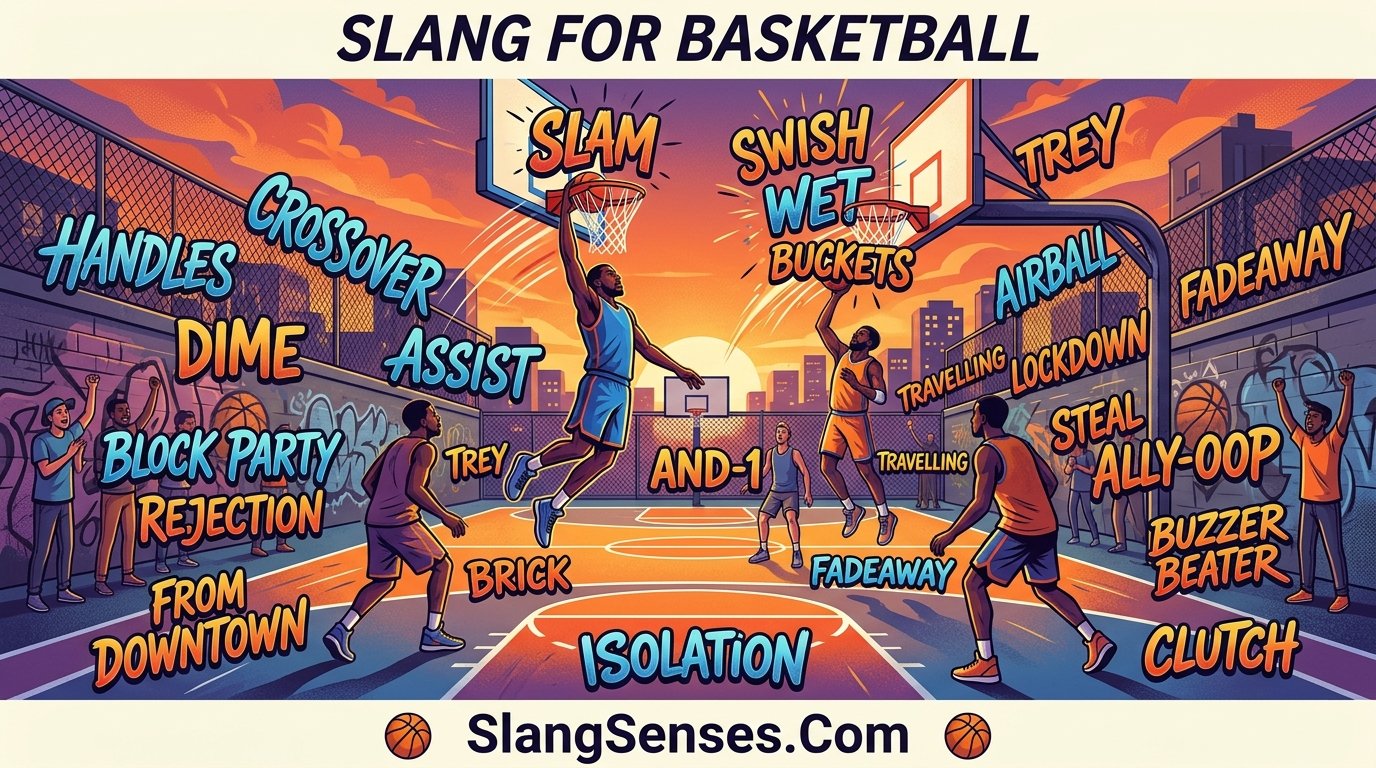
Slang for Basketball adds energy, personality, and a whole different flavor to the game. Whether you’re watching an intense NBA matchup, playing on the court with friends, or scrolling through basketball content on social media, you’ll hear unique terms that describe players, plays, skills, and memorable moments. Words like “dime,” “brick,” “ankle breaker,” “poster,” and “buckets” have become part of everyday basketball language.
Some terms are decades old, while others have grown popular through modern NBA culture, TikTok, and online communities. Understanding slang for basketball can make it easier to follow conversations between fans and players while helping you sound like you know the game. From classic court expressions to newer internet slang, these terms capture the competitive, creative, and exciting spirit of basketball.
Quick Table
| Slang Term | What It Means |
|---|---|
| Ballin’ / Hooping | Playing basketball |
| Rock / Leather | The basketball itself |
| Dime | A perfect, well-placed assist |
| And-One | Fouled while scoring, plus a free throw |
| Chucker / Gunner | Someone who shoots too much |
| Cherry Picking | Camping near your basket instead of playing defense |
| Handles | Dribbling skill |
| Ankle Breaker | A move so sharp it makes the defender stumble |
| Splash / Wet | A clean shot, barely touching the rim |
| Brick | A badly missed shot |
| Posterize | Dunking over someone so hard it’s highlight-reel material |
| Iso | Isolation — one-on-one offense |
| Run / Pickup | A casual, informal game |
| Next / Got Next | Calling your spot for the next game |
| Light Work | Said when a win comes easy |
| Green / Hitting the Green | Perfect shot timing (crossed over from NBA 2K) |
| Sweat | Someone playing way too intensely for a casual game |
| Cheese | An unfair or overpowered move/strategy |
The Pickup Game That Taught Me Basketball Slang
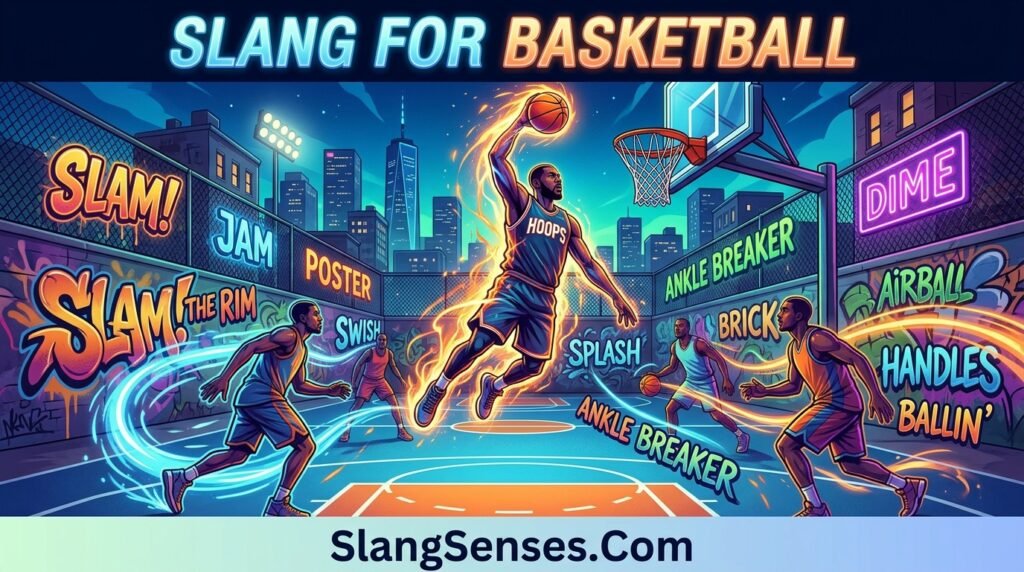
I remember standing on the sideline of a park run, waiting to get picked, when a guy shouted “next bucket wins, no cherry picking, and I’m not running with a chucker.” I nodded. Confidently. I understood none of it.
I got picked anyway. And because I had no idea what cherry picking meant, I hung out near our basket the entire game, waiting for easy buckets like I was doing something smart. By the third possession, my teammates were annoyed. Nobody explained why until after the game, when a guy named Marcus — bless him — broke it down for me on the walk to the water fountain.
That was years back now. Since then I’ve played rec league, pickup, and a couple of actual leagues in different cities, and slowly built up a working vocabulary the hard way. Through embarrassment, mostly. This guide is that vocabulary, minus the embarrassment part — hopefully.
Why Basketball Slang Even Matters
Fair question: why bother learning the lingo if you just want to play?
Here’s the honest answer. Basketball culture runs on shorthand. If you don’t know the terms, you’ll misread situations, get talked about without realizing it, or accidentally break an unwritten rule — like I did with cherry picking. It’s not just about sounding cool, though that’s part of it too.
Slang is also just how the culture connects. Half of basketball’s personality lives in its language — the trash talk, the hype calls, the inside jokes that go back generations of playground ball. Miss the slang, and you’re missing half the game’s flavor.
The Terms You’ll Actually Hear on the Court
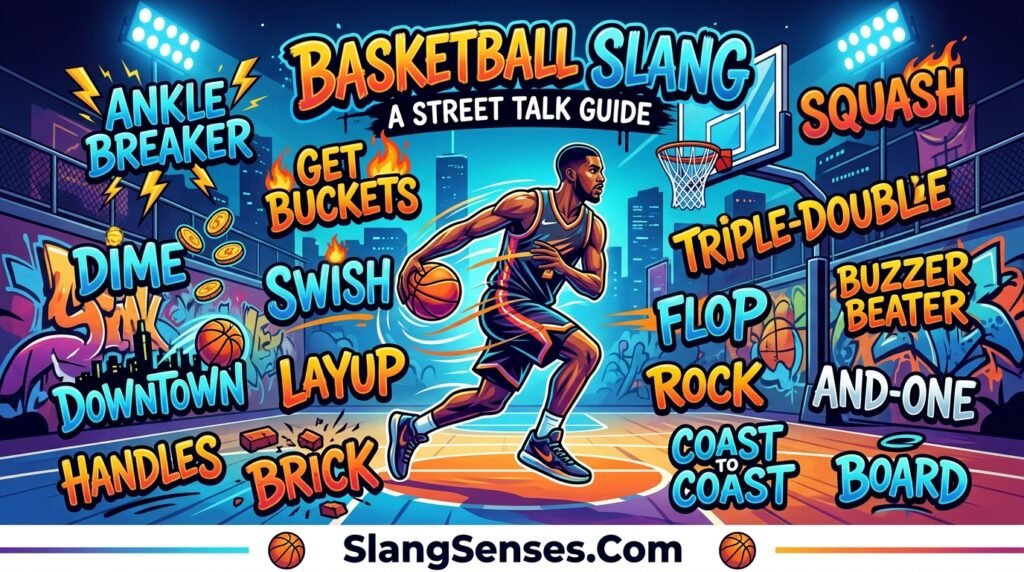
This isn’t a full glossary of official basketball terms — you can find that anywhere. This is the slang that actually gets used, sorted by what you’ll hear most.
“Ballin'” or “Hooping”
Simple. It just means playing basketball. “You hoopin’ tonight?” is basketball-speak for “are you playing tonight?” Nobody in a group chat says “I’m going to play basketball at 6.” You’ll sound like you’re reading off an instruction manual. Just say you’re hooping.
“Rock” or “Leather”
Another word for the basketball itself. “Pass the rock” means pass the ball, nothing more mysterious than that. First time someone told me to “protect the leather,” I genuinely thought they were talking about my shoes. They meant don’t turn the ball over.
“Dime”
A dime is a perfect assist — the kind of pass that sets a teammate up for an easy, uncontested score. “That was a dime” is high praise, and players will remember their best dimes for years. I’ve had maybe three worth bragging about in my adult life, and I still bring them up sometimes, unprompted.
“And-One”
When you get fouled but still make the basket anyway, you earn a bonus free throw — and everyone within earshot yells “AND ONE!” the second contact happens. Sometimes before the ball even goes in, which leads to some awkward silence if it clanks out.
“Chucker” or “Gunner”
Someone who shoots constantly, regardless of whether it’s a good look or whether a teammate is wide open. Every pickup game has one. If you’re not sure who the chucker on your team is, there’s a decent chance it’s you.
“Cherry Picking”
The term that got me, remember? It means hanging back near your own basket instead of playing defense, waiting for an easy fast-break score. It’s considered lazy and a little disrespectful — you’re skipping the hard part of the game while still wanting the glory of scoring.
“Handles”
Dribbling ability. “He’s got handles” means someone can dribble tight, change direction fast, and not cough the ball up easily. Bad handles gets you benched fast in anything competitive.
“Ankle Breaker”
A move so good it makes the defender stumble or fall trying to keep up — like their ankles literally gave out underneath them. Usually followed by someone on the sideline yelling “OHHHHH” way louder than necessary.
“Splash” or “Wet”
Used for a shot that goes in clean, barely touching the rim, mostly net. “That’s wet” or “splash” is basically shorthand for “that shot was pure.” Save it for the genuinely clean jumpers, not every made basket.
“Brick”
The opposite of splash. A badly missed shot that clangs awkwardly off the rim or backboard. If you miss everything entirely — no rim, no backboard — that’s its own category of embarrassment, usually just called an airball. And yes, people will chant it.
“Posterize”
When a player dunks over a defender so hard and so dramatically that the moment looks like it belongs on a poster. Rare in pickup games — usually reserved for someone having either a really good day or a really bad one.
“Iso” (Isolation)
Short for isolation. It’s when one player clears out space and takes on a defender one-on-one instead of running a team play. Plenty of guys love calling iso on themselves. It doesn’t always work out the way they picture it.
“Run” or “Pickup”
A casual, informal game, usually with teams that rotate depending on who’s around. “You coming to the Saturday run?” translates to “are you showing up for the regular pickup game?”
“Next” or “Got Next”
Calling your spot to play the winning team once the current game ends. This one has actual etiquette baked into it — more on that below, because it trips people up constantly.
“Light Work”
Said when a team or player wins easily. Sometimes it’s sincere, sometimes it’s sarcasm meant to get in someone’s head after a game that was closer than the score suggests.
You May Like To Read: Slang for Best Friend Popular TikTok and Social Media Terms
Step-by-Step: How to Actually Learn This Stuff Without Looking Lost
I wish someone had handed me this process instead of letting me figure it out the hard way.
Step 1: Watch before you play. Before jumping into your first run at a new park or gym, stand off to the side for one game. Listen to what people yell and when. Patterns show up fast.
Step 2: Ask one person, not the whole group. Find whoever seems chill — not the loudest trash talker — and quietly ask what a term means. People respect someone willing to learn far more than someone pretending they already know.
Step 3: Use YouTube and Reddit as backup. Streetball culture breakdowns and subreddits like r/nba are genuinely useful for slang explained in context. I spent one whole weekend watching old AND1 Mixtape Tour clips just to get streetball lingo down.
Step 4: Don’t force it into your vocabulary too fast. This was my mistake. I started calling every decent pass “a dime,” including plenty that weren’t. People noticed, and not in a good way. Let it come naturally once you actually understand when a term applies.
Step 5: Learn the etiquette, not just the definitions. Words like “next” aren’t just vocabulary — they come with unwritten rules attached. Call next but don’t have four players ready when your turn comes up? You lose your spot. Learn the culture behind the word, not just what it means on paper.
A Real Scenario: My Worst Slang Mistake
Second-worst moment of my hooping life, actually — cherry picking still takes first place. This one happened during a men’s league game in Austin. I missed two free throws in a row, and someone on the other team said “ball don’t lie.”
I had zero idea what that meant and assumed it was some kind of insult about my shooting form. I got a little defensive about it, which made the whole thing more awkward than it needed to be.
Turns out “ball don’t lie” is an old streetball phrase — popularized heavily by Rasheed Wallace in the NBA — that basically means karma balances out. Get away with a bad foul call, and you’ll probably miss the free throw as payback. It’s less an insult and more of a shared superstition players toss around. I felt a little ridiculous for getting worked up over it.
Lesson learned: don’t assume slang is aggressive just because it’s unfamiliar. A lot of basketball trash talk is playful, not personal, and once you understand the term, you’re free to laugh along instead of tensing up.
Common Mistakes People Make With Basketball Slang
Overusing it. Nothing outs a newcomer faster than yelling “splash” after every made shot, including layups. Save it for actual clean jumpers.
Using it in the wrong context. “Light work” after a nail-biter you barely won isn’t a flex — it just reads as fake confidence, and everyone on the court knows it.
Ignoring local variation. Slang shifts by city, and sometimes by the specific park. What’s called “next” in one place might be “winners” somewhere else. Travel for a tournament or switch cities, and expect small differences.
Assuming trash talk is personal. Most pickup-game chatter isn’t meant to actually hurt anyone’s feelings. Take it too seriously, and you’ll either get defensive or stop having fun — neither one helps your game.
Skipping the etiquette side. Knowing what “cherry picking” means matters more than knowing what “dime” means, honestly, because breaking an unwritten rule gets you talked about way more than not knowing a cool word does.
What’s New for 2026: Slang the Old Guides Missed
Most basketball slang guides stop at streetball terms from a decade ago. But basketball language keeps moving, and lately a lot of it is coming from an unexpected place: gaming.
Thanks to NBA 2K, Twitch streams, and TikTok clips, gaming slang has started leaking straight onto real courts — especially with younger players.
| Term | Meaning | Where It Came From |
|---|---|---|
| Green / Hitting the Green | Perfectly timed shot | NBA 2K’s shot meter, where the “green zone” means a guaranteed make |
| Cheese | An overpowered or unrealistic move/strategy | Gaming slang for exploiting something unfairly effective |
| Sweat | Someone playing way too intensely for a casual game | Gaming lobbies, now used for that one guy going way too hard in a pickup run |
| Lock Him Up | Guard someone tightly | Trash talk crossover, common in both gaming chat and real defense |
| Wet | Synonym for splash — a clean shot | Newer slang, closely tied to “splash” but trending harder with younger players |
This corner of basketball slang spread fast — a term coined in a gaming lobby or a Brooklyn playground can be everywhere within days once it hits TikTok. If you’re only learning classic terms like “dime” and “brick,” you’re missing half the current conversation, especially if you’re playing with anyone under 25.
Regional Basketball Slang: It’s Not the Same Everywhere
Here’s something most slang guides skip entirely: basketball slang isn’t universal. It shifts by region, and sometimes by the specific gym or park.
“Next” in one city might be “winners” in another. Some parks use “make it, take it” rules without ever using that exact phrase, expecting you to already know how it works. East Coast streetball culture, West Coast gym culture, and Midwest rec league culture all carry slightly different slang habits, shaped by decades of local pickup tradition.
If you move cities, join a new league, or travel for a tournament, don’t assume the terms you already know will translate exactly. Watch first, like we mentioned in Step 1. It’ll save you some confusion.
Frequently Asked Questions
What are other names for a basketball?
What are some catchy basketball phrases?
What is the slang term for playing basketball?
What is hoops lingo?
Conclusion
Slang for basketball adds personality to a game that’s already full of it, turning ordinary plays into moments people actually talk about afterward. From a clean “splash” to a highlight-reel “poster,” this vocabulary captures the skill and swagger that makes the sport fun to watch and play.
Terms like “dime,” “handles,” and “light work” aren’t just casual words — they’re a shared language connecting players and fans across generations, cities, and now, gaming culture too. Whether you’re new to pickup games or you’ve been hooping for years, knowing this slang helps you actually follow what’s happening around you.
And it keeps evolving, drifting in from streetball courts, NBA broadcasts, and now TikTok clips. So next time you’re on the court or watching with friends, drop a few of these in. Worst case, you sound like you know what you’re talking about. Best case, you actually do.

Rathna Kannan is a language enthusiast and writer at Slang Senses, sharing simple explanations of modern slang, internet expressions, and trending phrases. Rathna enjoys exploring how language evolves through social media and everyday conversations.
2 thoughts on “Slang for Basketball: Court Talk Only Real Hoopers Know”