
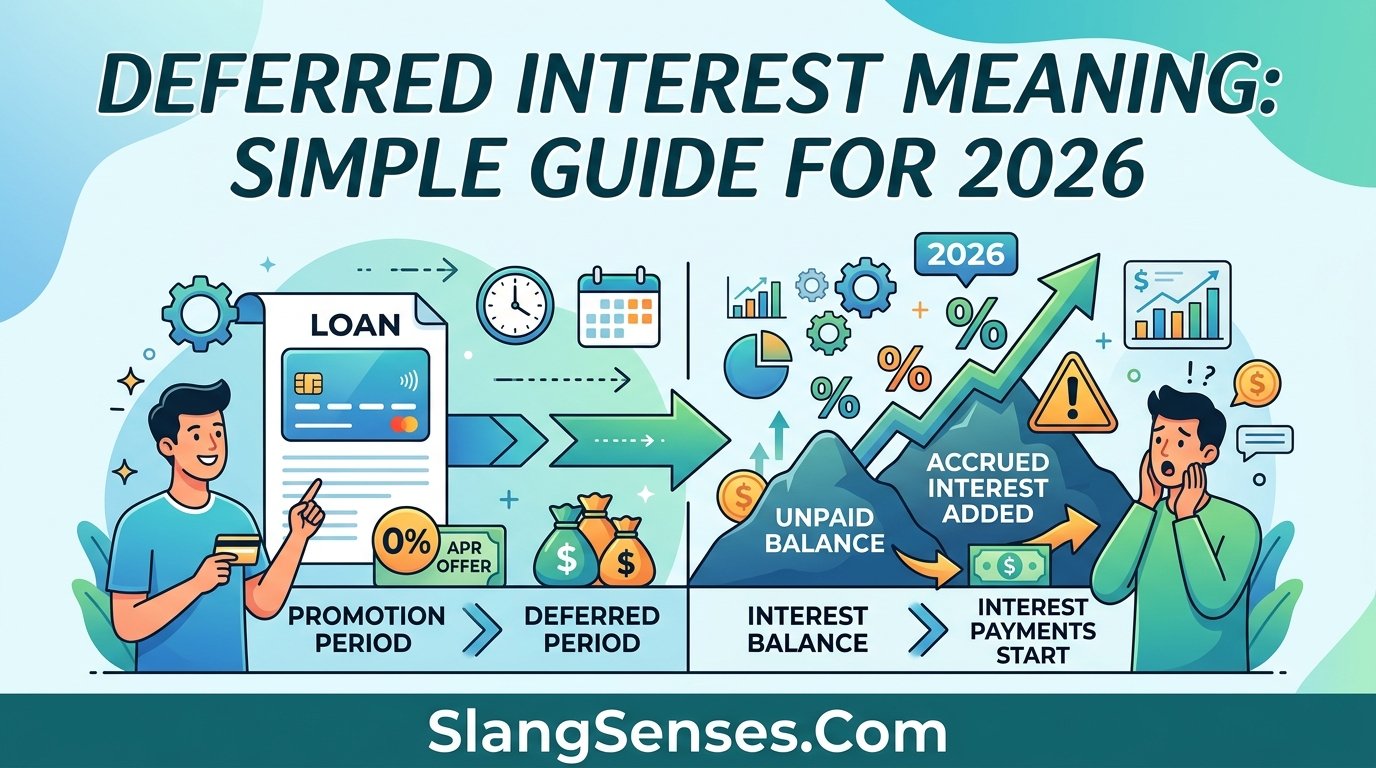
Deferred Interest Meaning is simple: it refers to interest that is postponed for a specific period, but the interest may not be completely gone. Depending on the financing agreement, interest can build during the promotional period and become payable later if you don’t meet the required conditions.
This is especially important when you see offers such as “no interest if paid in full.” The wording can make a financing deal sound completely interest-free, but there may be a specific payoff deadline, minimum payment, promotional balance, and regular APR you need to understand. Missing the deadline could turn an attractive offer into a much more expensive purchase.
In this guide, we’ll explain what deferred interest means, how deferred interest works, how it differs from 0% APR, and what can happen if you still have a balance when the promotional period ends. Whether you’re financing furniture, electronics, medical expenses, or using a promotional credit card offer, understanding the terms can help you avoid unexpected interest charges and make a more informed financial decision.
What Is Deferred Interest?
Deferred interest is a financing arrangement where interest payments are postponed for a specific period.
The important word is postponed.
It doesn’t always mean that interest isn’t accumulating. In many promotional financing arrangements, interest can accrue during the promotional period but isn’t immediately charged to you. If you meet the offer’s conditions, the accumulated interest may be waived.
For example, imagine you purchase a $2,000 television with a 12-month deferred-interest promotion.
The offer might say:
“No interest if paid in full within 12 months.”
You don’t necessarily have to pay interest each month during those 12 months. However, you usually need to pay enough to eliminate the promotional balance before the deadline.
If you still owe money when the promotional period ends, the terms may allow previously deferred interest to become payable.
So, deferred interest isn’t exactly the same thing as a free loan.
It’s more like interest on hold, with conditions attached.
The exact rules depend on the lender, credit card issuer, loan agreement, and promotional terms. Always read the specific agreement instead of assuming every deferred-interest offer works the same way.
Deferred Interest Meaning in Simple Words
Here’s the easiest way to understand Deferred Interest Meaning:
Deferred interest means interest is delayed for a certain period, but you may still become responsible for that interest if you don’t meet the offer’s requirements.
Think of it as putting interest in a waiting room.
It hasn’t necessarily vanished. It’s just waiting.
That’s why phrases such as “no interest if paid in full” deserve your attention.
A normal 0% introductory APR offer generally works differently. With a genuine 0% APR promotion, interest isn’t charged during the promotional period as long as the account remains subject to the stated terms.
With deferred interest, however, interest may accrue during the promotional period and may become payable if the balance isn’t paid according to the agreement.
Quick comparison
| Term | Simple meaning |
|---|---|
| Deferred interest | Interest is postponed and may become payable later |
| 0% APR | No interest is generally charged during the promotional period |
| Accrued interest | Interest that has built up over time |
| Promotional period | Special period with temporary financing terms |
| Regular APR | The standard annual interest rate after the promotion or under normal terms |
The biggest mistake is seeing “no interest” and assuming it always means “interest can never be charged.”
You May Like Read: Mustache Slang: 50+ Funny Nicknames & Expressions 2026
How Does Deferred Interest Work?
The basic process isn’t too complicated.
You make a purchase or take financing under a promotional offer. The lender provides a temporary period during which interest isn’t collected in the normal way.
During that period, you make payments according to the agreement.
If you pay the qualifying balance in full before the deadline, the deferred interest may be waived.
If you don’t, the agreement may allow interest that accumulated during the promotional period to become payable.
Here’s the basic flow:
Purchase → Promotional period → Payments → Payoff deadline → Interest treatment
The exact calculation and conditions vary between financial products.
The Promotional Period
The promotional period is the temporary period during which special financing terms apply.
It might be six months, 12 months, 18 months, 24 months, or another period specified by the lender.
For example:
Purchase: $2,000
Promotional period: 12 months
Regular APR: 24%
Goal: Pay the promotional balance in full before the deadline
If you want to clear $2,000 evenly over 12 months, a simple target would be:
$2,000 ÷ 12 = about $166.67 per month
That’s only a planning example. Your actual required payment may be different, and the account’s terms control.
And here’s something people sometimes overlook.
The minimum payment may not be enough to pay the entire promotional balance before the deadline.
That’s a big deal.
If you only make the minimum payment, you could reach the end of the promotional period with a remaining balance.
Before using a deferred-interest offer, check:
- promotional end date
- regular APR
- minimum payment
- promotional balance
- payment due date
- payoff requirements
- what happens to deferred interest
What Happens When the Period Ends?
When the promotional period ends, the special terms may end too.
If you’ve satisfied the requirements and paid the qualifying balance in full, deferred interest may be waived.
But if you still have a balance, the terms of the agreement determine what happens next.
Depending on the offer, you may have to pay interest that accumulated during the promotional period. You may also begin paying the regular APR on the remaining balance.
This is why the payment deadline matters so much.
Don’t wait until the final few days if you can avoid it. Payments can take time to process, and your agreement may have specific rules about when a payment counts.
Why Interest Can Be Charged Retroactively
This is one of the most confusing parts of deferred interest.
With certain deferred-interest offers, interest can accrue during the promotional period even though you’re not making regular interest payments.
If you don’t meet the conditions, that accumulated amount may become payable.
That’s sometimes described as retroactive interest because interest associated with the earlier promotional period can become due later.
Imagine interest accumulating month after month in the background.
You don’t see a large interest charge immediately.
Then the promotional deadline arrives.
If you haven’t met the conditions, suddenly the financial impact becomes much more noticeable.
That’s the catch.
Deferred Interest Example
A real example makes the concept much easier to understand.
Let’s say you purchase furniture for $2,000.
The store offers:
“No interest if paid in full within 12 months.”
Your regular interest rate after the promotion is relatively high.
You decide to use the offer because you expect to pay the entire balance within a year.
That’s where your payment plan matters.
Example of a $2,000 Purchase
Suppose the promotional balance is:
$2,000
And the promotional period is:
12 months
A simple payoff target would be:
$2,000 ÷ 12 = $166.67 per month
So, paying around $167 per month would give you a rough target for eliminating the original $2,000 balance over 12 months, assuming no other charges and ignoring differences caused by actual account terms.
Now imagine you pay only $100 each month.
After 12 months, you’ve paid about:
$1,200
You could still owe around:
$800
That means you’ve reached the end of the promotional period with a remaining balance.
What happens next depends on your financing agreement.
This is why you shouldn’t look only at the phrase “no interest.”
Look at the entire offer.
What Happens If You Pay It Off on Time?
If the offer says deferred interest is waived when the qualifying balance is paid in full, paying the balance by the required deadline can allow you to avoid that deferred interest.
That’s the ideal scenario.
You borrowed or financed the purchase for a limited period, followed the terms, and cleared the balance before the promotion ended.
Still, don’t assume that every offer has identical rules.
Check your statement and agreement.
Make sure you know:
- exactly which balance must be paid
- the exact promotional expiration date
- whether new purchases have different terms
- whether minimum payments are enough
- whether other fees apply
What Happens If You Still Owe Money?
This is where a deferred-interest offer can become expensive.
If you still owe money at the end of the promotional period, the agreement may require you to pay deferred interest that accumulated during the promotion.
You may also be charged the regular APR on the remaining balance going forward.
For example, suppose your promotional balance was $2,000 but you still owed $500 when the promotion ended.
Don’t assume your cost will simply be interest on that $500.
Under some deferred-interest arrangements, the terms can make previously accumulated interest relevant too.
That’s why you need to read the exact offer.
How Is Deferred Interest Calculated?
The deferred interest calculation depends on the financial product and its agreement.
A simplified interest illustration might look like this:
Interest = Principal × Annual Interest Rate × Time
Suppose a balance were $2,000 and the annual rate were 24% for one year:
$2,000 × 0.24 × 1 = $480
That’s a simple illustration, not necessarily the amount your credit card or lender would actually charge.
Credit card interest can be calculated using methods such as average daily balance or daily periodic rates. The account’s terms determine the actual calculation.
For deferred-interest financing, the important question isn’t just:
“What is the interest rate?”
You should also ask:
“What happens to the interest that accumulates during the promotional period?”
That’s the part that can surprise people.
A practical payoff formula
If you want to estimate how much you need to pay each month to eliminate a promotional balance:
Promotional balance ÷ Number of promotional months = approximate monthly payoff target
For a $2,400 balance over 12 months:
$2,400 ÷ 12 = $200
Again, this is a budgeting target, not a statement of the lender’s required payment.
If you can afford it, paying slightly more than the target can give you some breathing room.
Deferred Interest vs. 0% APR
This is one of the most important differences to understand.
The terms can look almost identical in advertisements, but the financial mechanics can be different.
| Feature | Deferred Interest | 0% APR |
|---|---|---|
| Interest during promotion | Accrues | Usually doesn’t accrue |
| Payoff requirement | Usually full balance | Minimum payments generally required |
| Retroactive interest | May apply | Generally no |
| Risk | Higher | Usually lower |
| Best for | People who can pay in full | People needing more repayment flexibility |
With deferred interest, the promotional period can come with a pay-in-full condition.
With a typical 0% APR introductory offer, interest generally isn’t charged during the promotional period.
But there’s an important detail:
0% APR doesn’t mean you can ignore payments.
You still need to make at least the required minimum payment, and other terms can apply.
So don’t compare offers based only on the giant “0%” or “NO INTEREST” text on an advertisement.
Read the details underneath it.
Is Deferred Interest Good or Bad?
Deferred interest isn’t automatically bad.
If you’re confident you can pay the promotional balance in full before the deadline, it can help you finance a large purchase without paying interest under the offer’s conditions.
The problem starts when the payment plan doesn’t match your budget.
A $2,000 purchase can look manageable when you’re thinking about the purchase itself.
But $2,000 divided across 12 months is about $167 per month.
Can you actually afford that?
That’s the question.
Deferred-interest financing can be useful for someone with predictable income and a realistic payoff plan.
It can be risky for someone who is already carrying debt or who may struggle to clear the balance before the promotional period ends.
Pros and Cons of Deferred Interest
| Pros | Cons |
|---|---|
| Can reduce interest costs if paid in full | Deferred interest may become payable |
| Useful for large purchases | High regular APR may apply |
| Gives you a promotional period | Minimum payments may not clear the balance |
| Can provide short-term financing flexibility | Easy to misunderstand |
| May help spread payments | Missing the deadline can be costly |
Pros
Potential interest savings:
If you meet the conditions, you may avoid paying the deferred interest.
Time to pay:
You can spread a purchase across a promotional period instead of paying everything immediately.
Useful for planned purchases:
It may make sense for necessary furniture, appliances, or other major expenses when you have a clear payoff strategy.
Cons
Deadline pressure:
You need to know exactly when the promotional period ends.
Possible interest charges:
Failure to satisfy the offer’s conditions can make the deal much more expensive.
High regular APR:
After the promotional period, the standard interest rate may be significantly higher.
Easy to misunderstand:
“Interest-free” advertising can sound simpler than the actual terms.
You May Like to Read: Names Meaning Star: Find A Popular Truly Special Name 2026
Where Is Deferred Interest Commonly Used?
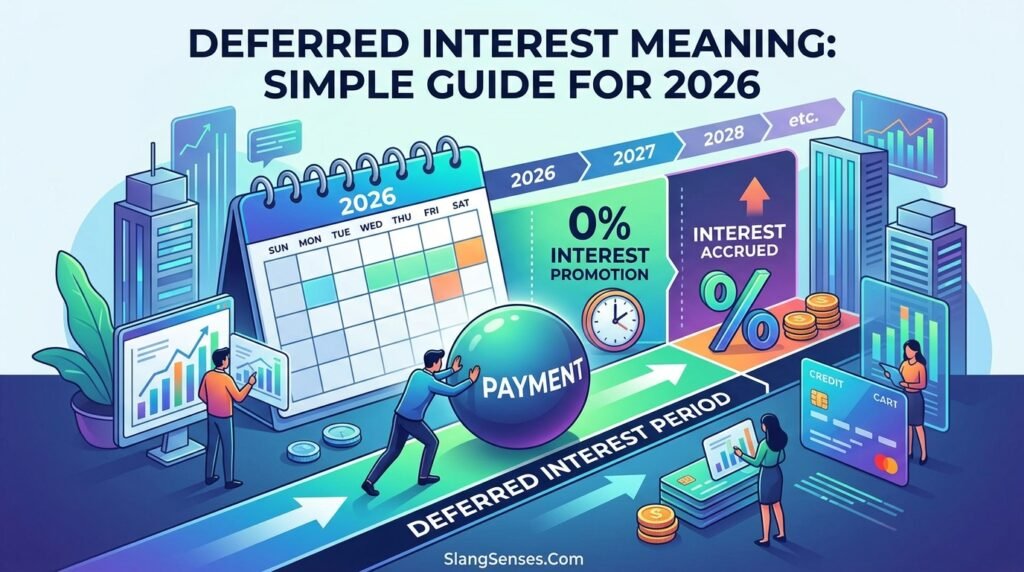
Deferred interest can appear in several forms of financing, although the rules aren’t identical across products.
Credit Cards
Deferred interest credit cards or promotional credit-card offers may provide special financing for purchases.
A common structure is:
“No interest if paid in full within X months.”
Always check whether the offer is truly deferred interest and what happens to accumulated interest if the balance isn’t cleared.
Store Financing
Retailers sometimes offer promotional financing through store credit cards or financing partners.
You might see offers on:
- appliances
- electronics
- furniture
- mattresses
- home improvement products
The purchase can look affordable because you’re given several months to pay.
But the promotional terms matter.
Furniture and Electronics
Furniture and electronics are common examples because consumers may want to spread the cost of an expensive purchase.
A $2,000 sofa or television can be easier to budget when divided into monthly payments.
But your goal should be more than simply making the minimum payment.
You need a plan to clear the qualifying balance before the promotion expires.
Medical Financing
Some healthcare financing products can include promotional periods.
Medical bills can already be stressful, so it’s especially important to understand the financing agreement before accepting one.
Look carefully at:
- promotional period
- regular APR
- minimum payment
- fees
- payoff deadline
- interest conditions
Personal Loans
Deferred interest can also be discussed in relation to certain loans, but personal loans aren’t all structured like promotional store financing.
Loan agreements can vary considerably.
Some forms of loan deferral involve postponing payments, while interest may continue accruing.
That’s different from simply receiving a 0% financing offer.
Read the loan documents carefully.
Mortgages
Mortgage-related deferred interest can have a different meaning again.
For example, certain mortgage structures can allow unpaid interest to be added to the loan balance. This can contribute to negative amortization, where the amount owed can increase instead of decreasing.
So don’t assume that every use of the term “deferred interest” works like a store credit-card promotion.
Context matters.
A lot.
How to Avoid Paying Deferred Interest
The easiest way to avoid unexpected deferred interest is to understand the offer before making the purchase.
Here are practical steps.
1. Read the promotional terms
Don’t rely on the advertisement alone.
Find the actual financing terms.
2. Know your deadline
Write down the exact date when the promotional period ends.
A vague “12 months” isn’t enough.
Know the actual date.
3. Calculate your monthly target
Take the promotional balance and divide it by the number of months available.
For example:
$1,800 ÷ 12 = $150 per month
That’s a simple starting point.
4. Pay more than the minimum when possible
The minimum payment may not be designed to eliminate the promotional balance before the deadline.
5. Don’t add unnecessary purchases
New purchases can have different APRs or promotional terms.
Keep track of each balance separately.
6. Check your statement
Look for:
- promotional balance
- expiration date
- minimum payment
- interest rate
- payment history
- remaining balance
7. Don’t wait until the last minute
Paying early can reduce the chance of missing a deadline.
Does Deferred Interest Affect Your Credit Score?
Deferred interest itself isn’t necessarily a negative mark on your credit report.
What matters more is how you manage the underlying credit account.
For example, missing payments can hurt your credit history.
A high balance can also affect your credit utilization, which can influence credit scores for revolving credit accounts.
Opening a new credit card or financing account can also have effects depending on the circumstances.
So the bigger issue isn’t simply:
“Does deferred interest hurt my credit?”
It’s:
“How am I managing the account?”
If you make payments on time, keep balances under control, and follow the terms, you’re in a much better position.
Deferred Interest vs. Accrued Interest
These terms sound similar, but they aren’t exactly the same.
Accrued interest is interest that has accumulated over time.
Deferred interest refers to an arrangement where payment or charging of that interest is postponed under specified terms.
Think of it this way:
Accrued = interest has built up.
Deferred = payment or collection of interest has been postponed.
A deferred-interest promotion can therefore involve interest accruing during the promotional period even though you aren’t paying that interest at the time.
That’s why understanding both terms is useful.
What Does “No Interest If Paid in Full” Mean?
The phrase “no interest if paid in full” usually means you may avoid the interest associated with the promotional offer if you pay the qualifying balance in full within the required promotional period.
The phrase “if paid in full” is doing a lot of work here.
It isn’t the same as simply saying:
“No interest.”
There’s a condition attached.
You need to know what “paid in full” means under that particular agreement and which balance qualifies.
Also check whether the offer applies to one purchase, a promotional balance, or other purchases made on the account.
Never assume.
Read the agreement.
Frequently Asked Questions
What exactly is deferred interest?
What is 12-month deferred interest?
Is deferred payment a good idea?
What is the difference between no interest and deferred interest?
Conclusion
Understanding Deferred Interest Meaning can help you make smarter decisions when using credit cards, store financing, or promotional offers. Deferred interest doesn’t always mean that interest has been completely removed. Instead, interest may be postponed during a specific promotional period and could become payable if you don’t meet the terms of the offer. That’s why it’s important to look beyond phrases like “no interest if paid in full.”
Before accepting a deferred-interest offer, check the promotional period, regular APR, minimum payment, balance, fees, and exact payoff deadline. If possible, create a monthly payment plan that allows you to clear the qualifying balance before the promotion ends. Also remember that deferred interest and 0% APR aren’t necessarily the same thing. Knowing the difference can prevent unexpected costs later.
In short, Deferred Interest Meaning is all about understanding what happens to interest during a promotional period. Read the fine print, know your deadline, and borrow only what you can realistically repay. A little planning can make a big difference.

Rathna Kannan is a language enthusiast and writer at Slang Senses, sharing simple explanations of modern slang, internet expressions, and trending phrases. Rathna enjoys exploring how language evolves through social media and everyday conversations.
2 thoughts on “Deferred Interest Meaning: Simple Guide for 2026”