
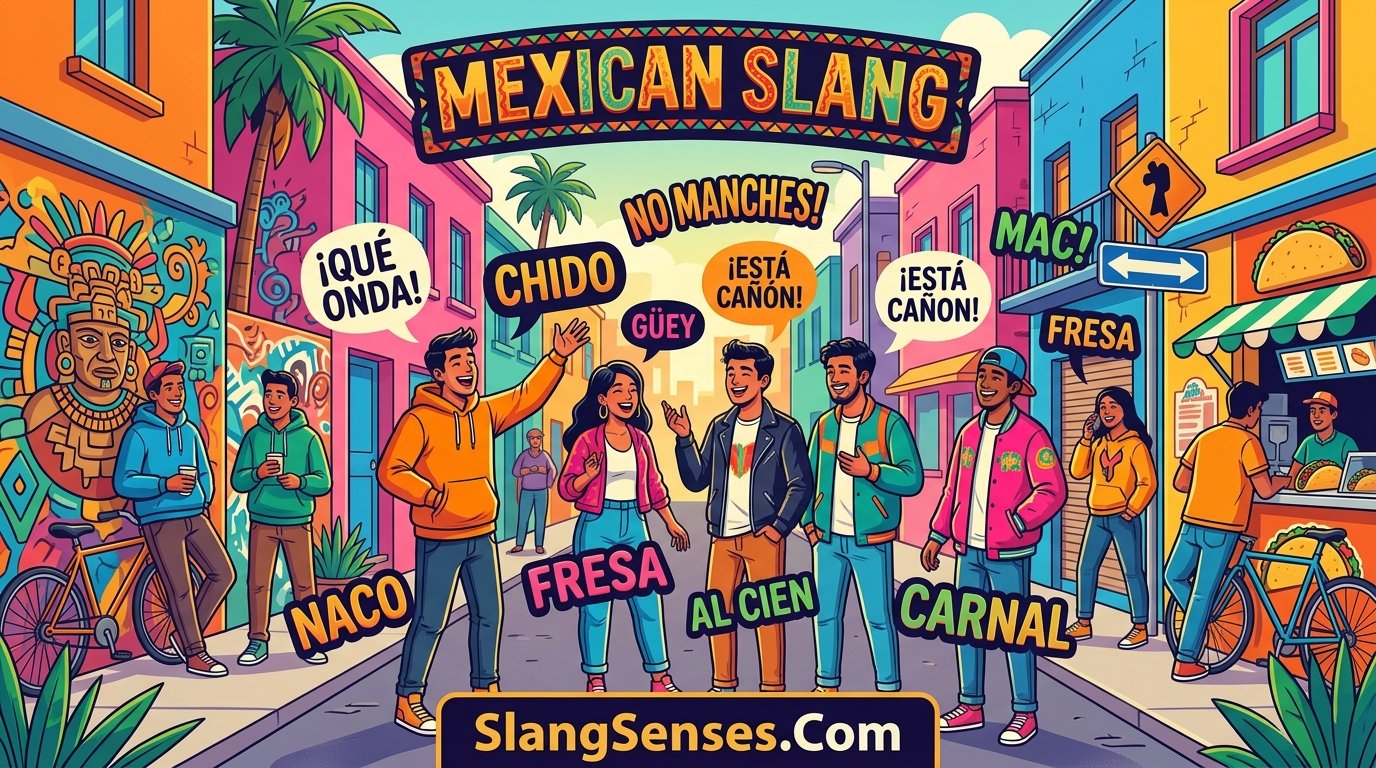
Mexican Slang—have you ever heard someone say “¿Qué onda, güey?”, “¡Órale!”, or “¡No manches!” and wondered what they were actually saying? If you learned Spanish from a textbook, Mexican conversations can sometimes sound like a completely different language.
So, what exactly is Mexican slang? It’s the informal words, phrases, and expressions commonly used in everyday Mexican Spanish, especially when people are talking casually with friends, family, or people they know. Words such as güey, chido, neta, chamba, sale, and padre are just a few examples.
But Mexican slang is much more than a list of funny words. It has been shaped by Mexican culture, regional differences, music, humor, history, and everyday life, and the meaning of many expressions depends heavily on context and tone.
In this guide, we’ll explore popular Mexican slang words and phrases, what they mean, how to use them, which ones to avoid, and how slang differs across Mexico.
What Is Mexican Slang?
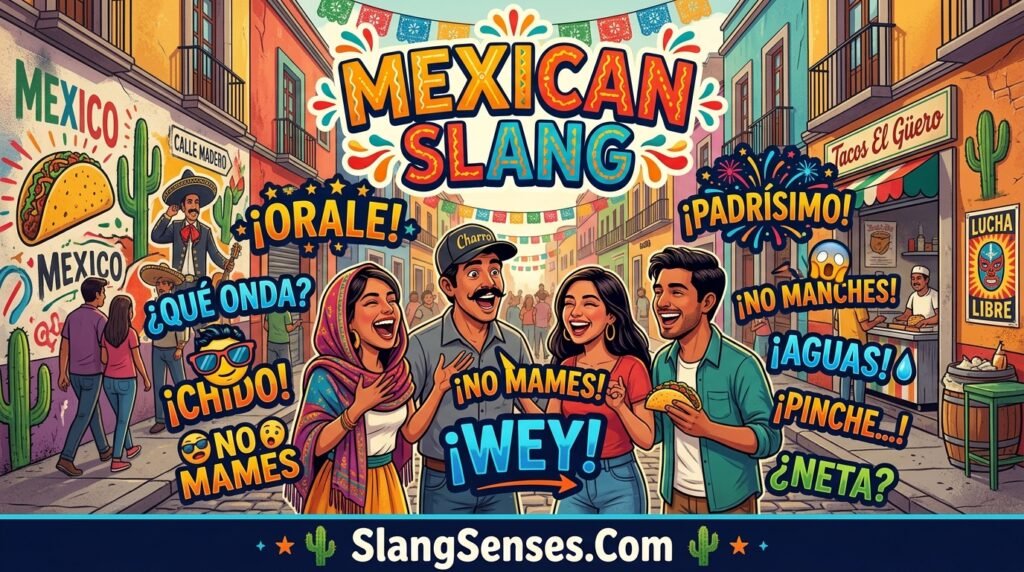
Mexican slang is the informal vocabulary, expressions, and turns of phrase used in everyday Mexican Spanish — words you won’t find in a standard textbook, but you’ll hear constantly on the street, at family gatherings, in taxis, and in casual texts.
A lot of it comes from repurposing normal words. Padre means “father,” but say “qué padre” and you’re saying “how cool.” Aguas literally means “waters,” but shout it at someone and you’re warning them to watch out. That’s the trick with Mexican slang — the literal translation and the actual meaning are often nowhere near each other, and context does most of the heavy lifting.
It’s also generational and regional. What a chilango (someone from Mexico City) says isn’t always what you’ll hear in Monterrey or along the coast. We’ll get into that later.
Everyday Mexican Slang Words
| # | Word/Phrase | Literal Meaning | Actual Meaning | Example |
|---|---|---|---|---|
| 1 | Güey (wey) | — | Dude, buddy (also “dumb” depending on tone) | ¿Ya vienes, güey? — You coming, dude? |
| 2 | Chido / Chida | — | Cool, awesome | Qué chido está tu carro. — Your car’s really cool. |
| 3 | Neta | Truth | Really? / Honestly | ¿Neta? No lo puedo creer. — Really? I can’t believe it. |
| 4 | Chela | — | Beer | Vamos por unas chelas. — Let’s grab some beers. |
| 5 | Padre | Father | Cool, great | Qué padre estuvo la fiesta. — The party was awesome. |
| 6 | Fresa | Strawberry | Preppy, snobby | Es bien fresa esa colonia. — That neighborhood is really preppy. |
| 7 | Feria | Fair | Money, cash | No traigo feria. — I don’t have cash on me. |
| 8 | Chamba | — | Work, job | Tengo mucha chamba hoy. — I have a lot of work today. |
| 9 | Naco / Naca | — | Tacky, low-class (use carefully) | Se ve bien naco eso. — That looks really tacky. |
| 10 | Gacho / Gacha | Slouch | Uncool, mean | Qué gacho lo que hizo. — What he did was really messed up. |
| 11 | Carnal | Flesh/blood | Close friend, brother | Ese es mi carnal. — That’s my brother (close friend). |
| 12 | Sale | — | OK, sure | ¿Vamos al cine? — Sale. — Wanna go to the movies? — Sure. |
| 13 | Cañón | Cannon | Really hard/difficult | El examen estuvo cañón. — The test was brutal. |
| 14 | Ándale | — | Come on / hurry up / that’s right | ¡Ándale, se hace tarde! — Come on, it’s getting late! |
| 15 | Rifársela | — | To go all out, to nail it | Se la rifó en el examen. — She crushed the exam. |
Notice how many of these are just regular words wearing a slang costume — padre, aguas, feria — that’s honestly the whole flavor of Mexican slang in a nutshell.
Mexican Slang Phrases for Greetings
Forget “¿Cómo está usted?” Nobody talks like that outside a job interview. Here’s how people actually say hello, ask how you’re doing, and greet each other casually in Mexico.
- ¿Qué onda? — “What’s up?” The most common casual greeting, works with friends and strangers your age.
- ¿Qué tranza? — Similar to “what’s up,” a bit more streetwise.
- ¿Qué show? — “What’s going on?” Used mostly among younger crowds.
- ¿Qué pex? — Informal “what’s going on,” casual and playful.
- ¿Cómo andas? — Literally “how are you walking,” basically “how’s it going?”
- Buenas — Shortened, casual version of “buenos días/tardes/noches.”
- ¿Todo bien? — “All good?” Common check-in greeting.
- ¡Quiúbole! — A contracted, very Mexican way to say “hey, what’s up?”
You’ll notice most of these lean on onda (wave/vibe). It shows up everywhere — buena onda (good vibes, nice person), mala onda (bad vibes, uncool). Once you get onda, half the greetings on this list click into place.
Mexican Slang for Travelers & Tourists
If you’re actually heading to Mexico, this is the practical stuff — the words you’ll need on buses, in markets, at bars, and just getting around.
- Camión — Bus (not “truck” like standard Spanish; you’ll hear this constantly for public transport).
- Combi — A small passenger van, common in cities and along the coast.
- Mande — Polite “what?” or “yes?” — say this instead of “¿qué?” when someone calls your name or you didn’t hear them.
- ¿Cuánto cuesta? — “How much does it cost?” Not slang exactly, but paired with regateo (haggling) culture at markets, it’s essential.
- Aguas — “Watch out!” Useful literally everywhere — uneven sidewalks, traffic, hot food.
- Pisto / Feria / Lana — Three different slang words for money. You’ll hear all three depending on the region.
- Antro — Nightclub. If someone invites you to “un antro,” it’s a club, not a museum.
- Chamarra — Jacket. Handy to know if you’re packing for cold Mexico City nights.
- Tianguis — An open-air street market, common across the country.
- La cuenta, por favor — Standard, but knowing it fast saves you awkward waiter-flagging moments.
A quick practical tip: taxi and rideshare drivers, market vendors, and hostel staff will often slow down and simplify their Spanish once they clock you as a foreigner. Don’t be shy about asking “¿qué significa eso?” (“what does that mean?”) — Mexicans are, generally speaking, happy to explain their own slang. It’s kind of a point of pride, honestly.
Funny Mexican Expressions That Confuse Outsiders
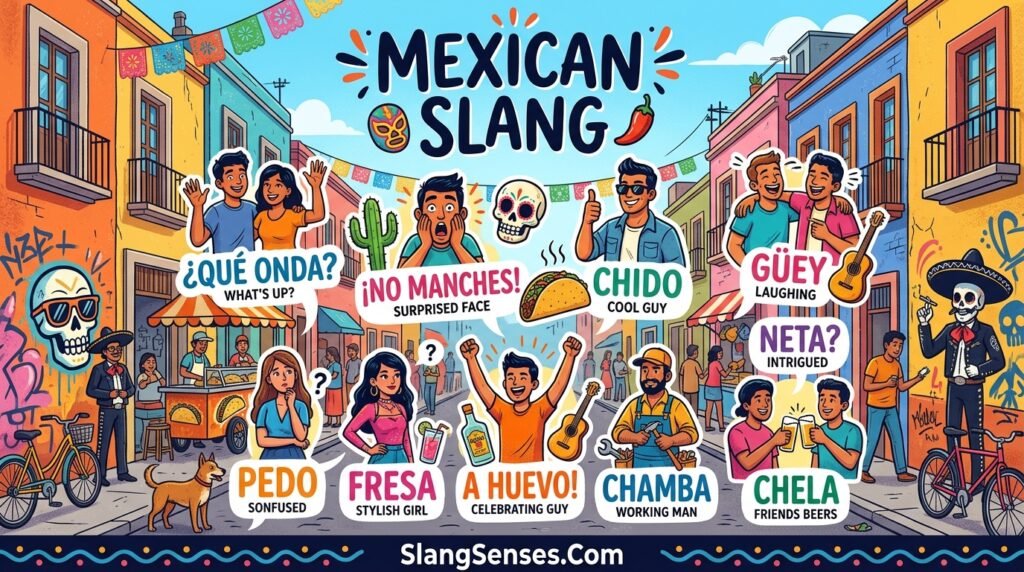
| Expression | Literal Translation | What It Really Means |
|---|---|---|
| ¡Ya nos cargó el payaso! | “The clown already carried us!” | We’re screwed / this went wrong |
| No hay tos | “There’s no cough” | No problem |
| Me vale madre | “It’s worth mother to me” | I don’t care (rude, careful with this one) |
| Se le fue el avión | “The plane left on them” | They spaced out / went off-topic |
| Echar la hueva | “To throw the laziness” | To be lazy, do nothing |
| Ponte trucha | “Put yourself trout” | Be sharp / pay attention |
| Caer el veinte | “The coin drops” | The penny drops — you finally get it |
| A darle que es mole de olla | “Get to it, it’s pot mole” | Get moving, don’t waste time |
Caer el veinte is my personal favorite, honestly — it comes from old pay phones, where the call wouldn’t connect until the coin literally dropped. So “the coin finally dropped” became Mexican for “oh, now I get it.” There’s something kind of charming about slang that still carries a piece of history nobody even thinks about anymore.
You May Like To Read: Unc Slang Meaning: What It Really Means in 2026
Mexican Slang to Use with Caution
Not everything on a slang list is safe for every room. Some of these are genuinely rude, some are just situational, and a few can land you in an awkward spot if you use them with the wrong crowd — your boss, your partner’s parents, a stranger on the street. Here’s the honesty section most guides skip.
| Word/Phrase | Formality Level | Notes |
|---|---|---|
| Pendejo | 🔴 Vulgar | Means “jerk” or “idiot” — genuinely insulting, not playful in most contexts |
| Cabrón | 🟡 Situational | Can mean “awesome” between close friends, or a real insult depending on tone |
| No mames | 🟡 Situational | Vulgar version of “no manches” — fine with friends, not with elders or in formal settings |
| Chingar (and derivatives) | 🔴 Vulgar | Extremely versatile curse word — appears in dozens of phrases, tone changes everything |
| Verga | 🔴 Vulgar | Crude, avoid in mixed or formal company |
| Pinche | 🟡 Situational | Can be a mild intensifier (“pinche calor” — this darn heat) or genuinely rude |
| Naco | 🟡 Situational | Classist undertone — don’t use it to describe people you don’t know |
| A huevo | 🟡 Situational | Enthusiastic “hell yeah” — casual and common, but skip it at work |
Regional Differences: Chilango, Norteño, and Coastal Slang
Here’s something most Mexican slang guides completely skip: Mexico is huge, and slang isn’t uniform across it. What flies in Mexico City might get you a blank stare in Tijuana.
Chilango slang (Mexico City) leans heavily on words like neta, chido, qué onda, and padre — the “textbook” Mexican slang most guides teach, honestly, because Mexico City media dominates what non-Mexicans hear first. Chilangos also tend toward faster, more clipped speech patterns.
Norteño slang (northern states like Nuevo León, Sonora, Chihuahua) has picked up more English loanwords thanks to the US border — words like troca (truck, instead of camión), lonche (lunch), and parquear (to park). The accent is also more clipped and direct, and you’ll hear wey used constantly, arguably even more than in Mexico City.
Coastal and southern slang (Veracruz, Yucatán, Oaxaca) brings in regional flavor too — Yucatán Spanish has Maya influence, with words like xix (crumbs) sneaking in, and speech patterns there are often described as more sing-song. Veracruz slang leans Caribbean-influenced, faster and more musical than the central plateau accent.
So if a Mexican friend from Monterrey doesn’t recognize a word from this list, that’s not you doing it wrong — Mexican slang isn’t one dialect, it’s a patchwork, and locals themselves switch it up depending on who they’re talking to.
Mexican Slang vs. Spain Spanish
If you’ve studied Spanish from Spain (or a textbook based on it), a few of these will trip you up. Same word, completely different meaning.
| Word | Mexican Meaning | Spain Meaning |
|---|---|---|
| Coger | Rarely used casually (vulgar connotation) | To grab/take — totally normal, everyday verb |
| Chulo | Cute, good-looking | Pimp |
| Camión | Bus | Truck |
| Guay | Not commonly used | Cool, awesome (Mexico uses “chido” instead) |
| Tío/Tía | Uncle/Aunt (literal only) | Dude/girl (slang, like “güey” in Mexico) |
| Vale | Rarely used | OK, sure (Mexico uses “sale” or “va”) |
| Coche | Used, but “carro” is more common | Car (standard term) |
The short version: if you learned Spanish in Spain and you’re heading to Mexico, brace yourself. A handful of totally normal Spain words carry different — sometimes awkward — meanings south of the Atlantic. Coger is the classic example that trips up almost every European Spanish speaker visiting Mexico.
How to Practice Mexican Slang Naturally
Memorizing a list only gets you so far. Slang lives in rhythm, tone, and repetition — you really have to hear it and use it, not just read it.
A few things that actually work: watch Mexican shows and YouTubers instead of textbook-style content — slang shows up naturally in unscripted talk in a way lessons rarely capture. Follow Mexican meme accounts or TikTok creators; slang spreads fast online and you’ll pick up current expressions, not just what was cool a decade ago.
If you’re studying with a tutor, ask them specifically to slip slang into practice conversations instead of sticking to formal dialogue. And don’t be afraid to just try a word out loud with a Mexican friend and ask “¿se dice así?” (“is that how you say it?”) — most people find it genuinely charming when a learner attempts local slang, even if you get it a little wrong.
One last thing: context is everything. The same word can be a compliment or an insult depending on who says it and how. Listen more than you speak at first, notice who uses what with whom, and the pattern starts to click — kind of like caer el veinte, actually.
Frequently Asked Questions
What is a very Mexican thing to say?
What is slang for Mexican people?
What do Mexicans say for OK?
What are some popular Mexican sayings?
Conclusion
Mexican slang gives you a much better feel for how people actually communicate in everyday Mexico. From “qué onda” and “güey” to “chido,” “neta,” “sale,” and “órale,” these expressions add personality, humor, and local flavor that you simply won’t get from formal Spanish alone.
The key is to remember that context matters. A word that sounds friendly between close friends can feel rude or inappropriate in another situation, while regional differences can change the way certain expressions are understood.
So don’t worry about memorizing every phrase at once. Start with a few common expressions, listen to how native speakers use them, and pay attention to the situation. Once you hear Mexican slang in real conversations, its meaning starts to click naturally.

Rathna Kannan is a language enthusiast and writer at Slang Senses, sharing simple explanations of modern slang, internet expressions, and trending phrases. Rathna enjoys exploring how language evolves through social media and everyday conversations.