
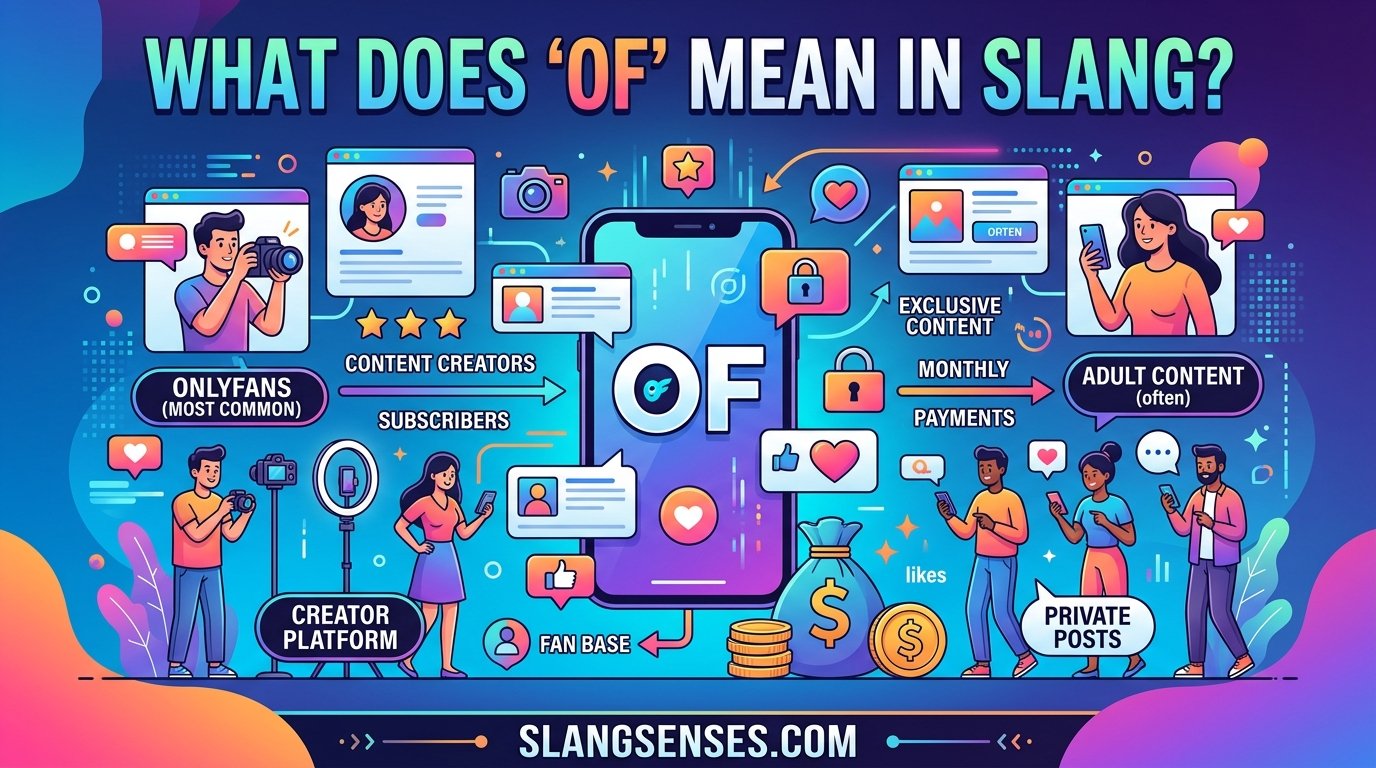
What Does “Of” Mean in Slang? The word “of” usually has a simple meaning in standard English, but online, especially on social media, it can sometimes appear as part of internet slang or a shortened phrase. Its meaning depends heavily on the sentence, platform, and context. In texting and casual chats, “of” may be used in phrases like “ofc” (of course), “asl” (as hell), or other popular Gen Z slang expressions.
Sometimes, people may also use “of” as a shortened or mistyped form of another word when typing quickly. On platforms such as TikTok, Snapchat, and Instagram, slang changes fast, so understanding the surrounding words is important. If you’ve seen “of” used in a strange or confusing way, don’t worry—it may have a simple explanation.
Quick Table
| # | Usage | Example | Where You’ll See It |
|---|---|---|---|
| 1 | Naming the account | “She’s got an OF” | Comment sections |
| 2 | Asking if someone joined | “Wait, does he have an OF now?” | Group chats |
| 3 | Promoting a page | “OF link in bio” | Instagram/TikTok captions |
| 4 | Talking money | “She’s making real money off OF” | Reddit threads |
| 5 | Quick DM shorthand | “Send me your OF” | Direct messages |
| 6 | Music/pop culture nods | Lyric references to OF income | Rap and pop lyrics |
| 7 | Journalism shorthand | “OF creator speaks out” | Entertainment news |
| 8 | Self-branding | “Full-time OF creator” | Bios and personal branding |
| 9 | Fan-facing calls to action | “Subscribe to my OF” | Creator posts |
| 10 | Bigger-picture commentary | “OF basically built the creator economy” | Opinion pieces, threads |
The Discord Message That Left Me Confused
A friend of mine dropped into a group chat one night and just typed: “yo drop your of.” No punctuation, no context, nothing. Within about two minutes, four different people had replied with links.
I sat there rereading it like I was missing something. Of? Of what? Was this a bit? Was I supposed to know what came next?
I didn’t ask, obviously. Nobody wants to be the one person in the chat going “wait what does that mean,” even when that’s exactly the question in your head. So I sat there, quietly confused, and figured it out the old-fashioned way — by googling it later that night, alone, like a coward.
Turns out I wasn’t behind on some obscure inside joke. I was behind on a piece of vocabulary that, by that point, half the internet had already absorbed without even noticing it happen.
If that’s you right now, don’t worry. You’re not late. You’re just catching up in public instead of in private, which honestly takes more guts.
The Short Answer
Here’s the no-nonsense version.
“OF” is internet shorthand for OnlyFans — the subscription platform where creators post content (photos, videos, behind-the-scenes stuff, sometimes explicit, sometimes not) that only paying subscribers get to see.
When someone says “she has an OF” or “check his OF,” they mean the platform, not the word. And once you know that, half the confusing sentences you’ve scrolled past suddenly click into place.
It works the same way “IG” became shorthand for Instagram or “TT” became shorthand for TikTok. Typing out the full name got old, so people trimmed it down, and the trimmed version stuck.
Where This Started (And Why It Spread So Fast)
OnlyFans has actually been around longer than most people realize — it launched back in 2016. For the first few years, it was a niche platform. Most people outside a specific corner of the internet had never heard of it.
Then 2020 happened.
During pandemic lockdowns, a huge wave of people — creators, influencers, and plenty of regular folks with time on their hands — either joined the platform or started talking about it constantly online. Subscriber numbers exploded, and so did the cultural conversation around it. Twitter (before it was X), TikTok, Reddit, Discord — the platform went from niche to nearly unavoidable in the span of a year.
There’s also a lesser-known chapter worth knowing: in August 2021, OnlyFans briefly announced it would ban sexually explicit content, largely due to pressure from banking and payment partners who didn’t want to be associated with the platform’s core content category. The backlash was immediate and massive, and within days the company reversed course entirely. That whole episode actually pushed OnlyFans even further into mainstream news coverage — which, ironically, helped cement “OF” as a term people just knew, whether they used the platform or not.
Once a word is everywhere, people get lazy about spelling it out. “OnlyFans” became “OF” the same way “Snapchat” became “snap” and “Instagram” became “the gram.” It’s not deep. It’s just efficiency.
By 2022, you’d see “OF” dropped into conversations that had nothing to do with the platform’s actual content — someone saying a coworker “has an OF” the same casual way they’d mention someone has a YouTube channel. It stopped being a niche reference and just became… vocabulary.
How People Actually Use It
“OF” isn’t a one-note term. The tone shifts a lot depending on who’s saying it and why.
Direct reference
This is the plainest use — someone’s literally asking for or pointing to a page.
“Drop your OF in the comments.”
No subtext here. It’s a straightforward ask, usually from a fan, a follower, or someone just curious.
Gossipy or surprised
This is the “wait, really?” energy. Usually shows up when someone finds out a person they know joined the platform.
“Hold on, she actually started an OF??”
You’ll see this a lot in celebrity gossip threads or group chats reacting to someone’s big life update.
Career / income talk
Here, “OF” gets treated less like a punchline and more like a job title.
“She quit retail because her OF is doing better than her paycheck ever did.”
The tone tends to be neutral, sometimes even a little impressed — this is the “creator economy as a legit career path” usage.
Jokey / roast-style
And then there’s the version that’s basically a punchline on its own.
“Bro just start an OF at this point lol.”
Usually thrown at someone for oversharing, being overly dramatic online, or just as a lighthearted jab between friends. Nobody actually means it literally most of the time.
A Few Things That Confused Me Early On
A handful of assumptions tripped me up before I actually understood how this term gets used. If you’ve made any of these same mental leaps, you’re not alone.
Assuming it’s only about adult content. It’s not, even though that’s the association most people jump to first. OnlyFans hosts fitness coaches, musicians, chefs, comedians, and all kinds of creators posting completely non-explicit content. “She has an OF” tells you nothing about what she’s actually posting.
Assuming it’s a Gen Z-only thing. Also not true. This term shows up across Reddit, X, TikTok, Facebook comment sections, and even in mainstream news headlines. It’s genuinely cross-generational at this point — plenty of millennials and even older users know exactly what it means.
Mixing it up with the actual word “of.” This one’s the trickiest, honestly, because context is everything. “She’s a fan of his work” and “she’s a fan of his OF” are two very different sentences that just happen to share a letter combo.
You May Like To Read: Unc Slang Meaning: What It Really Means in 2026
How to Tell Which “of” Someone Means
Not sure if you’re looking at slang or just… grammar? Here’s a fast gut-check.
- Is it capitalized? “OF” in all caps almost always signals the slang meaning. Lowercase “of” sitting in the middle of a normal sentence is just doing its regular job.
- Is someone asking for a link? “Send your of,” “link your of,” “of in bio” — this phrasing is a dead giveaway you’re not looking at grammar anymore.
- Is creator language nearby? Words like “subscribers,” “content,” “exclusive,” or “subscription” sitting close by are a strong signal.
- Is the conversation about money or side income? “Making bank on OF” is a very specific, very common phrasing pattern.
- Try the substitution test. Swap “OF” for “OnlyFans” in the sentence. If it still makes sense — “She quit her job for OnlyFans” — that’s your answer.
Is There Any Other Meaning?
| Meaning | Where You’ll See It |
|---|---|
| OnlyFans (the platform) | Social media, texting, casual conversation — by far the most common |
| Outfield | Baseball box scores and stats (OF is the standard position abbreviation) |
| Original Film | Movie and film discussion threads |
| Order Fulfilled / Order Form | Business, retail, and e-commerce shorthand |
| Just the word “of” | Regular grammar, no slang meaning at all |
If you’re on a sports page and see “OF” next to a player’s name, nobody’s talking about a subscription platform — that’s a fielding position. Context does almost all the heavy lifting here.
Why This Slang Stuck Around
A lot of platform-based slang fades the second the platform stops being relevant. Nobody’s shortening “MySpace” anymore because there was never enough conversation volume to justify it.
OnlyFans had a different trajectory. A few things kept “OF” alive as actual vocabulary:
- Constant cultural controversy — controversy drives conversation, and conversation drives repeated usage.
- Celebrity crossover — when public figures join or get associated with the platform, it becomes mainstream news, not just internet gossip.
- An unusually active creator-and-subscriber community that talks about the platform constantly, in public, across nearly every social app.
It also helps that “OF” is just easy to say out loud — “oh-eff” rolls off the tongue in a way that, say, abbreviating “Patreon” never really would. Short, pronounceable abbreviations tend to survive; clunky ones don’t.
A Quick Cheat Sheet Before You Go
OF = OnlyFans. A subscription platform where creators charge fans for access to exclusive content.
Phrases you’ll actually run into: “Drop your OF link” · “She runs an OF now” · “He finally made an OF” · “OF money is still money” · “Link your OF in bio” · “Just start an OF at this point”
You don’t have to use the term yourself. But now you’ll never freeze up when someone drops it into conversation.
Frequently Asked Questions
What is the meaning of 0F?
What does “of” on social media mean?
What is a 0F on TikTok?
What does “of” mean in a text?
Conclusion About What Does “Of” Mean in Slang
Understanding What “of” means in slang can be confusing because its meaning often depends on the context, platform, and surrounding words. In casual texting and social media, “of” may appear as part of shortened phrases, internet expressions, or playful language rather than its traditional grammatical role. Sometimes, people may even use it as a typo or abbreviation, so the intended meaning is not always obvious. The best way to understand it is to look at the complete sentence and the conversation around it. Slang also changes quickly, especially on platforms like TikTok, Instagram, and messaging apps. As a result, a meaning that is popular today may become less common later. Overall, “of” in slang has no single universal definition—it is the context that reveals what someone actually means.

Rathna Kannan is a language enthusiast and writer at Slang Senses, sharing simple explanations of modern slang, internet expressions, and trending phrases. Rathna enjoys exploring how language evolves through social media and everyday conversations.
2 thoughts on “What Does “Of” Mean in Slang? Popular Uses Explained 2026”