
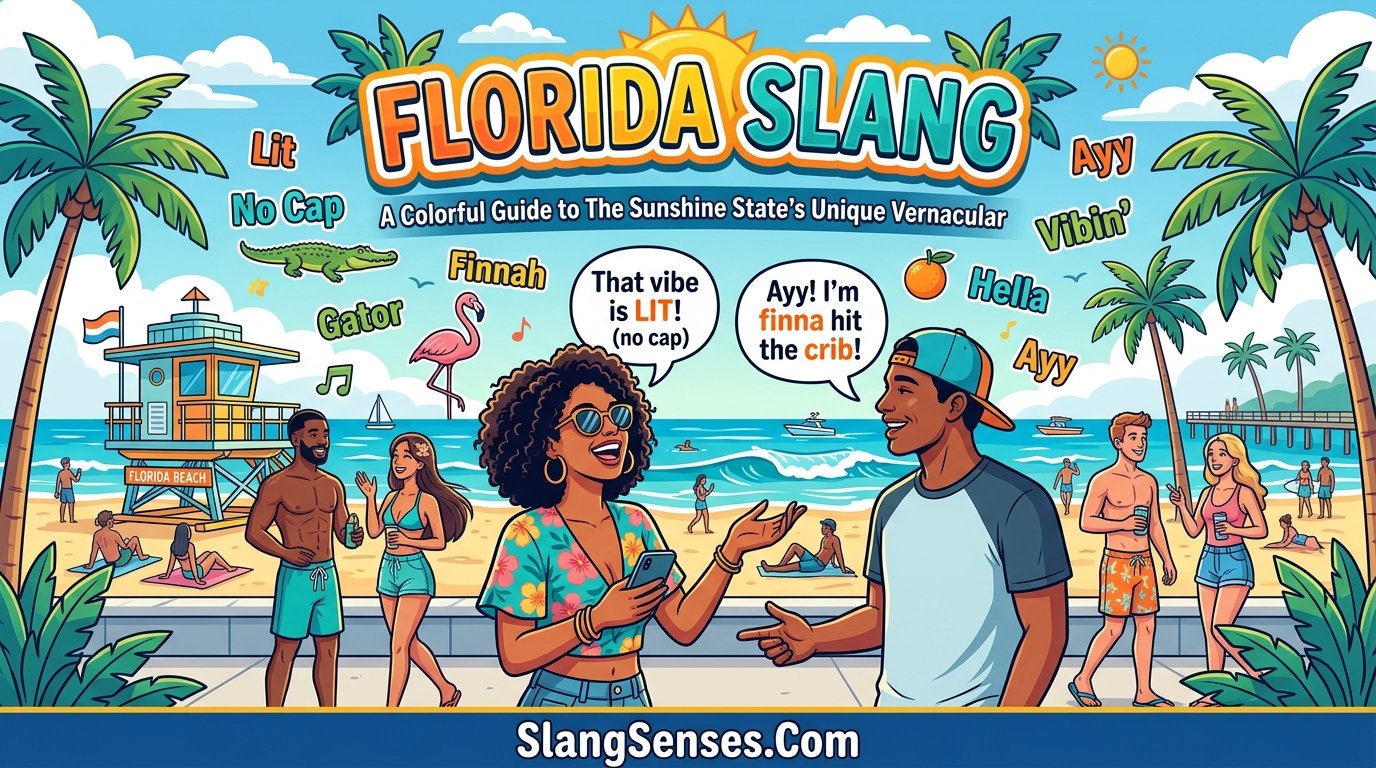
Florida slang reflects the state’s unique culture, beaches, diverse communities, and colorful lifestyle. From Miami streets to the Panhandle, people use expressions that may sound completely unfamiliar to visitors.
Popular Florida slang includes “jit” for a young person, “snowbird” for someone who spends winters in Florida, “no-see-ums” for tiny biting insects, and “the 305” for the Miami area. Locals may also describe cold weather as “brick” or use phrases connected to beaches, hurricanes, wildlife, and tourism.
Florida slang combines Southern expressions, Caribbean influences, Cuban and Latin culture, and modern urban language. That mix makes the way people speak in Florida different from almost anywhere else in the United States.
Quick Table
| Florida Slang | Meaning |
|---|---|
| Jit | A young person or kid |
| Snowbird | Someone who spends winters in Florida |
| No-See-Ums | Tiny biting insects |
| The 305 | Nickname connected to the Miami area |
| Brick | Surprisingly cold weather |
| Mad | A lot of something |
| Gator Country | Areas where alligators are common |
| Beach Day | A day spent relaxing at the beach |
| On the Water | Boating, fishing, or enjoying waterfront activities |
| Tourist Season | Time of year when many visitors arrive |
| Swamp Puppy | A humorous term for an alligator |
| Flip-Flop Weather | Warm weather suitable for sandals |
| Hurricane Party | A gathering before or during a storm |
| Conch | A person from the Florida Keys |
| Sun Pass | Florida’s electronic toll payment system |
| Mouse House | A nickname for Disney World |
| Sandbar Hangout | Relaxing at a shallow offshore area |
| Lovebug Season | The time when lovebugs are abundant |
| Gulf Side | Referring to Florida’s Gulf Coast |
| The Sunshine State | Florida’s popular nickname |
My First Experience with Florida Slang
The first time someone told me to “watch out for the snowbirds on US-1,” I genuinely looked up at the sky. I was visiting Fort Lauderdale and had no idea what they were talking about. My friend laughed and then explained that snowbirds were seasonal residents who come to Florida during winter.
That was my introduction to Florida slang. The state has its own way of speaking that mixes Southern language, Caribbean influences, Spanish expressions, beach culture, and modern street talk.
Florida is also a huge state with different cultures in different regions. The slang you hear in Miami may be completely different from what you hear in Jacksonville, Tampa, Orlando, or Pensacola. After spending time learning about these expressions, one thing becomes clear: Florida slang is more than just funny words. It reflects the people and culture of the Sunshine State.
The Snowbird Situation and Other Seasonal Slang
Let’s start with one of the most famous Florida slang terms: snowbird.
A snowbird is usually someone from the Northeast, Midwest, or Canada who comes to Florida during winter to escape colder weather. Many snowbirds stay for several months and return home when spring arrives.
Locals often talk about “snowbird season,” which usually refers to the period when seasonal residents and tourists arrive in large numbers. Roads become busier, restaurants fill up, and popular beaches become crowded.
Then there is “off-season.” In Florida, off-season often means the hotter and more humid months when fewer tourists are visiting. While the weather can be intense, many locals enjoy this period because beaches and restaurants are less crowded.
Seasonal expressions are an important part of Florida slang because tourism has such a major impact on everyday life throughout the state.
The Classics Every Florida Visitor Hears First
Some Florida slang words are almost guaranteed to confuse first-time visitors.
“Heading to the beach” sounds simple, but Florida locals often know exactly which beach someone means. The Gulf Coast and Atlantic Coast offer very different experiences, and residents often have strong opinions about which side is better.
“The ‘Glades” is a shortened way of referring to the Everglades. Instead of saying the full name, locals may simply say they are heading to the ‘Glades.
“Jit” is one of the most recognizable Florida slang words, especially in South Florida. It generally means a kid, teenager, or young person. Depending on the situation, it can be friendly, playful, or slightly insulting.
For example, someone might say, “That little jit has too much energy today.”
Another important word is “Floridian.” While it simply describes someone from Florida, many lifelong residents use it with pride. Being a real Floridian often means surviving hurricanes, humidity, mosquitoes, tourist traffic, and unpredictable weather.
Miami Slang That’s Crossed Into the Mainstream
Miami has developed its own unique style of language. English, Spanish, Caribbean culture, Cuban traditions, and modern urban expressions all influence the way people speak.
“Mira” is a Spanish word meaning “look,” but in Miami conversations it can also work like “listen” or “hey.” Someone might say, “Mira, let me tell you something.”
“Bobo” is another word commonly heard in South Florida. It can mean a fool or silly person, although friends sometimes use it jokingly.
“Dale” is one of the best-known Miami expressions. Depending on the situation, it can mean “let’s go,” “go for it,” “okay,” or “sounds good.”
For example, someone might ask, “Want to grab food?” and the answer could simply be, “Dale.”
Another popular expression connected to Miami culture is the “cafecito break.” Cuban coffee is a major part of daily life in South Florida, and meeting someone for a cafecito is often as much about conversation as it is about coffee.
Miami has helped spread many expressions beyond Florida, making South Florida slang recognizable across the country.
Central Florida and the Theme Park Belt
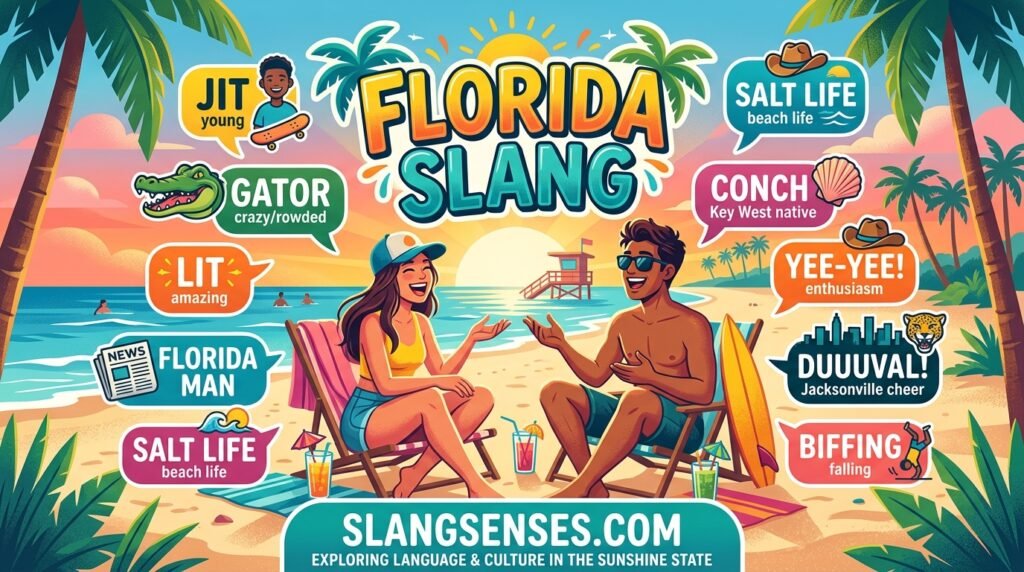
Central Florida has its own vocabulary, especially around Orlando and the theme park areas.
“The mouse” is a common nickname for Disney World. Locals may casually ask if someone is “going to the mouse” over the weekend.
People who regularly visit Disney parks are often called passholders or APs, short for annual passholders. For many Central Florida residents, visiting a theme park can feel like an ordinary weekend activity.
“The 408” can refer to the Orlando area code, while locals also frequently identify roads by numbers. This can confuse visitors who are unfamiliar with the region.
Tourism has a major influence on Central Florida slang. Locals often separate places and activities meant for tourists from those enjoyed by permanent residents.
The language in this region reflects a lifestyle built around entertainment, tourism, traffic, hotels, and theme parks.
North Florida and Panhandle Slang
North Florida and the Panhandle feel very different from Miami or South Florida. The language becomes more traditionally Southern as you move closer to Georgia and Alabama.
“Fixin’ to” is a classic Southern expression that means preparing or getting ready to do something. Someone might say, “I’m fixin’ to head to Publix.”
“The Panhandle” refers to the narrow northwestern section of Florida that stretches toward Alabama. Residents of this area often strongly identify with the Panhandle rather than South Florida culture.
“Bless your heart” is another well-known Southern phrase. Sometimes it expresses genuine sympathy, but depending on tone and context, it can also be a polite way of criticizing someone.
North Florida slang reflects the region’s rural communities, Southern traditions, and slower pace of life.
This is one reason Florida slang cannot be treated as one single language. The state contains several distinct cultural regions.
Weather Slang
Weather plays a huge role in everyday Florida life, so naturally, it has created its own collection of expressions.
“Liquid sunshine” is sometimes used to describe Florida’s quick and heavy rain showers. During summer, it can rain intensely for a short period and then become sunny again.
“SoFlo summer” refers to the extreme heat and humidity experienced in South Florida for much of the year. For newcomers, the weather can feel overwhelming.
“The cone” or “cone of concern” becomes a common phrase during hurricane season. It refers to the forecast area used to show the possible path of a tropical storm or hurricane.
You may hear someone casually say, “We’re in the cone,” which means their area could potentially be affected by a storm.
“Hurricane party” is another phrase associated with Florida culture. Some people gather with friends before a storm, although serious hurricanes and evacuation orders should always be treated as safety emergencies.
Florida residents have learned to talk about extreme weather with a combination of experience, humor, and preparation.
Mistakes Tourists and New Residents Make
Florida slang can be difficult to understand, especially for tourists and people who recently moved to the state.
One common mistake is assuming that Miami slang is used everywhere in Florida. Expressions popular in South Florida may not be common in the Panhandle or northern cities.
Another mistake is using “snowbird” directly toward someone in a negative way. While the term is widely used, context matters.
New residents may also underestimate how seriously locals take weather conversations. Florida residents have heard complaints about the heat thousands of times.
Tourists can also misunderstand local road names, area codes, and regional references. Florida is geographically large and culturally diverse, so learning a few local expressions can make conversations much easier.
The best approach is simple: listen first. Florida slang often makes more sense when you understand the region and the people using it.
You May Like To Read: Florida Slang Words: The Ultimate Local’s Guide (2026)
A Few More Gems Worth Knowing
“Publix sub” refers to a sandwich purchased from the Publix deli. For many Florida residents, it is more than just a sandwich. It is part of local culture.
“The 305” refers to Miami’s famous area code and is often used as a symbol of Miami identity and pride.
“Cracker” has a specific historical meaning in Florida. The term “Florida Cracker” can refer to descendants of early Florida settlers and traditional cattle ranching communities. Context is important when using this word.
“No-see-ums” are tiny biting insects that are especially annoying around water and during certain times of the day. You may not see them, but you will definitely notice the bites.
“Gator bait” is sometimes used as a playful Florida expression connected to alligators or the University of Florida Gators.
“Swamp puppy” is another humorous nickname for an alligator.
“Lovebug season” refers to the periods when lovebugs become extremely common in parts of Florida.
“Sandbar hangout” describes spending time relaxing at a shallow sandbar, often with boats and groups of friends.
These expressions show how much Florida slang is connected to the state’s wildlife, beaches, weather, and lifestyle.
Why Florida Slang Actually Matters
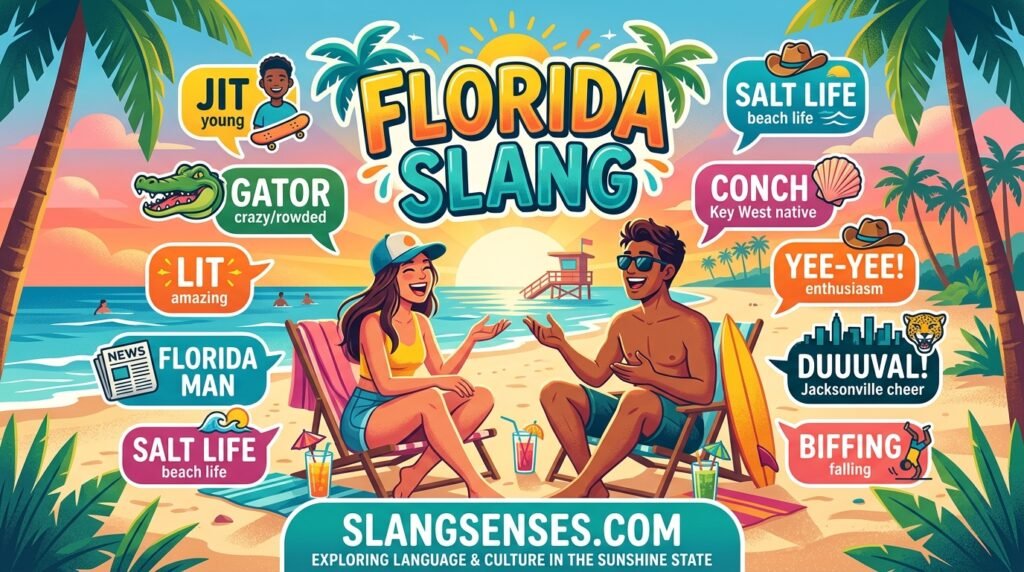
Florida slang is not just a collection of unusual words. It tells the story of a state shaped by different cultures and communities.
Florida is geographically part of the South, but South Florida has strong Caribbean and Latin American influences. Central Florida is heavily shaped by tourism and entertainment, while North Florida shares many traditions with neighboring Southern states.
This diversity creates a language that changes from one city to another.
When someone in Miami says “dale,” they are reflecting the multicultural character of South Florida. When someone in the Panhandle says “fixin’ to,” they are using traditional Southern language. When a local complains about snowbird season, they are talking about one of the most recognizable parts of Florida life.
Learning Florida slang helps visitors understand the culture behind the words. It can also make conversations more natural and help newcomers feel less like outsiders.
Language connects people to places, and Florida’s unique vocabulary is part of what gives the state its personality.
Frequently Asked Questions
What are some hood slang words?
How do Floridians say “hi”?
What are 10 slang words?
What does z mean in Florida slang?
Conclusion
Florida slang is a colorful reflection of the Sunshine State unique identity. From popular words like “jit” and “snowbird” to local expressions such as “the 305,” “no-see-ums,” and “fixin’ to,” these terms reveal how diverse Florida culture really is.
The language of Florida has been shaped by Southern traditions, Caribbean communities, Cuban and Latin American culture, tourism, beaches, wildlife, and modern street language.
What makes Florida slang especially interesting is that it changes from region to region. South Florida does not always sound like North Florida, and Miami slang can be very different from the expressions heard in the Panhandle.
Whether you are planning a trip, moving to Florida, or simply interested in American regional slang, learning these expressions can help you understand local conversations better.
Florida slang continues to evolve as new generations and communities influence the state’s culture. That makes it entertaining, dynamic, and an important part of everyday life in the Sunshine State.

Rathna Kannan is a language enthusiast and writer at Slang Senses, sharing simple explanations of modern slang, internet expressions, and trending phrases. Rathna enjoys exploring how language evolves through social media and everyday conversations.