
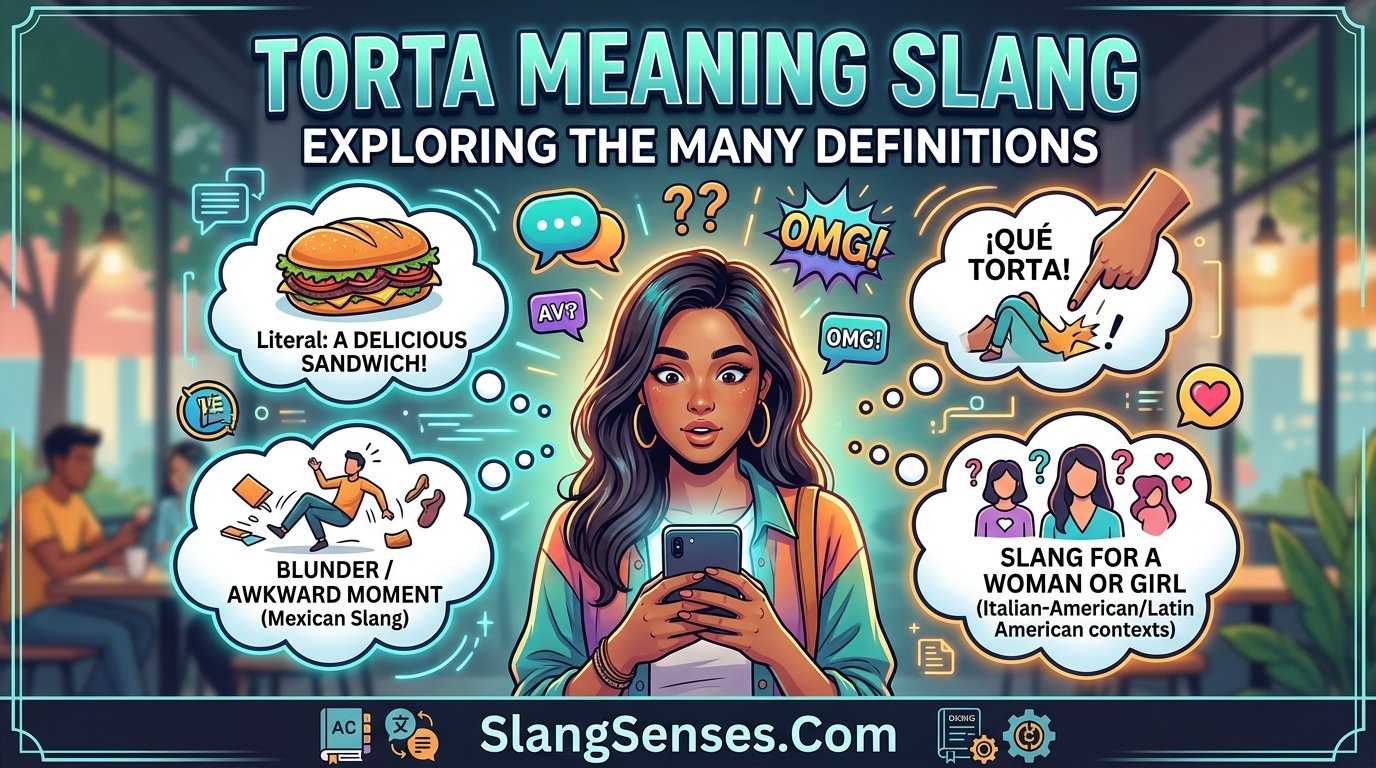
Torta meaning slang can vary depending on the country, language, and context in which the word is used. In Spanish-speaking communities, “torta” is commonly known as a type of cake, sandwich, or flatbread, but in slang, it can have completely different meanings.
On social media and in casual conversations, people may use torta as a playful, regional, or sometimes offensive expression. Understanding the context is important because the meaning can change significantly from one conversation to another.
Understanding the Torta Meaning Slang

Torta, in its slang usage, refers to a woman with a curvy or fuller body type — the comparison comes straight from the Mexican torta sandwich, which is thick, layered, and stuffed with meat, cheese, beans, avocado, and whatever else fits. Full. Hearty. Satisfying. You see where this is going.
The metaphor isn’t subtle, but it’s not meant to be. It’s food-culture shorthand, the kind of comparison that makes sense instantly if you grew up around Mexican or Chicano culture and might need a second explanation if you didn’t.
But — and this matters a lot — torta as slang has almost nothing to do with the literal word anymore once it’s being used this way. Context flips the meaning entirely.
The Literal vs. Slang Meaning
Here’s where a lot of confusion starts, because “torta” doesn’t mean the same thing everywhere, even in standard Spanish.
| Region | Literal Meaning |
|---|---|
| Mexico | Sandwich (made with bolillo or telera bread) |
| Spain | Cake, or informally, a slap/hit |
| Argentina / Uruguay | Cake (often layered) |
| Philippines | A type of omelette |
So the slang meaning we’re talking about here — the curvy-Latina-woman meaning — is really a Mexican and Chicano-specific development layered on top of an already regionally-inconsistent word. Worth keeping in mind before you use it anywhere outside that context.
Etymology: Where Did Torta Slang Come From?
This isn’t a new TikTok invention, even though a lot of people assume it is. The term dates back to the early 2000s, showing up in Mexican-American communities well before smartphones existed. Urban Dictionary has entries referencing it as far back as 2003, and at that point, it wasn’t being used kindly. It was largely a body-shaming term, used to criticize or tease women who didn’t fit narrow beauty standards.
The comparison itself — food to body — makes a certain grim sense once you break it down. Tortas are thick, layered, round, filling. Someone decided that description could apply to a person’s body, and the word stuck, spreading through Chicano communities in cities like Los Angeles and San Antonio, places with large, tight-knit Hispanic populations where slang like this circulates fast and sticks around.
Evolution Through the Years
Language doesn’t sit still, and “torta” is a good case study in how far a word can travel.
- Early 2000s — Used mainly as an insult. Criticized women who didn’t match narrow beauty ideals. Negative connotation, straightforward and unkind.
- 2010s — Still used informally, but it started showing up in hip-hop lyrics and barrio humor. Outsiders using it were still seen as disrespectful.
- 2020–2023 — The TikTok explosion begins. Latina creators start talking about the term openly — some reclaiming it, some calling out its problematic history in the same breath.
- 2024–2026 — Full reclamation era. “Torta girl” becomes its own identity, less an insult and more a badge — curves, confidence, culture, all wrapped into one label.
That’s roughly two decades of a word doing a complete 180. Not many slang terms manage that.
Why Is Torta Meaning Slang Trending on TikTok in 2026?

Short answer: a handful of trends collided at once, and torta slang was right in the middle of it.
The Reclamation Movement
This is the biggest driver, honestly. Latina women have been actively taking the word back — posting videos with captions like “I’m a torta and I’m proud,” celebrating curves instead of hiding from the label. It follows a pattern that’s happened with other reclaimed terms throughout history: a word used to hurt gets picked back up by the people it was aimed at, and its whole emotional charge flips.
The Edgar Connection
Around the same time, “Edgar” — slang for Latino men with a specific bowl-cut fade hairstyle — went viral too. The internet, doing what the internet does, paired the two into a whole comedic narrative: Edgar and his torta girlfriend. Relationship jokes, skits, “POV: you’re Edgar’s torta” content — it multiplied fast, and honestly, it’s a big part of why the term crossed over to people who’d never encountered it before.
Body Positivity and Representation
None of this happened in a vacuum. It’s riding alongside a much bigger cultural shift toward celebrating different body types across social media generally. Torta girl content slots right into that — a specifically Latina answer to a conversation that’s been happening more broadly for years.
Viral TikTok Moments
A few specific videos really pushed things forward. One creator’s “pounding your first torta” clip pulled over a million likes and sparked a wave of response videos. Another creator’s “I’m not a torta, I’m a pan dulce” video — drawing a distinction between body-type categories — did similar numbers and basically created a whole sub-conversation of its own. These weren’t one-off viral blips; they became reference points other creators kept building on.
The Torta Girl Aesthetic
“Torta girl” has become more than a body descriptor at this point — it’s a recognizable style and identity within Latina internet culture.
Physical Characteristics
The obvious starting point is body type — curvy, fuller-figured, often hourglass or pear-shaped. But the identity goes past just physical traits into how someone carries that body: with confidence, not apology.
Fashion and Style
Torta girl fashion tends to be bold and unmissable. Think fitted jeans and leggings that actually show curves instead of hiding them, crop tops, leopard print (it’s basically the unofficial signature pattern), gold jewelry, and athleisure that works with the body instead of against it.
Attitude and Personality
This is the part that gets skipped a lot, but it’s arguably the most important layer. Torta girl identity carries an attitude — unapologetic confidence, loyalty to friends and family, comfort in your own skin, and pride in where you come from. The body type gets the word started, but the personality is what actually holds the identity together.
Regional Variations in Torta Slang
Here’s a real trap for anyone using this term outside a specific context: it does not mean the same thing everywhere.
Mexico
This is where the slang usage is strongest and most consistently understood — a woman who’s curvy or fuller-figured, sometimes teasing between friends, sometimes genuinely disrespectful from a stranger.
Other Latin American Countries
In Argentina and Chile, “torta” can actually mean lesbian in slang — a completely different meaning from the Mexican usage, and using the Mexican version there could cause real confusion or offense. In standard Spanish across much of the region, it just means cake. Puerto Rico uses the term far less, with different body-type terminology preferred instead.
Context Matters Everywhere
No matter the region, the same variables decide the tone:
| Context | Interpretation |
|---|---|
| Between friends in the same community | Usually playful teasing |
| From strangers or outsiders | Often disrespectful |
| Self-referential | Empowering, reclamation |
| Inside a meme, with humor | Generally acceptable |
| Meant to mock or shame | Clearly offensive |
Examples of Torta Slang in Use
Seeing it in real sentences clears things up faster than any definition can.
Social Media Examples
- “Just got called a torta at the mall… okay and? I look amazing in these jeans 💅 #tortagirl” — self-empowerment, owning the label.
- “When your Edgar boyfriend loves his torta girlfriend 😍 #tortaandedgar” — relationship humor, affectionate use.
- “Not everyone using ‘torta’ understands the cultural weight behind it. Do better. #respectourculture” — cultural pushback against careless outside use.
Real-Life Conversation Examples
- Between friends: “Girl, look at you in that dress!” — “I know, embracing my torta energy tonight!” Positive, self-descriptive.
- At a family gathering: “Mija, you’ve gotten more torta since I last saw you.” Could land as concern or criticism depending entirely on tone and relationship — a genuinely tricky one.
- At the gym: “I’m trying to lose my torta shape.” — “No way, tortas are beautiful. Work out to be healthy, not to change your shape.” Shows the body-positivity conversation playing out in ordinary moments, not just online.
The Connection Between Food and Body Type Slang

Torta isn’t a one-off. Using food to describe bodies shows up across a lot of cultures, and there are some clear reasons why.
Food comparisons work because they’re visually intuitive (round foods, round shapes), culturally familiar (everyone knows their local food), and sometimes they soften what would otherwise feel like a blunt physical description. There’s also just an element of humor baked in — pun very much intended — that makes an otherwise sensitive topic feel a little lighter.
| Term | Origin | Meaning |
|---|---|---|
| Gordita | Mexican Spanish | “Little chubby one” — also a type of thick tortilla |
| Pan dulce | Mexican Spanish | “Sweet bread” — softer, sweeter variation on the torta description |
| Thicc | Internet slang | Curvy, voluptuous — not food-based, but the same underlying idea |
| Snack | Internet slang | An attractive person — a food metaphor used purely positively |
The torta comparison specifically works because the sandwich itself is beloved — satisfying, indulgent, appreciated. That built-in positive association is part of what’s made reclaiming the term feel possible in a way that a purely negative comparison probably wouldn’t.
Is Torta Offensive? Understanding the Controversy
This is the question everyone actually wants answered, and the honest answer is: it depends, genuinely, on who’s talking.
When It’s Offensive
Torta tends to land badly when it’s used by outsiders describing someone else’s body uninvited, when the clear intent is to mock or shame, in professional or formal settings (just don’t), or on dating apps where it can slide into fetishizing rather than describing.
When It’s Acceptable
It reads very differently when a woman is using it about herself, especially in an empowering context, within a community that shares the cultural understanding behind it, as part of openly reclamation-focused content, or as consensual humor among people who are all comfortable with it.
The Reclamation Debate
Not everyone in the Latina community agrees this word should be reclaimed at all, and that disagreement is worth taking seriously rather than glossing over.
Arguments for reclaiming it: it takes power away from people who’d use it negatively, it celebrates curves in a culture that includes a lot of plus-size women, it builds community, and it pushes back against Eurocentric beauty standards.
Arguments against: the term started as an insult and maybe shouldn’t be normalized regardless of intent, it still centers conversation on women’s bodies, not every curvy Latina wants to be called a torta, and there’s real concern about how younger girls internalize any of this — reclaimed or not.
Both sides make fair points. This isn’t a settled debate, and honestly, it probably shouldn’t be treated like one.
Torta Pounder: Understanding Related Slang
A companion term that’s grown alongside “torta girl” is “torta pounder.”
What Does Torta Pounder Mean?
It’s slang — usually describing a man — for someone who’s specifically attracted to or dates torta girls. The phrase plays on “quarter pounder,” the McDonald’s burger, as a pun. It picked up real attention after a rapper released a song snippet under that exact title in 2024, though how directly that moment “caused” the term’s spread versus simply amplifying something already circulating is honestly a little fuzzy in most retellings — worth taking that origin story with a small grain of salt.
Is Torta Pounder Problematic?
There’s real disagreement here too. Critics point out it reduces women to a body type and can feel objectifying or fetishizing, and that it implies dating a plus-size woman is somehow unusual enough to need its own label. Defenders argue it’s just humor naming a preference that already exists, and that it actually challenges old stigma around dating plus-size women rather than reinforcing it. Like torta itself, where you land on this probably depends on tone, intent, and who’s saying it.
How TikTok Changed Torta Culture in 2026
TikTok didn’t just spread the term — it reshaped how it’s used and understood.
Algorithm-Driven Visibility
The platform’s recommendation system pushed torta content well beyond people who already knew the word, which cut both ways: a lot of genuine cultural education happened, but there’s also a real worry the term is losing some of its specific cultural weight the more broadly it spreads.
Hashtag Movements
Hashtags like #tortagirl, #torta, #edgarandhistorta, #tortapounder, and #pandulce have collectively pulled in serious view counts, and they’ve functioned as actual gathering points — not just labels, but small communities where women share experiences and support each other.
Creator Economy Impact
Some Latina creators have turned torta girl identity into genuine platforms and small businesses — fashion lines, beauty content, body-positivity coaching. It’s proof that representation, when it’s authentic, actually has commercial pull.
Cross-Cultural Conversations
Bringing the term to non-Latino audiences opened up bigger conversations too — about cultural appropriation versus appreciation, who gets to use slang like this, and how body image plays out differently across cultures. Not always comfortable conversations. Still valuable ones.
The Psychology Behind Torta Girl Identity
There’s more going on here than just a trending word, if you dig a little.
Identity Formation
For a lot of Latina women, claiming the torta girl label offers a sense of belonging, pride in rejecting body-shame, a stronger connection to cultural identity, and visibility in spaces that historically didn’t include them.
Rejection of Eurocentric Standards
The aesthetic pretty explicitly pushes back against beauty standards built around thinness, minimal curves, and “understated” everything. Loud, curvy, bold — on purpose.
Empowerment Through Ownership
Reclaiming a term generally follows a pattern: acknowledge it was used to hurt, reframe its emotional meaning, build a community around the new, positive version, and then use it publicly and proudly. Torta girl fits that pattern closely, the same way plenty of other reclaimed words have throughout history.
Torta vs. Pan Dulce: Body Type Distinctions
Here’s a distinction that emerged directly out of one viral moment and stuck.
Understanding Pan Dulce
When a creator’s “I’m not a torta, I’m a pan dulce” video blew up, it introduced a whole new layer of categorization. Pan dulce — sweet bread — is softer and smaller than a torta sandwich, and that distinction got mapped onto body type too.
- Torta — curvier, thicker, more substantial
- Pan dulce — soft, sweet, maybe less dramatically curvy but still fuller-figured
- Gordita — even fuller than torta (“little fatty,” also a thick tortilla)
Why Create Categories?
Some of this is just playfulness with food metaphors, sure. But it also reflects something real: not every curvy or plus-size woman fits the same description, and creating sub-categories lets people find language that actually feels personal rather than one-size-fits-all. Not everyone loves this trend, honestly — some see it as still reducing women to food comparisons, just with more steps. Both reactions make sense.
Torta Girl Fashion: Building the Look
If the aesthetic itself interests you, here’s roughly how it comes together.
Bottoms: high-waisted jeans, fitted leggings, bodycon skirts, form-fitting dresses.
Tops: crop tops, fitted graphic tees, bodysuits, off-shoulder or halter styles.
Beauty: dark lip liner (brown or burgundy) with a lighter gloss on top, sharp winged eyeliner, bold brows, big gold hoop earrings, long acrylic nails.
None of this requires an expensive wardrobe, either — the aesthetic shows up at every price point, from fast fashion to plus-size-specific retailers. The common thread across all of it is confidence in how it’s worn, more than the price tag on any individual piece.
Common Misconceptions About Torta Slang
A handful of misunderstandings keep coming up, so let’s clear them out.
“It’s always an insult.” Not anymore, necessarily. It started that way, but reclamation has genuinely shifted how a lot of people use and hear it now.
“All Latinas are fine with it.” Definitely not true. Opinions inside the community vary a lot — never assume.
“It only refers to weight.” The torta girl identity has grown into something bigger than a body descriptor — style, attitude, and cultural pride all factor in now.
“Anyone can use it casually.” Cultural terms carry different weight depending on who’s speaking. Outsiders should tread carefully here, especially when describing someone else.
“It’s a brand-new term.” It’s over twenty years old. What’s new is the mainstream visibility, not the word itself.
The Future of Torta Slang Beyond 2026
Where does this go from here? A few likely directions.
Continued mainstreaming — more brands, more representation, more content, if the trajectory holds.
Potential backlash — with mainstream attention comes real risk of appropriation by brands with zero cultural connection to the term, and commercialization tends to flatten meaning over time.
Language evolution — the word could keep splitting into subcategories, spread to new regions with adapted meanings, settle fully into a positive connotation, or eventually just fade as newer slang takes its place. That’s just how language works.
More scrutiny — expect continued interest in how reclamation actually plays out, how identity forms through social platforms, and what all this says about body image conversations happening across Latina communities specifically.
Tips for Respectful Engagement
If you’re going to engage with this term or culture at all, a few ground rules help.
Do’s
- Learn the term’s real history before using it.
- Respect it if someone doesn’t want it applied to them.
- Amplify the women actually defining the term for themselves.
- Ask yourself honestly why you’re using it.
Don’ts
- Don’t use it to describe someone else, especially outside the community.
- Don’t assume everyone’s comfortable with it — they’re not.
- Don’t reduce a person to their body type.
- Don’t dismiss someone if they tell you your usage feels off.
For Allies
If you want to genuinely support this movement rather than just spectate: amplify Latina voices instead of talking over them, push back on body-shaming when you see it, support Latina-owned brands and creators where you can, and take some time to actually learn about Chicano and Mexican culture more broadly — not just the slang.
Frequently Asked Questions
What does torta mean in slang?
Is calling someone a torta offensive?
What is a torta girl?
What does torta pounder mean?
Can non-Latinos use the term torta?
Conclusion About Torta Meaning Slang
Torta meaning slang has traveled a genuinely long road — from an early-2000s insult in Mexican-American communities to a 2026 identity that a lot of women are choosing for themselves, on their own terms. The sandwich comparison is still doing the heavy lifting underneath it all, but what it represents now is a lot bigger than food: cultural pride, body positivity, and a pretty public argument about who gets to define what a word means.
That argument isn’t finished, and honestly, it might never fully settle — reasonable people land in different places on reclamation, and that’s okay. What’s clear is that the conversation itself, messy as it is, says something real about identity, representation, and how fast language can move once social media gets hold of it.

Rathna Kannan is a language enthusiast and writer at Slang Senses, sharing simple explanations of modern slang, internet expressions, and trending phrases. Rathna enjoys exploring how language evolves through social media and everyday conversations.
2 thoughts on “Torta Meaning Slang: Popular Uses & Examples 2026”