
Audiodisplayed Meaning can seem confusing when you suddenly see this term in a chat, app, transcript, or digital interface. Is it related to a voice message, audio description, or simply a technical system label? In most cases, “audiodisplayed” refers to audio content being shown, represented, or presented by a digital system.
However, its exact meaning depends on where you found it. It may appear as a chat export placeholder, an audio status, or a technical term used by an app or website. The important thing is that displayed doesn’t always mean played or listened to. In this guide, we’ll explain Audiodisplayed Meaning, its common uses, and how to understand it in different situations.
Why Audiodisplayed Does Not Have One Fixed Meaning
The biggest mistake people make with audiodisplayed meaning is looking for one definition that works in every situation.
That isn’t how technical labels work.
Normal English words usually have fairly stable meanings. If you see the word “book,” for example, you know roughly what it means whether you’re reading a message or a newspaper.
Technical labels are different.
An app developer, chat-export tool, transcript system, media player, or accessibility feature may create its own wording. A label that looks like ordinary English may actually be an internal identifier, placeholder, status name, or piece of metadata.
That’s why audiodisplayed can be confusing.
Break the term into two parts:
| Part | Basic meaning |
|---|---|
| Audio | Sound, speech, music, recording, or another sound-based element |
| Displayed | Shown, presented, rendered, or made visible |
| Audiodisplayed | A combined label suggesting an audio-related display or representation |
The combined word therefore gives you a useful clue, but not a complete universal definition.
Current pages ranking for this query commonly describe the term as a technical or system-style expression rather than ordinary texting slang.
This matters if you’re trying to understand what happened to a voice message.
Seeing audiodisplayed does not automatically prove:
- Someone listened to the entire recording.
- Someone pressed the play button.
- The audio was downloaded.
- The recipient heard every word.
- The audio was completed.
Those are separate events in systems that track them separately.
The Three Interpretations That Actually Hold Up
Although the exact definition depends on the source, three interpretations make the most sense when looking at the current search results.
1. A placeholder for an audio message
In a text-based export, an audio file can’t always be represented as ordinary text.
Instead, the export may insert a label or placeholder where the audio appeared.
In that situation, audiodisplayed can tell you that an audio or voice message existed at that point in the conversation.
It doesn’t mean the word itself is the audio recording.
Think of it like this:
Written message → written text
Voice message → audio placeholder
Image → image placeholder
The placeholder preserves the position of the multimedia item even when the actual media isn’t inside the text document.
Some current search results specifically describe <<audiodisplayed>> in this kind of exported-chat context.
2. An accessibility or descriptive-audio context
Another possible interpretation involves media accessibility.
Audio description is a separate accessibility feature that adds spoken narration about important visual information in video or other media.
For example, a descriptive audio track might explain:
“A person walks into the room and closes the door.”
That narration helps users understand visual events that aren’t fully explained by dialogue.
However, this is where you need to be careful.
Audiodisplayed is not a universal synonym for audio description.
Some pages associate similar wording with accessibility or descriptive audio, but the exact label depends on the platform or media system. One current result, for example, discusses the term in relation to audio-description functionality.
So if you see the term inside an accessibility menu, check the surrounding settings before deciding what it means.
3. A generic system or technical label
The third possibility is a technical event, identifier, or interface label.
Software often combines words to create compact names.
For example, developers may use forms such as:
audioDisplayedaudio_displayedaudio-displayedAudioDisplayed
When capitalization, spacing, or formatting disappears, the result can look like:
audiodisplayed
In this context, the label may describe an event involving an audio element being displayed, presented, rendered, or made available in an interface.
The exact behavior depends on the system that created it.
That last sentence is important.
Don’t assume that every website or app uses audiodisplayed as the same technical event.
The Chat Export Placeholder Meaning
This is one of the most useful contexts to understand.
Imagine you export a conversation as text.
Normal messages can be copied directly:
Sarah: Are you coming tonight?
A voice message is different. The recording itself isn’t ordinary text.
So an export tool may preserve its location with a marker such as:
<<audiodisplayed>>
The marker can essentially tell the reader:
An audio item was here.
It helps keep the conversation in the correct order.
For example:
| Original conversation | Text representation |
|---|---|
| Hey, are you free? | Hey, are you free? |
| Voice note | <<audiodisplayed>> |
| I’ll call you later. | I’ll call you later. |
This doesn’t mean the text marker contains the actual recording.
It is better to think of it as a placeholder, label, or representation.
Several current pages targeting this keyword discuss this exported-chat interpretation, particularly around voice messages and text-based records.
Does the placeholder mean the audio was deleted?
Not necessarily.
The marker may simply indicate that the exported text doesn’t contain the original media.
Don’t confuse:
“The export doesn’t include the audio”
with:
“The original audio no longer exists.”
Those are two different things.
The actual situation depends on the application, export settings, storage, and whether the original message was later deleted.
The Audio Description Accessibility Meaning
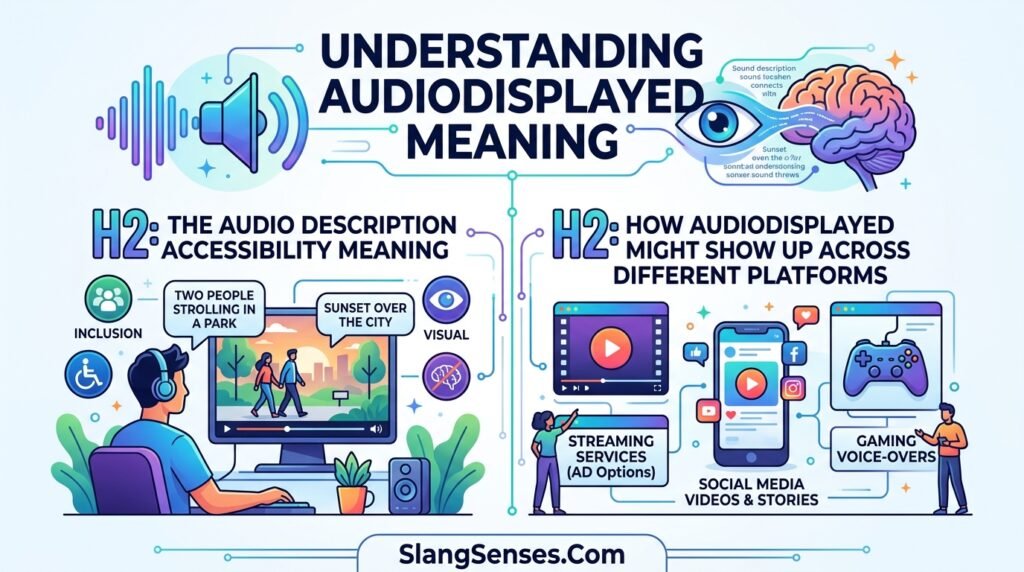
Audio description deserves its own explanation because the words can be confusing in media interfaces.
Audio description is designed to make visual content more accessible by adding spoken information about important visual events.
For example, during a movie, an audio-description track might explain an action that isn’t obvious from dialogue.
It can describe:
- People entering or leaving a scene
- Important visual actions
- Facial expressions
- On-screen text
- Changes in location
- Visual events that affect the story
But again, don’t make the mistake of treating audiodisplayed and audio description as identical terms.
They aren’t necessarily the same.
| Term | General idea |
|---|---|
| Audiodisplayed | A label or phrase associated with audio being represented or displayed |
| Audio description | Spoken narration explaining important visual information |
| Voice message | A recording sent by a person |
| Audio player | An interface used to access or play audio |
If you found audiodisplayed inside a TV, streaming service, accessibility menu, or media application, look at the surrounding labels.
The interface will usually provide better evidence about what the term means than the word alone.
The Generic System Label Meaning
Technical systems love short labels.
They’re useful for software, but not always friendly to humans.
A developer might need to record an event such as:
Audio element displayed
Instead of storing a long sentence, the system could use a compact identifier.
That might look like:
audioDisplayed
Or, after formatting is removed:
audiodisplayed
This doesn’t necessarily mean the term is part of normal English.
That’s why searching dictionaries may not help much.
Current competitors consistently note that audiodisplayed isn’t an established everyday English slang term and appears more like a technical label, combined expression, or system-generated phrase.
Why does the capitalization matter?
Compare:
audioDisplayed
with:
audiodisplayed
The first version gives you a visual clue that there are two words.
The second version hides that clue.
This can happen when a technical identifier is copied into a document, transcript, log, notification, or website without preserving its original formatting.
So, sometimes the strange spelling is actually part of the mystery.
How To Figure Out Which Meaning Applies To You
Don’t guess from the word alone.
Look at where you found it.
Start with these questions.
Where did you see audiodisplayed?
Was it:
- A WhatsApp export?
- A text file?
- A transcript?
- A messaging application?
- A website?
- A video player?
- An accessibility menu?
- A notification?
- A developer tool?
- A database or log?
- A social-media interface?
The location is your biggest clue.
What appears around it?
Look at the surrounding text.
If you see:
<<audiodisplayed>>
inside a conversation, a placeholder interpretation becomes more plausible.
If you see:
audioDisplayed
inside code, a technical identifier becomes more plausible.
If you see it next to accessibility options, investigate whether the interface is referring to descriptive audio.
Context beats guesswork.
What happened before and after it?
Suppose a chat contains:
“Listen to this.”
Then:
<<audiodisplayed>>
Then:
“What did you think?”
That strongly suggests the marker represents an audio message in that conversation.
But it still doesn’t tell you whether someone played the recording.
That’s a separate question.
What To Do Once You Know Which Meaning Applies
Once you understand the context, the next step is simple.
If it’s a chat-export placeholder
Treat it as a representation of the audio message.
If you need the actual recording, look for the original media file or return to the original application.
If it’s an accessibility label
Check the accessibility or audio settings around it.
Look for terms such as:
- Audio description
- Descriptive audio
- Narration
- Accessibility audio
- Audio track
- Spoken description
The exact names vary by platform.
If it’s a technical label
Don’t assume its meaning from the English words alone.
Look at:
- The application
- Documentation
- Event name
- Code surrounding it
- Metadata
- Developer notes
- Status definitions
A technical system may assign a very specific meaning to an event.
How Audiodisplayed Compares To Similar Terms
This is where many people get confused.
The words can sound similar, but they don’t necessarily describe the same event.
| Term | General meaning | Does it prove someone heard the audio? |
|---|---|---|
| Audio sent | Audio was submitted by the sender | No |
| Audio delivered | Audio reached the intended system/device | No |
| Audio displayed | Audio-related content became visible or represented | No |
| Audio opened | Relevant content was opened | Not necessarily |
| Audio played | Playback started | More directly related to playback |
| Audio completed | Playback reached an endpoint, if tracked | Not necessarily proof of attention |
Not every application tracks all these states.
That’s crucial.
One app might track delivery and playback. Another might only show a simple media status. A third might use completely different terminology.
So don’t transfer the definition from one application to another without checking the system’s own documentation.
How Audiodisplayed Might Show Up Across Different Platforms
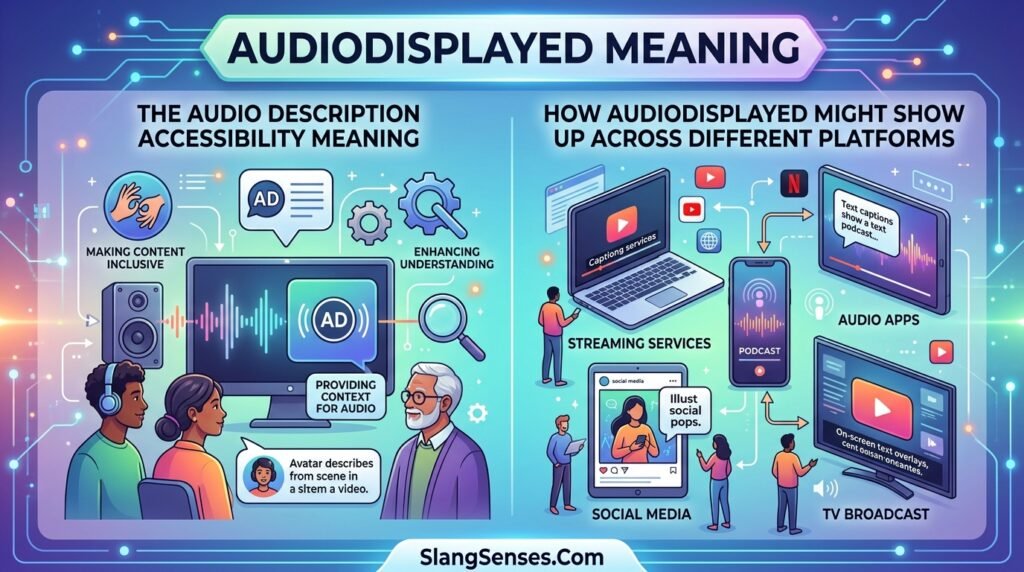
The meaning can change with the environment.
Messaging apps
In messaging environments, you may encounter the term alongside voice messages, audio files, or exported conversations.
Here, it may function as a placeholder or system-style label.
Chat exports
This is one of the clearest use cases.
An exported conversation may preserve an audio message’s position using a text marker.
The actual audio might be stored separately—or not included in the export.
Transcripts
A transcript converts multimedia content into a text-based representation.
A label may be used to indicate that an audio element occurred at a particular point.
The exact notation depends on the transcription system.
Websites
A website might display an audio player, track title, waveform, duration, or other audio-related information.
Here, “displayed” can refer to the interface rather than the actual sound being played.
Technical interfaces
Developers may use event names or identifiers related to displaying audio content.
This is where forms such as audioDisplayed can appear.
Social media
Don’t assume audiodisplayed is a special TikTok, Instagram, Facebook, or Snapchat slang term simply because you encountered it while dealing with social media.
The source of the label matters more than the social platform.
Current search results similarly describe the term as context-dependent rather than as established mainstream social-media slang.
What This Term Comes Down To
Let’s simplify everything.
Audiodisplayed usually points to audio being represented, shown, presented, or identified by a digital system.
But that doesn’t automatically tell you what happened to the audio itself.
It might be:
- A chat placeholder
- A transcript marker
- A technical event
- A system label
- An audio-related interface term
- A context-specific accessibility label
And there’s one distinction you should remember:
Displayed does not automatically mean played.
That’s the part people most often misunderstand.
If a voice message appears on someone’s screen, the interface may have displayed the message without the person actually starting playback.
A visible play button isn’t the same thing as a completed listening event.
Audio Displayed Versus Audio Played
This deserves a closer look because the difference is small in wording but significant in meaning.
Audio displayed
This generally suggests that an audio-related element was:
- Shown
- Presented
- Rendered
- Made visible
- Represented by a placeholder
- Identified by a system
Audio played
This more directly suggests that playback began.
Imagine a 60-second voice recording.
The recipient opens the conversation and sees the voice message.
At this point, the audio can be displayed.
But they may never press play.
If they press play for five seconds, playback has started.
If the system tracks completion and the recording reaches the end, it may record a completed playback event.
Those are different stages.
| Situation | Displayed? | Played? |
|---|---|---|
| Voice message appears in chat | Possibly yes | Not necessarily |
| User sees the audio player | Yes | Not necessarily |
| User presses Play | Yes | Yes |
| User listens for part of recording | Yes | Yes |
| Recording reaches the end | Yes | Yes, if playback wasn’t interrupted |
The exact tracking behavior still depends on the application.
Audio Status Terms Compared
Here’s a simple way to remember the common terms:
| Status | What it generally tells you |
|---|---|
| Sent | The sender submitted the audio |
| Delivered | The message reached its destination |
| Displayed | The audio-related element was presented or represented |
| Opened | The relevant content was opened |
| Played | Playback was initiated |
| Completed | Playback reached its tracked endpoint |
But don’t treat this as a universal technical standard.
There isn’t one worldwide status system that every messaging application follows.
A platform may use “played” differently from another. Some may not track “displayed” at all. Others may combine events.
That’s why the specific platform or software documentation remains the final authority when you need a precise technical interpretation.
Why Systems Track Audio Display Events At All
You might wonder why software would bother tracking something as simple as displaying an audio element.
There are several practical reasons.
User-interface behavior
A system may need to know whether a particular media element has appeared in the interface.
Analytics
Websites and applications often track interaction with different elements.
An audio display event can help describe how users encounter media.
Accessibility
Systems may need to distinguish between audio content, descriptive audio, captions, transcripts, and other accessibility elements.
Debugging
Developers use events to understand what happened inside an application.
If an audio player isn’t appearing correctly, event information can help identify where the process failed.
Media loading
A system may need to distinguish between an audio element being presented and the audio actually starting playback.
That distinction can be useful when diagnosing performance or interface problems.
Data exports
A text-based export needs some way to represent multimedia that cannot be placed directly into ordinary text.
A placeholder solves that problem.
So, while audiodisplayed may look like a strange word, the underlying idea isn’t particularly mysterious.
It is about how software represents or tracks audio-related content.
Frequently Asked Questions About Audiodisplayed Meaning
Why am I getting audio descriptions?
What does it mean when it says audio described?
What does audio description mean on iPhone?
What does audio description mean on your TV?
Conclusion About Audiodisplayed Meaning
Understanding Audiodisplayed Meaning becomes much easier when you look at the context. In simple terms, it usually refers to audio content being shown, represented, or identified by a digital system. You may see it in chat exports, messaging apps, accessibility features, or technical interfaces.
Remember, displayed doesn’t necessarily mean played or heard. If you’re unsure what the term means on a specific app or device, check the surrounding message, settings, or status information. Once you understand where the term appears, its meaning is usually much clearer. Overall, Audiodisplayed Meaning is less about slang and more about how digital platforms represent and track audio content.

Rathna Kannan is a language enthusiast and writer at Slang Senses, sharing simple explanations of modern slang, internet expressions, and trending phrases. Rathna enjoys exploring how language evolves through social media and everyday conversations.