
Solti Meaning In Text can be confusing because this word isn’t a standard English texting abbreviation with just one fixed definition. In many Nepali and South Asian contexts, “Solti” can be used as a casual, friendly term for a male friend, buddy, or someone you feel familiar with. Depending on the relationship and tone, it can sound warm, playful, teasing, or simply friendly.
But there’s more to it than a simple translation. The meaning can shift based on who says it, where they’re from, and how it appears in the conversation. In this guide, we’ll break down what Solti means in texting, where the word comes from, how Gen Z uses it, and what it can reveal about friendship. We’ll also look at real examples so you can understand the word without guessing.
Solti Meaning In Text Origin And Cultural Footprints
The word solti is strongly associated with Nepali language and culture. Unlike abbreviations such as “LOL” or “BRB,” it didn’t simply appear as internet shorthand. Its use is connected to informal speech and relationship-based forms of address.
That cultural background matters because translating solti into one English word can be misleading.
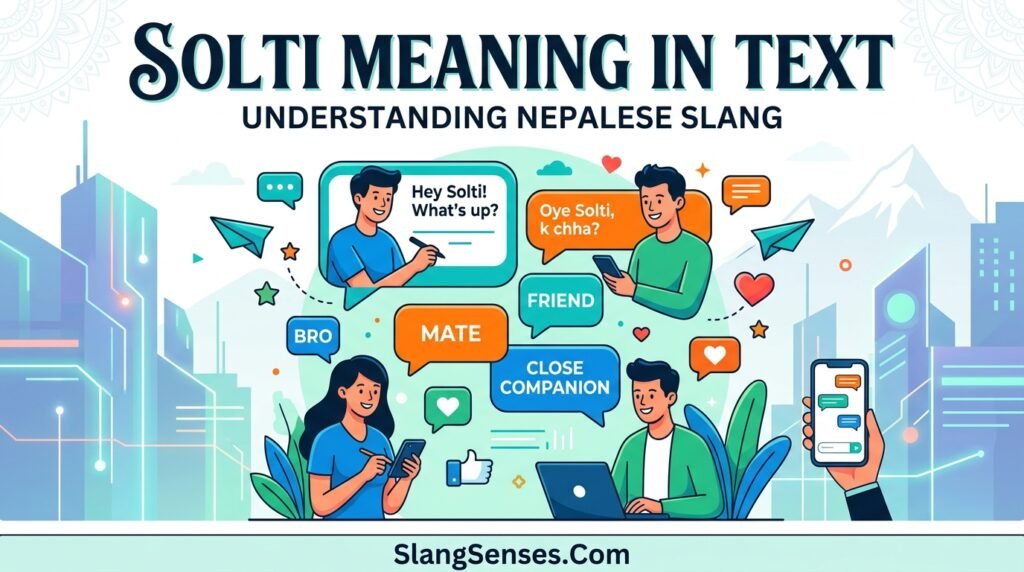
In a casual conversation, it may feel like:
- Bro
- Buddy
- Friend
- Mate
- Dude
- My guy
These aren’t perfect translations. They simply capture the friendly feeling.
There is another side to the word, too. Several current sources describe kinship-related uses of solti in Nepali communities, although descriptions differ about the exact family relationship and regional usage.
So, think of solti as a word with layers.
The meaning isn’t always sitting inside the spelling. It lives in the relationship.
Other Meanings Of Solti
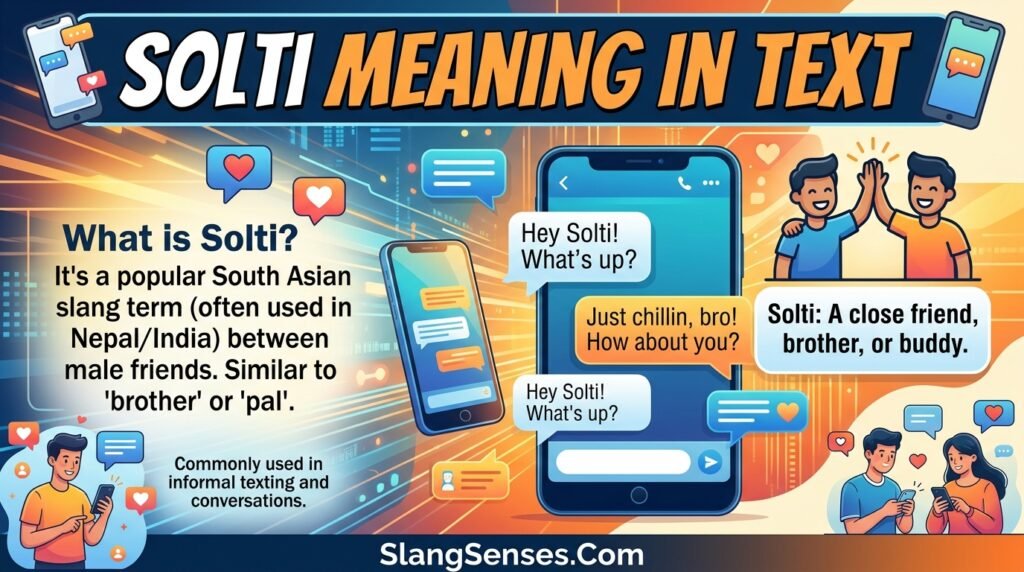
The most common modern conversational meaning is a friendly or familiar way of addressing a male person. It can be used much like “bro” or “buddy,” especially among people who already know each other.
But there are several possible interpretations.
| Context | Possible meaning | Tone |
|---|---|---|
| Close friends | Bro or buddy | Friendly |
| Casual chat | Friend or mate | Relaxed |
| Nepali family context | Kinship-related term | Familiar/respectful |
| Social media comment | Friendly address | Casual |
| Joke between friends | Playful nickname | Humorous |
| Unknown cultural context | Name or cultural reference | Unclear |
There are also unrelated uses of Solti as a name or surname. For example, the spelling can refer to Sir Georg Solti, the famous conductor. If you see “Solti” in a discussion about orchestras, opera, classical music, or music history, it obviously isn’t being used as friendship slang.
That’s why context beats a dictionary definition here.
Why Does Solti Have So Many Different Definitions?
Because language isn’t mathematics.
One word can carry a literal meaning in one setting and an emotional meaning in another. A family may use it one way. Friends may use it another way. Someone on social media might use it simply because it sounds familiar.
This is especially common with culturally specific words.
For example:
“Thanks, solti!”
Between close friends, that may sound like:
“Thanks, bro!”
But a message involving a Nepali family relationship may have a more specific meaning.
Then there’s tone.
“Hey, solti 😂” feels playful.
“Solti, we need to talk.” feels much more serious.
The word hasn’t changed. The situation has.
Current explanations of solti repeatedly point to context, relationship, tone, and cultural background as the clues that determine the intended meaning.
Does Solti Mean The Same Thing Outside The US?
Not necessarily.
- In the United States, someone who doesn’t know Nepali vocabulary may simply see solti as an unusual word, username, nickname, or piece of foreign slang.
- Among Nepali speakers or people familiar with Nepali culture, however, the word can carry much more meaning.
- It may suggest friendship, familiarity, or a specific relationship depending on the context.
- This is one reason you shouldn’t force an American English translation onto every use of solti.
- For an English speaker, “bro” might be the closest feeling.
- For a Nepali speaker, the cultural background can add another layer.
The same thing happens with words such as “mate,” “brother,” or “cousin.” Their literal translations don’t always explain how people actually use them.
Who Uses It Most?
Solti is especially associated with Nepali speakers and Nepali cultural communities. It can appear in everyday conversation, text messages, social media comments, memes, and informal chats.
You may encounter it among:
- Nepali-speaking friends
- Young people chatting online
- Classmates
- Close male friends
- People from Nepali communities abroad
- Social media users familiar with Nepali culture
It can also appear in English-language conversations when people naturally mix languages.
That doesn’t necessarily mean the speaker is trying to sound trendy.
Sometimes it’s just how they normally talk.
And that’s an important distinction. Solti isn’t best understood as a universal English texting abbreviation. It is better understood as a culturally connected informal expression that has found a place in digital communication.
Real Conversation Examples Using Solti
The easiest way to understand solti is through actual-looking situations.
Example 1: Greeting a Friend
“Hey solti, where are you?”
Here, solti is probably similar to “bro,” “buddy,” or “mate.”
Example 2: Saying Thanks
“Thanks, solti. You really helped me.”
The word adds familiarity to the sentence.
It makes the message feel more personal.
Example 3: Making Plans
“Solti, are you coming tonight?”
This is simply a casual way of addressing someone.
Example 4: Light Teasing
“You forgot your keys again, solti 😂”
Now the word carries a playful tone.
Example 5: Family Context
“I spoke to my solti yesterday.”
Here, you need more context. A family-related Nepali usage may be intended rather than the casual “buddy” meaning.
That’s the big lesson:
Don’t translate the word before understanding the relationship.
Usage Of Solti In Different Contexts
The solti meaning in text can change slightly depending on where and how it appears.
In Text Messages
In texting, solti is usually informal and familiar.
“What’s up, solti?”
Think “What’s up, bro?”
In WhatsApp
WhatsApp conversations often mix English with Nepali expressions. Solti can appear naturally in greetings, jokes, plans, and group chats.
In Face-to-Face Conversation
This is where cultural context becomes especially important. A person familiar with Nepali speech may understand the relationship behind the word immediately.
At Work
Be careful.
Solti is informal. It may be perfectly normal between friends who happen to work together, but it isn’t automatically appropriate for formal professional communication.
In Family Conversations
This is where the kinship-related meaning may become important. Don’t assume the speaker means “buddy” simply because you saw the word in a message.
How Gen Z Uses Solti Today
Gen Z communication moves quickly between languages.
One message might contain English, Nepali, emojis, abbreviations, and slang—all in the same sentence.
That’s why words like solti can travel easily from everyday speech into:
- TikTok comments
- Instagram captions
- WhatsApp chats
- Group messages
- Memes
- Short videos
- Online communities
But calling it a purely Gen Z slang word would oversimplify things.
Solti has cultural and conversational roots that existed outside the internet. Younger users may simply be carrying that word into newer communication spaces. Current competitor pages similarly describe its use across social media without treating it as a conventional English acronym.
So the internet didn’t necessarily create solti.
It helped more people encounter it.
Does Solti Just Mean Weird Or Quirky?
No. Solti does not generally mean “weird” or “quirky” in its common Nepali friendship usage.
This is an important distinction because slang dictionaries can sometimes collect user-generated or loosely defined meanings.
If someone says:
“Hey solti!”
that doesn’t automatically mean:
“Hey, weird guy!”
The more established casual interpretation is closer to friend, bro, buddy, mate, or familiar male companion.
A person could certainly use the word while teasing a friend.
But the teasing comes from the context and tone, not because solti itself universally means “weird.”
When A Friend Becomes Family
- This is probably the most interesting part of the Solti Meaning In Text question.
- Some words describe people by their relationship rather than by their name.
- That can make a friendship feel almost like family.
- When close friends use family-style language casually, the word can communicate:
- “You’re one of us.”
- That’s why translating solti simply as “friend” may miss some of its emotional weight in certain contexts.
- The relationship matters.
- A stranger calling you solti may feel strange.
- A longtime friend saying it may feel completely natural.
- A family member using it may have a specific kinship meaning.
- Same word. Different relationship.
And that’s exactly why the phrase “What does solti say about your friendship?” is more interesting than simply asking for a dictionary definition.
It can suggest familiarity and social closeness—but you still need the surrounding context to know what the speaker intends.
Meaning Across Social Media
You may see solti on several platforms.
Solti on TikTok
On TikTok, it may appear in comments, memes, cultural videos, or conversations between Nepali-speaking users.
Solti on Instagram
It can appear in captions, comments, DMs, or posts about friends.
Solti on WhatsApp
WhatsApp is especially suited to informal expressions because conversations are usually personal or group-based.
Solti on Facebook
Facebook comments and community groups can also contain culturally specific vocabulary.
Solti in Group Chats
- A group chat gives the word even more room to change tone.
- “Solti 😂” may be affectionate.
- “Solti, what are you doing?” may be neutral.
- “Listen, solti.” might signal seriousness.
- The platform doesn’t determine the meaning.
- The people do.
Common Confusions
Several things can make solti confusing.
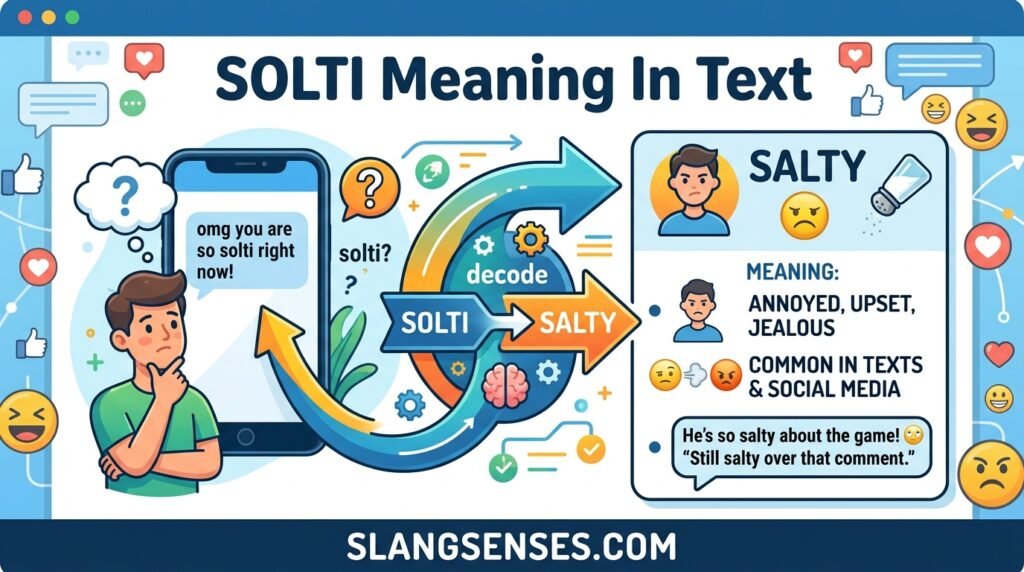
Solti Meaning In Text vs. Salty
“Salty” is an English slang term often associated with being annoyed, bitter, or upset.
Solti is different.
Don’t automatically treat a spelling that looks similar as the same word.
Solti Meaning In Text vs. A Name
Solti can also appear as a personal name or surname.
If someone says, “I listened to Solti’s recording,” they could be referring to the conductor Sir Georg Solti, not talking about a friend.
Solti Meaning In Text vs. English Slang
Solti isn’t best treated as a standard English texting abbreviation.
It doesn’t have a universally accepted “full form.”
Solti Meaning In Text vs. One Fixed Definition
This is probably the biggest mistake.
There isn’t always one English word that replaces it perfectly.
Context matters.
Solti Meaning In Text Related Slang Terms
If you’re trying to understand the feeling behind solti, these English terms are useful comparisons:
| Term | General feeling |
|---|---|
| Bro | Friendly and familiar |
| Buddy | Friendly and casual |
| Mate | Informal friendship |
| Dude | Casual address |
| Homie | Close friendship |
| My guy | Friendly and relaxed |
| Friend | Neutral and direct |
| Solti | Culturally specific, informal, context-dependent |
These aren’t perfect synonyms. They simply help an English speaker understand the conversational tone.
For example, “bro” may be the closest match in one conversation, while “buddy” might fit another.
How To Reply When Someone Says Solti
If someone calls you solti, your response depends on the situation.
If they’re clearly being friendly, keep it casual.
You could reply:
“Hey bro! What’s up?”
Or:
“Haha, what’s going on?”
Or simply:
“Hey! How are you?”
If the person is using the term in a Nepali family context, respond according to that relationship rather than treating it like internet slang.
And if you’re unsure?
Don’t panic.
Just continue the conversation naturally or ask what they mean.
That’s better than confidently using a cultural term incorrectly.
When Did Solti Go Mainstream?
It’s difficult to identify one exact moment when solti “went mainstream.”
The current sources describe it as a culturally established Nepali expression that is now also visible in digital communication, rather than a word with a clearly documented internet launch date.
Social media has certainly increased its visibility.
Words that once stayed within a particular language community can now appear in public comments, videos, memes, and international conversations.
That creates a funny effect.
Someone in another country can see a Nepali expression online, search it, and suddenly wonder:
“Wait, what does this mean?”
That’s probably one reason searches for Solti Meaning In Text have become more common.
The word didn’t necessarily become new.
It became easier to encounter.
FAQs About Solti Meaning In Text
What does “solti” mean in English?
What does it mean to be solti?
What does soaltee mean?
What is the meaning of solta?
Conclusion About Solti Meaning In Text
Understanding the Solti Meaning In Text really comes down to context, culture, and the relationship between the people using it. In many Nepali and South Asian conversations, “Solti” can be a casual and friendly way to address a male friend, buddy, or someone who feels like part of your close circle.
It doesn’t automatically mean something romantic, weird, or negative. A friend might use it playfully in a text, WhatsApp chat, social media comment, or group conversation simply to show familiarity. The tone matters just as much as the word itself.
So, if someone calls you “Solti,” don’t overthink it. Look at the conversation, your relationship with that person, and the way they normally speak. That small bit of context can reveal whether they’re being friendly, joking, teasing, or simply showing closeness.

Rathna Kannan is a language enthusiast and writer at Slang Senses, sharing simple explanations of modern slang, internet expressions, and trending phrases. Rathna enjoys exploring how language evolves through social media and everyday conversations.