
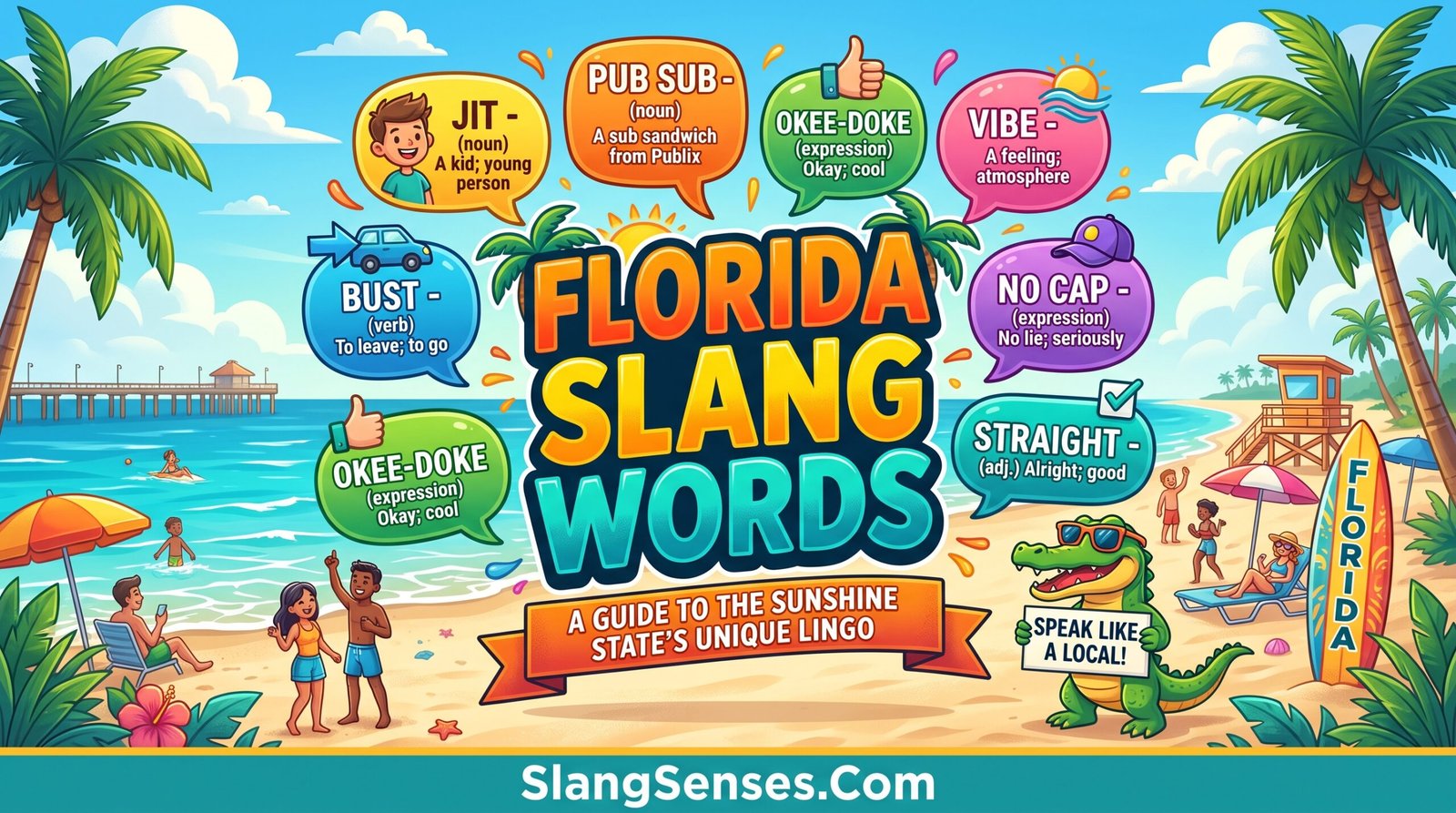
Florida slang words are a fun mix of local expressions, Southern sayings, beach culture, internet language, and phrases shaped by the state’s diverse communities. If you’re visiting Florida or simply trying to understand how locals talk, you may come across words and phrases that sound confusing at first but make perfect sense once you know the meaning. From casual nicknames and laid-back expressions to funny Florida-specific terms, the local vocabulary adds its own personality to everyday conversations.
In this guide, we’ll explore the most popular Florida slang words and phrases, what they mean, where you might hear them, and how locals use them in real conversations. Whether you’re a Florida native, a visitor, or just curious about the unique language of the Sunshine State, these expressions will help you understand Florida slang like a local.
Florida Slang at a Glance
| Florida Slang Word | Meaning |
|---|---|
| Jit | A young person or kid |
| Snowbird | Someone who spends winters in Florida, then leaves |
| No-See-Ums | Tiny biting insects you can’t actually see |
| Gator | Alligator, shortened |
| Pub Sub | A sandwich from the Publix grocery store deli |
| The 305 | Miami’s area code, used as a badge of pride |
| SoFlo | South Florida |
| Dale | Spanish for “go for it” or “let’s do it” — huge in Miami |
| The Mouse | Disney World |
| O-Town | Orlando |
| Parked in Goofy | Parked really far away (Disney World reference) |
| Fixin’ to | About to do something (North Florida/Southern) |
| The Panhandle | Florida’s northwestern strip near Alabama |
| Conch | Someone from the Florida Keys |
| Cone of Concern | The hurricane forecast track shown on local news |
What Is Florida Slang?
Florida slang words are the informal terms, phrases, and expressions that locals use to describe everyday life in the Sunshine State — everything from the weather to the wildlife to the specific cultural mashup that makes Florida sound nothing like any other Southern state. And that’s really the key thing to understand right away: Florida is technically Southern, geographically. But linguistically? It’s its own animal.
Here’s why. Florida has been shaped by an unusual mix of influences — deep Southern roots up north, a massive wave of Cuban and Caribbean immigration down south, decades of Northern retirees moving in for the winter, and a tourism industry so large it’s basically created its own vocabulary around theme parks and traffic. Mix all of that together for a few generations, and you get a slang dialect that’s genuinely unlike anywhere else in the country.
You’ll hear Southern phrases in Pensacola that would sound completely normal in Georgia. Drive four hours south to Miami, and half the conversation is happening in Spanglish. Head to Orlando, and suddenly people are giving you directions using ride names. It’s a lot, honestly. But it’s also part of what makes the state so much fun to actually spend time in — once you’re in on the language, you stop feeling like a tourist.
Classic Florida Slang Everyone Should Know
Before we get into the regional stuff, there are five terms you genuinely cannot visit — or live in — Florida without hearing. Consider this the survival kit.
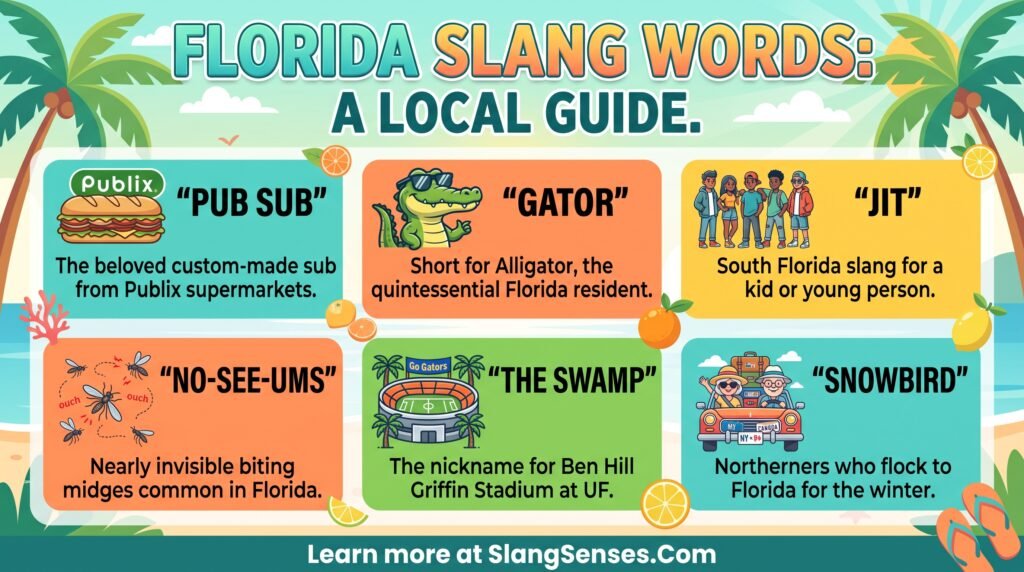
Jit — This one catches almost everyone off guard the first time. In Florida, especially South Florida, “jit” means a young kid or teenager. “That jit was running circles around the parking lot” is a completely normal sentence. It comes out of African American Vernacular English and has deep roots specifically in Miami’s local culture. Depending on tone, it can sound playful, teasing, or a little dismissive — context matters.
Snowbird — Someone, usually a retiree from the Northeast or Midwest, who flocks down to Florida every winter to escape the cold and heads back north once it warms up. They’re not bad people, honestly. But they will slow down traffic on US-1, crowd every early-bird dinner special in a 20-mile radius, and vanish like clockwork every April. Locals say “snowbird season is here” the exact same way people elsewhere might brace for hurricane season — resigned, a little tired, but not really mad about it.
No-See-Ums — Tiny biting insects, technically called biting midges, that you genuinely cannot see but will absolutely feel, especially near water at dusk. Every single Floridian has a no-see-ums story. “Bring bug spray, the no-see-ums are out tonight” is advice you should always take seriously.
Gator — Just short for alligator. Not really slang for anything else, but it shows up constantly, from “gator country” (areas where they’re common) to “gator bait” (an affectionate nickname for University of Florida fans, sometimes used more broadly too).
Pub Sub — A sandwich from Publix, the beloved Florida grocery chain. This isn’t just food — it’s practically sacred. Don’t argue with a Floridian about the correct Pub Sub order. You will lose.
Know these five, and you’re already ahead of most visitors.
Miami & South Florida Slang
Miami runs on its own linguistic frequency, and honestly, it’s one of the more beautiful examples of a bilingual culture blending naturally into everyday speech.
Dale — If you’ve ever heard a Pitbull song, you already know this one. Pronounced “dah-lay,” it’s Spanish for “go ahead,” “let’s do it,” or general enthusiasm. It’s become so woven into Miami culture that plenty of non-Spanish speakers use it constantly without thinking twice. “Want to grab Cuban food?” “Dale.”
Mira — Technically means “look” in Spanish, but functionally it’s used more like “hey” or “listen.” “Mira, let me tell you something” is peak Miami energy, and you genuinely don’t have to be Latino to use it — the whole city has absorbed it into everyday English conversation.
Bobo — In standard Spanish, this means “fool” or “silly.” In South Florida slang, though, it’s closer to light-hearted teasing between friends. Calling someone a bobo isn’t really an insult — it’s practically affectionate.
Acere — A Cuban Spanish term for a close friend, similar to “bro.” You’ll hear this a lot in Miami’s Cuban community specifically. “Acere, long time no see.”
The 305 — Miami’s area code, used the way New Yorkers might say “718” — as a shorthand symbol of hometown pride. You’ll see it on shirts, hear it in songs, see it tattooed on people who take Miami pride very, very seriously.
SoFlo — Just short for South Florida, generally referring to the Miami, Fort Lauderdale, and Palm Beach corridor. “SoFlo traffic gets bad on Fridays” is a sentence you’ll hear roughly every Friday.
And one more thing worth mentioning — the cafecito break. Not technically slang, but it’s a genuine cultural institution. Taking a quick break for a tiny, strong cup of Cuban coffee is just part of daily life in Miami. Offices do it. Friends do it. If someone invites you for a cafecito, go. There’s no polite way to say no.
Central Florida & Theme Park Belt Slang
Spend time around Orlando and the vocabulary shifts entirely — mostly because everything, and I mean everything, gets filtered through theme park culture.
The Mouse — Everyone knows exactly what this means. Disney World. “Are you going to the mouse this weekend?” is said completely without irony by people who live there.
O-Town — Orlando’s local nickname. “Want to drive to O-Town this weekend?”
Parked in Goofy — A phrase specific to Disney World’s massive parking structure, where lots are named after characters. If you parked in Goofy, you’re in for a long walk. “We’re still ten minutes away, we had to park in Goofy” is a genuinely common complaint.
Passholder — Someone with an annual Disney or Universal pass, often shortened to “AP.” These folks have a whole subculture of their own — hopping parks on a random Tuesday night like it’s nothing, tracking ride refurbishments, the works.
The 408 — Locals refer to Orlando’s East-West Expressway by its number, not its name. Tourists get endlessly confused because Florida expressways tend to have both, and locals will usually default to whichever one is least helpful to a newcomer.
North Florida & Panhandle Slang
People genuinely forget how far Florida stretches north — the Panhandle actually touches Alabama and Georgia, and once you’re past Gainesville, the whole vibe shifts. Slower. More rural. Straight-up Southern in the truest sense of the word.
Fixin’ to — Classic Southern American English, and you’ll hear it constantly in Tallahassee, Pensacola, and Panama City. “I’m fixin’ to head to the Publix” is a completely normal sentence up there — no irony, no performance, just how people talk.
The Panhandle — Locals are fiercely proud of this identity. It’s the strip of Florida extending west toward Alabama, home to gorgeous beaches like Destin, 30A, and Seaside — crystal white sand, emerald water. Panhandle locals want you to know, clearly and often, that they are not the same as Miami or Orlando.
Bless your heart — A pan-Southern phrase, sure, but North Floridians wield it with real precision. It can mean genuine sympathy. It can also be the politest possible way to call someone an idiot. You’ll need context clues to know which one you’re getting.
Florida Keys & Conch Culture
Head all the way down to the Keys, and you’ll hit a regional identity that’s honestly distinct enough to deserve its own paragraph, even though most guides barely mention it.
Conch — This is what people from the Florida Keys, particularly Key West, call themselves. It comes from the conch shellfish that’s long been part of the local diet and identity. A “Conch” traditionally refers to someone born and raised in the Keys, with the term carrying real generational pride — not unlike “Florida Cracker” in the sense that it marks deep roots, not just current residency.
The Keys culture blends Caribbean influence, old fishing-village independence, and a laid-back “island time” attitude that genuinely feels different from the rest of the state. Locals down there aren’t in a rush, and they’ll tell you so, cheerfully, while you wait for your food at any restaurant on Duval Street.
Weather & Seasonal Slang
Florida weather isn’t just weather — it’s basically a full personality trait, and the state has developed a whole vocabulary around it.
Liquid sunshine — A quick, heavy rain shower that’s gone in twenty minutes flat. Florida gets these almost daily in summer. Tourists panic and run for cover. Locals don’t even move their beach chairs.
Lovebug season — Twice a year, these mating insects show up in massive numbers and splatter across every windshield in the state. Not romantic. Not cute. Just annoying, and everyone knows it.
Brick — When it’s “brick” outside, it means surprisingly cold weather — which, to be fair, for Florida might just mean the 50s. Don’t laugh. It’s relative.
Hurricane party — Controversial, since emergency managers genuinely hate this one, but it’s real. Some Floridians throw parties when a storm’s coming, assuming it’s a lower-category hurricane and they’re not in an evacuation zone. Locals who’ve weathered a few storms tend to know exactly when to take it seriously and when a little community bonding helps ease the nerves.
Cone of concern — Technically a meteorological term, but every single Floridian knows it by heart during hurricane season. The National Hurricane Center (based in Miami) releases storm-track forecasts inside a cone shape. Once local news starts showing “the cone,” people check their hurricane kits. You’ll hear someone casually say “we’re in the cone” with a level of calm that would genuinely alarm anyone visiting from out of state.
There’s also an older, more poetic bit of Southern weather slang worth knowing — when it rains while the sun’s still out, some old-timers call it “the devil beating his wife.” Not something you’ll hear from younger Floridians much anymore, but it’s stuck around in pockets of the state.
Florida Nicknames & Pop-Culture Terms
Florida has collected an entire wardrobe of nicknames over the years, some affectionate, some pretty brutally honest.
Florida Man — At this point, it’s basically a meme with its own Wikipedia-level cultural footprint. It refers to the genre of bizarre, often unhinged news headlines that seem to specifically involve men in Florida doing something nobody would believe otherwise. Search “Florida Man headlines” if you’ve never seen this phenomenon — it’s a rabbit hole.
The Sunshine State — Florida’s official, family-friendly nickname. Shows up on license plates, tourism ads, all of it.
God’s Waiting Room — A darker piece of humor referencing how many retirees move to Florida to spend their final years. Not exactly kind, but it’s stuck around.
Floridiot — A derogatory term for someone unintelligent who happens to be from Florida. Not a term you’ll want aimed at you.
Floridabulous — Locals mostly use this with disdain — it describes something trashy, unoriginal, or a little embarrassing, usually in reference to yet another wild local news story.
You May Like To Read: Torta Meaning Slang TikTok, Texting, and Social Media Meaning
Regional Slang Comparison Table
Because Florida’s slang genuinely shifts depending on where you are, here’s a side-by-side to keep it all straight.
| Feature | Miami / SoFlo | Central Florida | Panhandle / North FL | Florida Keys |
|---|---|---|---|---|
| Core influence | Cuban & Caribbean Spanish | Tourism & theme parks | Deep South / Georgia-Alabama border | Caribbean & old fishing culture |
| Signature term | Dale, the 305 | The Mouse, O-Town | Fixin’ to, the Panhandle | Conch |
| Tone | Fast, bilingual, proud | Casual, insider-shorthand | Slow, warm, Southern | Laid-back, island time |
| Best-known identity marker | SoFlo pride | Passholder culture | Panhandle pride | Conch identity |
| Feels most like | A Caribbean city | A theme-park suburb | Rural Georgia/Alabama | A Caribbean island |
If you only remember one thing from this table, remember this: using Miami slang in the Panhandle (or vice versa) will get you a confused look, not a warm welcome. Match your words to your region.
Common Mistakes Tourists Make With Florida Slang
A few honest heads-ups, because Florida slang doesn’t come with a manual, and getting it wrong is instantly noticeable.
Calling the highway “I-4 the highway.” Locals just say “the 4” or “Eye-Four.” Adding “highway” out loud marks you as an outsider immediately.
Calling someone a snowbird to their face. Even if they technically are one, it’s not exactly a compliment. Use it to describe the phenomenon in general, not as a direct label.
Assuming Miami slang works statewide. Say “dale” in the Panhandle and you’ll probably get a blank stare. Florida is enormous, and the regional cultures genuinely don’t overlap the way you’d expect.
Complaining about the heat to a local. They know. They’ve always known. They’ve made peace with it. Saying “it’s SO hot here” just gets you a tired look and the unspoken thought, “then why’d you come in July?”
Frequently Asked Questions
How do Floridians say “hi”?
What are the top 10 slang words?
What are some street slangs?
What are some gangster slang words?
Conclusion
So there it is — Florida slang words, region by region, from the Cuban coffee culture of Miami to the “fixin’ to” drawl of the Panhandle to whatever exactly a Conch is proud of being. It’s honestly one of the more fascinating linguistic mashups in the country, if you ask me, precisely because Florida refuses to be just one thing.
That’s really the whole point, isn’t it? A snowbird in Naples, a jit running around a Miami parking lot, someone “fixin’ to” head to Publix up in Pensacola — they’re all technically Floridians, and they’re all speaking a version of the same state’s language that sounds almost nothing alike depending on where you catch them.
Learning even a handful of these terms won’t just help you survive a conversation without that confused, sky-glancing moment I had back in that Fort Lauderdale parking lot. It’ll actually change how you experience the place. You stop being the tourist standing outside the joke, and you start being the person who’s in on it.
Next time someone tells you the no-see-ums are bad tonight, or that they’re “fixin’ to” grab a Pub Sub, or that traffic’s rough because it’s officially “season” — you’ll know exactly what they mean. And honestly? That’s a pretty good feeling.

Rathna Kannan is a language enthusiast and writer at Slang Senses, sharing simple explanations of modern slang, internet expressions, and trending phrases. Rathna enjoys exploring how language evolves through social media and everyday conversations.
5 thoughts on “Florida Slang Words: Fun Local Terms You’ll Love (2026)”